To save content items to your account,
please confirm that you agree to abide by our usage policies.
If this is the first time you use this feature, you will be asked to authorise Cambridge Core to connect with your account.
Find out more about saving content to .
To save content items to your Kindle, first ensure no-reply@cambridge.org
is added to your Approved Personal Document E-mail List under your Personal Document Settings
on the Manage Your Content and Devices page of your Amazon account. Then enter the ‘name’ part
of your Kindle email address below.
Find out more about saving to your Kindle.
Note you can select to save to either the @free.kindle.com or @kindle.com variations.
‘@free.kindle.com’ emails are free but can only be saved to your device when it is connected to wi-fi.
‘@kindle.com’ emails can be delivered even when you are not connected to wi-fi, but note that service fees apply.
The chapter sums up the book by addressing four issues. It first looks at the aims of WSS and the agenda it could pursue. Second, it explores how WSS should best relate to the existing as well as possibly emerging bridge-building exercises between the natural and social sciences. Third, it examines the case for the discipline of International Relations (IR) as a promising place from which to start generating WSS. Fourth, it reflects on the scale of change in the anthroposphere that is at stake in the Anthropocene crisis with which WSS would need to engage. While it might get started in IR, WSS will quickly venture beyond it. What is at stake is change not just within the parts, or singular systems, of modern global society, but in its cultural and political-economic foundations and evolutionary trajectories as a whole.
The social sciences and history need to mount a matching response to the Anthropocene crisis to that constructed by the natural sciences in the form of Earth Systems Science. Humankind is facing major changes to its conditions of existence. While the natural sciences have done an exemplary job of assessing the limits of planetary carrying capacity, they are not well equipped to understand the social side of this equation. The chapter sets up the idea of a World System Science to complement and extend what ESS has done (and continues to do). It looks at the methodological and conceptual compatibilities and differences between ESS and WSS, and at how concepts such as system, can both unite and divide them. It begins to set out how WSS might be developed, and what it might aim to do.
This introductory chapter outlines the aims and rationale of the textbook, introduces the discipline of International Relations, and engages with the contested question of how the Middle East is defined. It situates the study within the field of International Relations of the Middle East and explains how the textbook is organised, including the format of the chapters, before concluding with a note addressed to teachers and students.
How might changes in the credibility of one alliance relate to the credibility of other alliance commitments? Debate between competing views on this question spans decades in part because systematic tests are difficult. We contribute systematic evidence with a new measure of credibility in U.S. alliances and novel technique to estimate interdependence. Our measure draws on expert ratings of allied beliefs over U.S. credibility and our analysis employs Gaussian process regression to analyze credibility. We find strong correlations in allied credibility perceptions within regions and little correlation across regions. Supplementary analyses suggest that these correlations reflect common unobservables and a small impact of shared perception of past U.S. behavior.
This article uses the Kenya Office in Cairo (KOC) to explore the intersections and tensions between territorial nationalism and supranational networks of anticolonial patronage during a brief window in the broader era of decolonization. It argues that the principal staffers of the KOC were in many ways marginal figures in Kenyan nationalist politics, but were able to build a degree of political capital and stature due to their proximity to external patrons in a period when more established nationalist figures were restricted to the physical space of colonial Kenya. The article then analyzes a factional schism within the KOC to highlight how nationalist outposts and exilic activists became imbricated in competition between political rivals and visions operating at multiple geographic and ideological scales. That the figures involved in the KOC and its post-schism rival would be sidelined by the official infrastructures of Kenyan nationalism and anticolonial internationalism and the “Big Men” who came to control them shows, first, that mobility is not always the most productive framework for apprehending these histories and, second, that proximity to internal and external patrons and the clout that accompanies this proximity were contingent and could both make and break political capital.
This article challenges the image of Cold War Pakistan as a passive client state, arguing instead that Pakistan’s early international history was shaped by friction between a pro-Western elite and a domestic polity animated by anti-imperial solidarity, socialism, and Muslim internationalism. Examining the 1955 Bandung Conference, the 1955 Baghdad Pact, and the 1956 Suez Crisis, the article shows how domestic contestation shaped Pakistan’s foreign policy, introducing the concept of agency-in-effect to argue that polities lacking formal diplomatic power can influence states and, through that influence, help shape world events. These social forces, preconditioned by Bandung and the Baghdad Pact, erupted during the Suez Crisis, provoking a domestic legitimacy crisis and contributing to broader anti-imperial struggles that rendered European colonialism untenable. Together, these events reconceptualize world order from below, revealing the contested role of Pakistan’s domestic polity in the transition from British-French colonialism to American hegemony in West Asia during decolonization.
Natural scientists have joined forces to develop Earth System Science (ESS), a bold response to the mounting contradiction between the planet's limits and humanity's accelerating demands. However, interdisciplinary insights from social scientists are urgently needed to understand the various ways in which social and natural systems relate to each other, and to analyse the driving social forces within the anthroposphere. This timely volume is a rallying call for a 'World System Science' (WSS) in which social scientists and historians would step into this gap. International Relations experts draw from the fields of history, economics, and sociology to develop methodologies for a social science-led response to the political challenges of the Anthropocene. They identify areas of common ground where Earth System Science and World System Science might work together to generate and promote planetary stewardship, improving humanity's chances of surviving the Anthropocene crisis and looming tipping points in the earth system.
Previous attempts at explaining how geographically distant and disparate Bronze Age polities, like the chiefdoms of northern Europe and the urban states of the Mediterranean, were connected have focused on exchange networks. By combining insights from political science with archaeology, this article sets out to do two things. First, to reintroduce system thinking to model interconnectivities in the Bronze Age world, using an old trope in international relations studies as a lens and analytical tool. Second, to argue that diplomacy and war must be treated on a par with trade as institutions of such a system, of major importance for understanding international relations during the Bronze Age. The authors discuss the so-called Amarna system’s scope in time and space, exploring whether and how Bronze Age polities in the far north of Europe, as outsiders, can be plausibly construed as constitutive ‘others’.
Drawing on the knowledge of leading scholars in the field, International Relations of the Middle East is a unique textbook that explores the promise and limitations of International Relations theories through detailed examination of various case studies from the Middle East. The textbook explores the full spectrum of theoretical perspectives, ranging from mainstream (classical realism, structural realism, liberalism, Marxism, the English School) to critical (historical sociology, constructivism, poststructuralism, postcolonialism, feminism, and green theories) approaches. Each chapter follows a consistent format and engages with case studies from Egypt, Syria, Iran, Turkey, Saudi Arabia, Yemen, Morocco, and Algeria, addressing themes such as revolution, war, the Israel–Palestine conflict, foreign policy, gender, natural disasters, identity, and the environment. The textbook concludes with a chapter that evaluates International Relations theory as it applies to the Middle East and beyond.
This article offers a state-of-the-art review of a new and growing research program in International Relations (IR) that analyzes the far right’s inter- and transnational politics. Responding to the rise of far-right leaders, parties, and movements worldwide, this nascent literature sheds light on the inter- and transnational drivers, patterns, connections, and effects of far-right politics. To further consolidate and develop this emerging research program, as this article argues, it is imperative to integrate this literature into a wider framework that delineates different analytical approaches and research agendas. For this purpose, the article identifies and examines five research strands: (1) foreign and security policy, (2) international thought, (3) the global causes of the rise of the far right, (4) trans- and international collaboration, and (5) international norms, institutions, and orders. It appraises their different analytical perspectives and insights, connects each research strand with various IR paradigms, subdisciplines, and literatures, and identifies unexplored lines of inquiry. Thereby, the article aims to broaden and diversify the theoretical, empirical, and methodological scope of this research program and to further facilitate synergies between IR and far-right studies. It then discusses a series of limitations and challenges facing this research program and proposes a level-of-analysis approach to advance it.
Following the breakup of the Soviet Union, Russia has aspired to remain a major power in international relations. Until the mid-2000s, the country’s leaders sought to revive its great power status in partnership with Western nations. Since the mid-2000s, Russia has moved in the direction of challenging Western global priorities by stressing values of national sovereignty and patriotism. More recently, Russia has sought to establish areas of mutual noninterference in relations with the West. In 2022, this approach resulted in Russia’s invasion of Ukraine and the escalation of tensions and confrontation with the United States and NATO. Outside the West, Moscow has aspired to take advantage of global economic and geopolitical opportunities. The chapter reviews the main developments in Russian foreign policy since 1991, giving an overview of the country’s relations with Western and non-Western countries.
What might entitle agents or agencies that are not sponsored by the state, only by some other social group or organization, to represent their people in an international forum. A state-centred approach would deny that they ever have a title to such a role, while an individual-centred approach would hold that they have as good a title as the state. Both approaches have problems and the paper presents a third, more satisfying alternative. On this approach, such bodies may claim to represent their people insofar as the state enjoys standby control over their proposals, being able to oppose them, should it wish to do so, with a radical veto or a moderate refusal to be bound. Ideally, however, the state with such standby control will be required to allow the proposals to be publicized domestically and to provide reasons for opposing them, if that is what it chooses to do. Under the arrangement proposed, state-independent representatives will be able to explore innovative ideas collaboratively with their counterparts from elsewhere, to identify imaginative solutions to common problems, and to have the opportunity to persuade their own states, under domestic pressure, to fall in line.
International Relations (IR) has come under increasing and sustained criticism for marginalizing Africa’s intellectual traditions, rich history, Indigenous knowledge systems, and lived experiences. Several scholars of IR have argued that meaningful engagement with African contexts and thought would lead to better theory and pedagogy, more robust concepts, sharper analysis, and the study of issues that have greater relevance to contemporary global life. Despite the seriousness and widespread nature of the criticism, it is rare to find manuscripts in major IR journals that move beyond critique to demonstrate concretely how centring Africa in IR scholarship could transform the discipline or substantially enhance its analytical tools. This symposium takes up that difficult task by showing how a focus on African systems of thought can enrich IR’s conceptual vocabulary, reorient core assumptions, and expand the range of questions the discipline is equipped to address.
Resolving the Israeli-Palestinian Conflict is aimed at politicians, diplomats, policymakers, scholars, journalists, and informed readers seeking to understand why peace efforts have repeatedly failed-and how true reconciliation remains possible. Based on over one hundred interviews with Middle-Eastern, European, and American leaders, alongside extensive archival research, the book offers rare insight into the dynamics of diplomacy. It reveals how trust, fairness, and political courage are vital for peace. By analysing pivotal moments-from Oslo to Camp David and the Abbas-Olmert talks, it identifies recurring mistakes and proposes strategies to foster mutual recognition and lasting coexistence. Both authoritative and accessible, the book blends history, law, ethics, and international relations into a practical roadmap for future peace efforts. Its interdisciplinary approach and use of primary sources make it both authoritative and engaging. Readers will come away with a deeper understanding of the conflict and the tools needed to help resolve it.
One of the most prominent theories in modern international relations is the democratic peace theory, which posits that democracies tend not to engage in armed conflicts with fellow democracies. Recently, Rathbun, Parker, and Pomeroy examined this effect at a microstructural level, performing surveys, computational studies, and meta-analysis. Of particular originality in their work was embedding analysis, which I review and offer a systematic critique of. Then, I propose a new and improved methodology that addresses its issues while leveraging foundational embedding models. My replication results agree with their findings that the democratic peace effect is racialized, that is, it is associated with racial and ethnocentric motivations. The findings offer a timely guide in conducting embedding analysis in political science research.
This chapter explores the evolution and practice of diplomacy in the ancient Near East from the third to the first millennium BC. Drawing on a wide range of textual sources – including letters, treaties and royal inscriptions – it examines how early states and empires developed complex systems of international relations. Key diplomatic mechanisms included the exchange of messengers, gifts and royal women, as well as the swearing of oaths and the negotiation of treaties. The chapter highlights the metaphor of ‘brotherhood’ among kings, the role of divine sanction in alliances and the importance of protocol and etiquette in diplomatic encounters. It also discusses the transition from interpersonal diplomacy among city states to more formalised state-level diplomacy, particularly during the El Amarna period. The chapter concludes by emphasizing the continuity and ritualisation of diplomatic practices over centuries, forming what may be considered the earliest known international system.
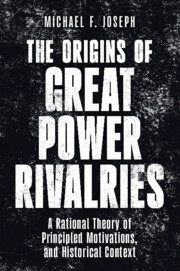
Michael F. Joseph's The Origins of Great Power Rivalries advances a comprehensive rationalist theory of how great powers assess emerging threats; why enduring great power rivalries unfold through either delayed competition, or delayed peace; and how diplomacy functions when rising powers emerge on the scene. In an important departure from traditional realist theory, Joseph argues that countries are motivated by distinct principles - normative values that shape foreign policy beyond simple security concerns. Exploring instances of great power competition, he explains why rational states draw qualitative inferences about rivals' intentions by examining the historical context of their demands, not just military capabilities. Offering an analysis of great power rivalries since 1850, Joseph illuminates British reactions to Stalin at the beginning of the Cold War, among other rivalries. He animates a theoretically sophisticated defense of America's approach to China in the post-Cold War era with 100s of Washington-insider interviews.
This chapter introduces and immerses readers in the ‘Brussels Bubble’, a term encapsulating both the geographic heart of the European Union’s political machinery and its distinctive social and professional ecosystem. Through the daily routine of Jack, a mid-level Irish diplomat, the chapter reveals the rhythms, rituals, and jargon that define life in the European Quarter – where EU institutions, diplomats, lobbyists, and journalists converge. The Bubble is a microcosm of multilingual, multinational exchange, shaped by its own language (‘Bubblespeak’), unwritten rules, and digital habits, from Politico’s influential newsletters to the relentless scroll of Twitter.
The chapter situates the Bubble within the EU’s evolution from a post-war coal and steel community to a unique polity, blending functionalist pragmatism with normative ideals. It introduces the book’s dual focus: first, to chronicle the everyday practices and lived experiences that make the Bubble a world unto itself; second, to explore how digital technologies – smartphones, social media, and virtual meetings – reshape diplomacy, governance, and social hierarchies within this space. By treating Brussels as an ethnographic ‘village’, the authors argue for a grounded, practice-based understanding of international politics, where the digital and the material are increasingly entangled, and where the EU’s future is negotiated not only in meeting rooms but also on screens and in real-time feeds.
This article examines how artificial intelligence (AI) became framed as a critical node of U.S.–China strategic competition between 2015 and 2023, arguing that “hybrid epistemic experts” – figures who straddle technical expertise, corporate leadership and policy influence – played a decisive role in shaping elite understanding of AI. Through a critical review of policy documents, news media, public statements and institutional developments, this article examines how the “U.S.–China AI Race” narrative did not emerge along the usual pathways of state-driven, top-down bureaucratic processes or traditional lobbying but was actively constructed and amplified by figures like former Google executive Eric Schmidt. Schmidt’s role as a hybrid actor allowed him to translate AI from a narrow technological domain into an existential competition requiring massive policy investment. This overarching capability was driven by AI’s speculative, technically complex and general-purpose nature, which has concentrated knowledge production in private hands, enabling hybrid actors to achieve disproportionate influence over AI policy discourse. This phenomenon raises concerns about democratic governance, the collapse of independent expertise and the self-reinforcing dynamics between private power and public policymaking in emerging technologies.
Every serious analyst of Britain’s role in global politics understood that the country’s decision to leave the European Union would have a significant – perhaps fundamental – effect on its standing in the wider world and the way it would henceforth pursue its foreign, defence and security policies. It was the biggest strategic reorientation in Britain’s external relations for over half a century; a shift for which the country was completely unprepared and in which the policy establishment was explicitly prevented from doing any contingency planning. With the shock of the Brexit decision in 2016, the prospects for British foreign affairs seemed to range from the excitingly uncertain to the simply dire. In the event, Britain’s standing in the world has both risen and sunk in the decade since, driven by challenges, events and responses only peripherally connected to Brexit issues as they arose at the time. ‘Brexit Britain’ certainly figures in the way the country is perceived internationally, but those perceptions are overlaid by more imperative judgements about how the country now positions itself in response to more fundamental challenges than were ever envisaged in Brexit debates at the time.