Most cited
This page lists all time most cited articles for this title. Please use the publication date filters on the left if you would like to restrict this list to recently published content, for example to articles published in the last three years. The number of times each article was cited is displayed to the right of its title and can be clicked to access a list of all titles this article has been cited by.
Contents
- Cited by 23
An experimental investigation of planar countercurrent turbulent shear layers
-
- Published online by Cambridge University Press:
- 10 May 2005, pp. 241-264
-
- Article
-
- You have access
- Export citation
- Cited by 23
Dynamics and surface stability of a cylindrical cavitation bubble in a rectilinear vortex
-
- Published online by Cambridge University Press:
- 01 March 2019, pp. 963-992
-
- Article
-
- You have access
- HTML
- Export citation
- Cited by 23
Leakage from gravity currents in a porous medium. Part 2. A line sink
-
- Published online by Cambridge University Press:
- 06 January 2011, pp. 414-427
-
- Article
-
- You have access
- Export citation
- Cited by 23
Some investigations on the use of ultrasonics in travelling bubble cavitation control
-
- Published online by Cambridge University Press:
- 16 April 2004, pp. 365-389
-
- Article
-
- You have access
- Export citation
- Cited by 23
On the instabilities of a potential vortex with a free surface
-
- Published online by Cambridge University Press:
- 05 July 2017, pp. 230-264
-
- Article
-
- You have access
- HTML
- Export citation
- Cited by 23
Two-dimensional turbulent convection in a toroidal duct of a liquid metal blanket of a fusion reactor
-
- Published online by Cambridge University Press:
- 14 August 2015, pp. 36-52
-
- Article
-
- You have access
- HTML
- Export citation
- Cited by 23
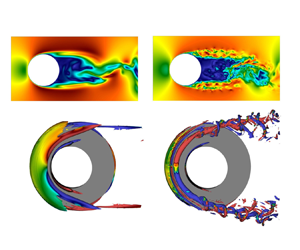
The flow around a stepped cylinder with turbulent wake and stable shear layer
-
- Published online by Cambridge University Press:
- 11 December 2023, A3
-
- Article
-
- You have access
- Open access
- HTML
- Export citation
-
The turbulent external flow around a three-dimensional stepped cylinder is studied by means of direct numerical simulations with the adaptive mesh refinement technique. We give a broad perspective of the flow regimes from laminar to turbulent wake at
 $Re_D=5000$, which is the highest ever considered for this flow case. In particular, we focus on the intermediate Reynolds number
 $Re_D=1000$ that reveals a turbulent wake coupled with a stable cylinder shear layer (subcritical regime). This flow shows a junction dynamics similar to the laminar
 $Re_D=150$, where no hairpin vortex appears around the edges, and just two horseshoe vortices are visible. A new stable vortex in the form of a ring, which coils around the rear area, is also identified. In the turbulent wake, the presence of three wake cells is pointed out: the large and small cylinder cells together with the modulation region. However, the modulation dynamics varies between the subcritical and turbulent regimes. A time-averaged, three-dimensional set of statistics is computed, and spatially coherent structures are extracted via proper orthogonal decomposition (POD). The POD identifies the (long-debated) connection between the N-cell and the downwash behind the junction. Furthermore, as the Reynolds number increases, the downwash phenomenon becomes less prominent. Eventually, a reduced-order reconstruction with the most energetically relevant modes is defined to explain the wake vortex interactions. This also serves as a valuable starting point for simulating the stepped cylinder wake behaviour within complex frameworks, e.g. fluid–structure interaction.


- Cited by 23
Instabilities of buoyancy-driven coastal currents and their nonlinear evolution in the two-layer rotating shallow-water model. Part 1. Passive lower layer
-
- Published online by Cambridge University Press:
- 30 June 2010, pp. 69-93
-
- Article
-
- You have access
- Export citation
- Cited by 23
Non-ideal oblique shock waves
-
- Published online by Cambridge University Press:
- 21 May 2018, pp. 266-285
-
- Article
-
- You have access
- Open access
- HTML
- Export citation
- Cited by 23
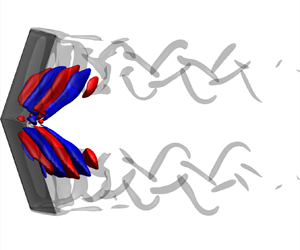
Triglobal resolvent analysis of swept-wing wakes
-
- Published online by Cambridge University Press:
- 09 January 2023, A42
-
- Article
-
- You have access
- HTML
- Export citation
-
Through triglobal resolvent analysis, we reveal the effects of wing tip and sweep angle on laminar separated wakes over swept wings. For the present study, we consider wings with semi-aspect ratios from
 $1$ to
 $4$, sweep angles from
 $0^\circ$ to
 $45^\circ$ and angles of attack of
 $20^\circ$ and
 $30^\circ$ at a chord-based Reynolds number of
 $400$ and a Mach number of
 $0.1$. Using direct numerical simulations, we observe that unswept wings develop vortex shedding near the wing root with a quasi-steady tip vortex. For swept wings, vortex shedding is seen near the wing tip for low sweep angles, while the wakes are steady for wings with high sweep angles. To gain further insights into the mechanisms of flow unsteadiness, triglobal resolvent analysis is used to identify the optimal spatial input–output mode pairs and the associated gains over a range of frequencies. The three-dimensional forcing and response modes reveal that harmonic fluctuations are directed towards the root for unswept wings and towards the wing tip for swept wings. The overlapping region of the forcing–response mode pairs uncovers triglobal resolvent wavemakers associated with self-sustained unsteady wakes of swept wings. Furthermore, we show that for low-aspect-ratio wings optimal perturbations develop globally over the entire wingspan. The present study uncovers physical insights on the effects of tip and sweep on the growth of optimal harmonic perturbations and the wake dynamics of separated flows over swept wings.


- Cited by 23
Filling box flows in porous media
-
- Published online by Cambridge University Press:
- 09 October 2015, pp. 455-478
-
- Article
-
- You have access
- HTML
- Export citation
-
We report upon a theoretical and experimental investigation of a porous medium ‘filling box’ flow by specifically examining the details of the laminar descending plume and its outflow in a control volume having an impermeable bottom boundary and sidewalls. The plume outflow initially comprises a pair of oppositely directed gravity currents. The gravity currents propagate horizontally until they reach the lateral sidewalls at
 $y=\pm L$ . The flow then becomes of filling box type, with a vertically ascending ‘first front’ separating discharged plume fluid below from ambient fluid above. The flow details are described analytically by first deriving a new similarity solution for Darcy plumes with
 $\mathit{Pe}>O(1)$ , where
 $\mathit{Pe}$ is the Péclet number. From the similarity solution so obtained, we then derive expressions for the plume volume flux and mean reduced gravity as functions of the vertical distance from the source. Regarding the plume outflow, a similarity solution adopted from Huppert & Woods (J. Fluid Mech., vol. 292, 1995, pp. 55–69) describes the height and front speed of the gravity currents, whereas a semi-implicit finite difference scheme is used to predict the first front elevation versus time and horizontal distance. As with high-Reynolds-number filling box flows, that studied here is an example of a coupled problem: the gravity current source conditions are prescribed by the plume volume flux and mean reduced gravity. Conversely, discharged plume fluid may be re-entrained into the plume, be it soon or long after reaching the bottom impermeable boundary. To corroborate our model predictions, analogue laboratory experiments are performed with fresh water and salt water as the working fluids. Our experiments consider as independent variables the porous medium bead diameter and the plume source volume flux and reduced gravity. Predictions for the gravity current front position and height compare favourably against analogue measured data. Good agreement is likewise noted when considering either the mean elevation or the profile of the first front. Results from this study may be adopted in modelling geological plumes. For example, our equations can be used to predict the time required for discharged plume fluid to return to the point of injection in the case of aquifers closed on the sides and below by impermeable boundaries.


- Cited by 23
The role of surface disturbances in the entrainment of bubbles by a liquid jet
-
- Published online by Cambridge University Press:
- 10 October 1998, pp. 189-212
-
- Article
-
- You have access
- Export citation
- Cited by 23
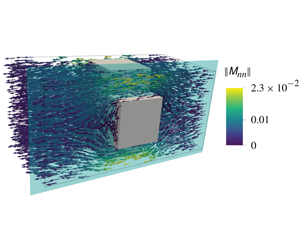
Effective stress jump across membranes
-
- Published online by Cambridge University Press:
- 01 April 2020, A9
-
- Article
-
- You have access
- HTML
- Export citation
- Cited by 23
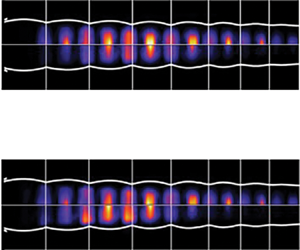
Wavepacket modelling of broadband shock-associated noise in supersonic jets
-
- Published online by Cambridge University Press:
- 05 May 2021, A9
-
- Article
-
- You have access
- HTML
- Export citation
-
We present a two-point model to investigate the underlying source mechanisms for broadband shock-associated noise (BBSAN) in shock-containing supersonic jets. In the model presented, the generation of BBSAN is assumed to arise from the nonlinear interaction between downstream-propagating coherent structures with the quasi-periodic shock cells in the jet plume. The turbulent perturbations are represented as axially extended wavepackets and the shock cells are modelled as a set of stationary waveguide modes. Unlike previous BBSAN models, the physical parameters describing the hydrodynamic components are not scaled using the acoustic field. Instead, the source characteristics of both the turbulent and shock components are extracted from the hydrodynamic region of large-eddy simulation and particle image velocimetry datasets. Apart from using extracted data, a reduced-order description of the wavepacket structure is obtained using parabolised stability equations. The validity of the model is tested by comparing far-field sound pressure level predictions to azimuthally decomposed experimental acoustic data from a cold Mach 1.5 underexpanded jet. At polar angles and frequencies where BBSAN dominates, encouraging comparisons of the radiated noise spectra for the first three azimuthal modes, in both frequency and amplitude (
 ${\pm }2\ \textrm {dB}\,\textrm {St}^{-1}$ at peak frequency), reinforce the suitability of using reduced-order wavepacket sources for predicting BBSAN peaks. On the other hand, wavepacket jitter is found to have a critical role in recovering sound amplitude at interpeak frequencies. The paper presents a quantitative demonstration that the wavepacket–shock interaction, carefully reconstructed by extracting components from data or linearised models, contains the correct essential flow physics that accounts for most features of the far-field BBSAN spectra.

- Cited by 23
Moffatt eddies in the cone
-
- Published online by Cambridge University Press:
- 05 September 2005, pp. 113-135
-
- Article
-
- You have access
- Export citation
- Cited by 23
Mean flow structure in horizontal convection
-
- Published online by Cambridge University Press:
- 05 January 2017, pp. 525-540
-
- Article
-
- You have access
- HTML
- Export citation
-
We analyse the global flow structures in horizontal convection systems, where the heat supply and removal takes place through separated parts of a lower horizontal surface of a fluid layer. The results are based on direct numerical simulations for the length-to-height aspect ratio of the convection cell
 $\unicode[STIX]{x1D6E4}=10$ , Rayleigh number
 $\mathit{Ra}$ from
 $3\times 10^{8}$ to
 $3\times 10^{11}$ and Prandtl number
 $\mathit{Pr}$ from 0.05 to 50. The structure of the mean flows in horizontal convection is described in terms of time-averaged spatial distributions of the temperature, velocity, kinetic energy, thermal and kinetic dissipation rates. A possible scenario of transition to turbulent horizontal convection in the whole convection cell of a large aspect ratio is discussed.


- Cited by 23
Flow structure behind two staggered circular cylinders. Part 2. Heat and momentum transport
-
- Published online by Cambridge University Press:
- 30 June 2008, pp. 81-107
-
- Article
-
- You have access
- Export citation
- Cited by 23
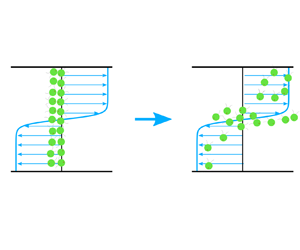
Gyrotactic trapping of micro-swimmers in simple shear flows: a study directly from the fundamental Smoluchowski equation
-
- Published online by Cambridge University Press:
- 31 March 2022, A37
-
- Article
-
- You have access
- HTML
- Export citation
- Cited by 23
Experimental control of natural perturbations in channel flow
-
- Published online by Cambridge University Press:
- 04 July 2014, pp. 296-309
-
- Article
-
- You have access
- Export citation
- Cited by 23
Subcritical and supercritical bifurcations in axisymmetric viscoelastic pipe flows
-
- Published online by Cambridge University Press:
- 21 October 2021, A16
-
- Article
-
- You have access
- HTML
- Export citation
-
Axisymmetric viscoelastic pipe flow of Oldroyd-B fluids has been recently found to be linearly unstable by Garg et al. (Phys. Rev. Lett., vol. 121, 2018, 024502). From a nonlinear point of view, this means that the flow can transition to turbulence supercritically, in contrast to the subcritical Newtonian pipe flows. Experimental evidence of subcritical and supercritical bifurcations of viscoelastic pipe flows have been reported, but these nonlinear phenomena have not been examined theoretically. In this work, we study the weakly nonlinear stability of this flow by performing a multiple-scale expansion of the disturbance around linear critical conditions. The perturbed parameter is the Reynolds number with the others being unperturbed. A third-order Ginzburg–Landau equation is derived with its coefficient indicating the bifurcation type of the flow. After exploring a large parameter space, we found that polymer concentration plays an important role: at high polymer concentrations (or small solvent-to-solution viscosity ratio
 $\beta \lessapprox 0.785$), the nonlinearity stabilizes the flow, indicating that the flow will bifurcate supercritically, while at low polymer concentrations (
 $\beta \gtrapprox 0.785$), the flow bifurcation is subcritical. The results agree qualitatively with experimental observations where critical
 $\beta \approx 0.855$. The pipe flow of upper convected Maxwell fluids can be linearly unstable and its bifurcation type is also supercritical. At a fixed value of
 $\beta$, the Landau coefficient scales with the inverse of the Weissenberg number (
 $Wi$) when
 $Wi$ is sufficiently large. The present analysis provides a theoretical understanding of the recent studies on the supercritical and subcritical routes to the elasto-inertial turbulence in viscoelastic pipe flows.


