






No CrossRef data available.
Article contents
Where the psychological adaptations hit the ecological road
Published online by Cambridge University Press: 11 May 2017
Abstract
We argue that the target authors focus too much on adaptive behavioral responses and not enough on actual psychological adaptations. We suggest the Dark Triad traits may represent facultative, psychological adaptations sensitive to seasonal variance and food shortages. We document that shorter distances from the equator are linked to higher national narcissism levels, whereas longer distances are associated with higher national-level machiavellianism. Dark Triad traits may serve as critical survival mechanisms when prioritizing oneself over and/or at the cost of others.
Information
- Type
- Open Peer Commentary
- Information
- Copyright
- Copyright © Cambridge University Press 2017
References
Crawford, C. B. & Anderson, J. L. (1989) Sociobiology: An environmentalist discipline. American Psychologist
44:1449–59.CrossRefGoogle Scholar
Hare, R. D. (1985) Comparison of procedures for the assessment of psychopathy. Journal of Consulting and Clinical Psychology
53:7–16.CrossRefGoogle ScholarPubMed
Jonason, P. K., Duineveld, J. J. & Middleton, J. P. (2015a) Pathology, pseudopathology, and the Dark Triad of personality. Personality and Individual Differences
78:43–47.Google Scholar
Jonason, P. K. & Ferrell, J. D. (2016) Looking under the hood: The psychogenic motivational foundations of the Dark Triad. Personality and Individual Differences
94:324–33.Google Scholar
Jonason, P. K., Li, N. P., Webster, G. W. & Schmitt, D. P. (2009) The Dark Triad: Facilitating short-term mating in men. European Journal of Personality
23:5–18.Google Scholar
Jonason, P. K. & Tost, J. (2010) I just cannot control myself: The Dark Triad and self-control. Personality and Individual Differences
49:611–15.Google Scholar
Jonason, P. K. & Webster, G. D. (2010) The Dirty Dozen: A concise measure of the Dark Triad. Psychological Assessment
22:420–32.Google Scholar
Jonason, P. K. & Webster, G. D. (2012) A protean approach to social influence: Dark Triad personalities and social influence tactics. Personality and Individual Differences
52:521–26.Google Scholar
Jonason, P. K., Webster, G. W., Schmitt, D. P., Li, N. P. & Crysel, L. (2012) The antihero in popular culture: A Life History Theory of the Dark Triad. Review of General Psychology
16:192–99.Google Scholar
Jonason, P. K., Wee, S. & Li, N. P. (2015b) Competition, autonomy, and prestige: Mechanisms through which the Dark Triad predict job satisfaction. Personality and Individual Differences
72:112–16.Google Scholar
Paulhus, D. L., Hemphill, J. D. & Hare, R. D. (2009) Manual for the self-report psychopathy scale. Multi-Health Systems.Google Scholar
Paulhus, D. L. & Williams, K. M. (2002) The Dark Triad of personality: Narcissism, Machiavellianism and psychopathy. Journal of Research in Personality
36:556–63.Google Scholar
Raskin, R. & Terry, H. (1988) A principal components analysis of the narcissistic personality inventory and further evidence of its construct validity. Journal of Personality and Social Psychology
54:890–902.Google Scholar
Schmitt, D. P. (2015) The evolution of culturally-variable sex differences: Men and women are not always different, but when they are … it appears not to result from patriarchy or sex role socialization. In: The evolution of sexuality, ed.Weekes-Shackelford, V. A. & Shackelford, T. K., pp. 221–56. Springer.Google Scholar
Wai, M. & Tiliopoulos, N. (2012) The affective and cognitive empathic nature of the Dark Triad of personality. Personality and Individual Differences
52:794–99.Google Scholar
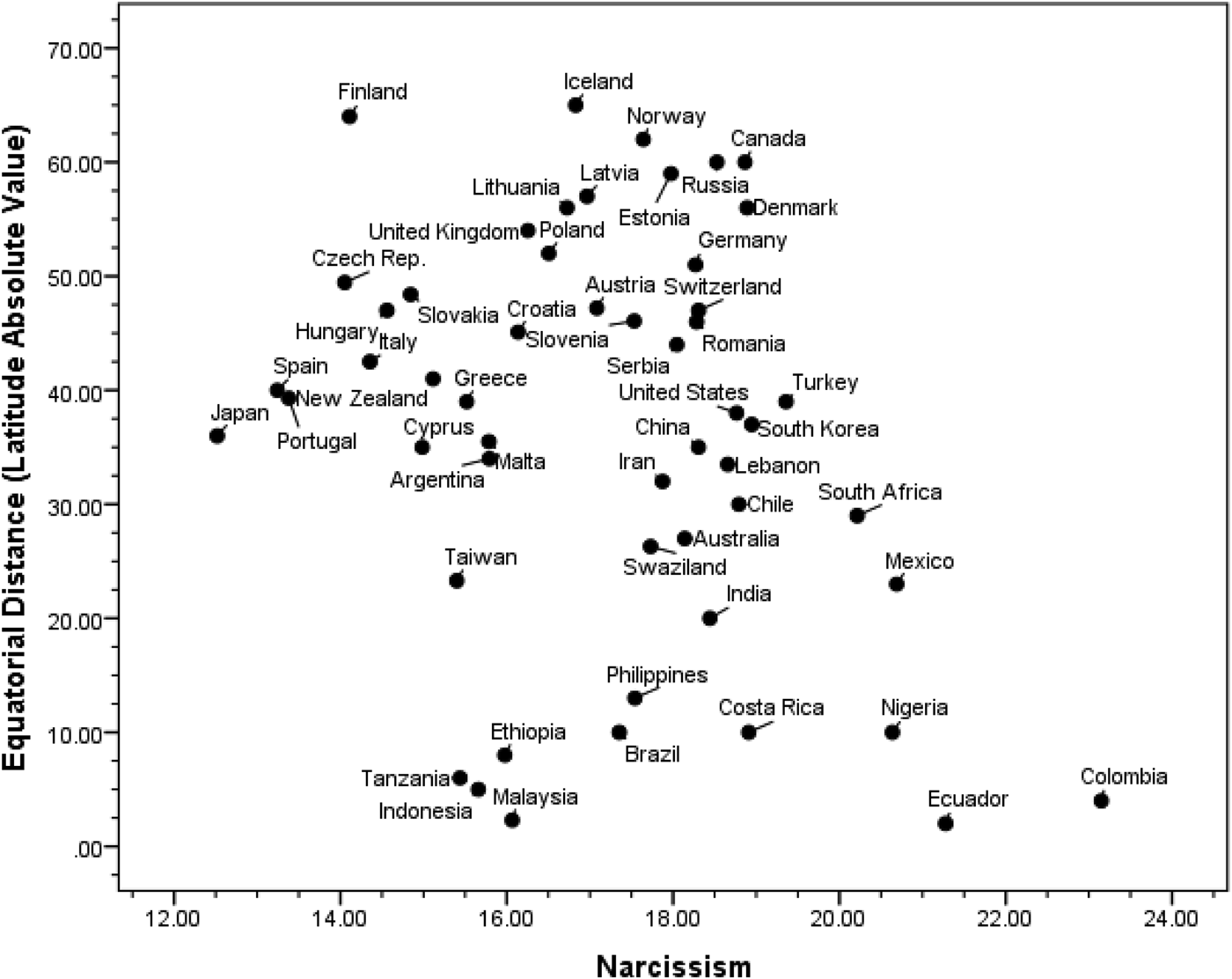
Figure 1. National narcissism levels related to distance from the equator across 53 nations from the International Sexuality Description Project 2 (Schmitt 2015).
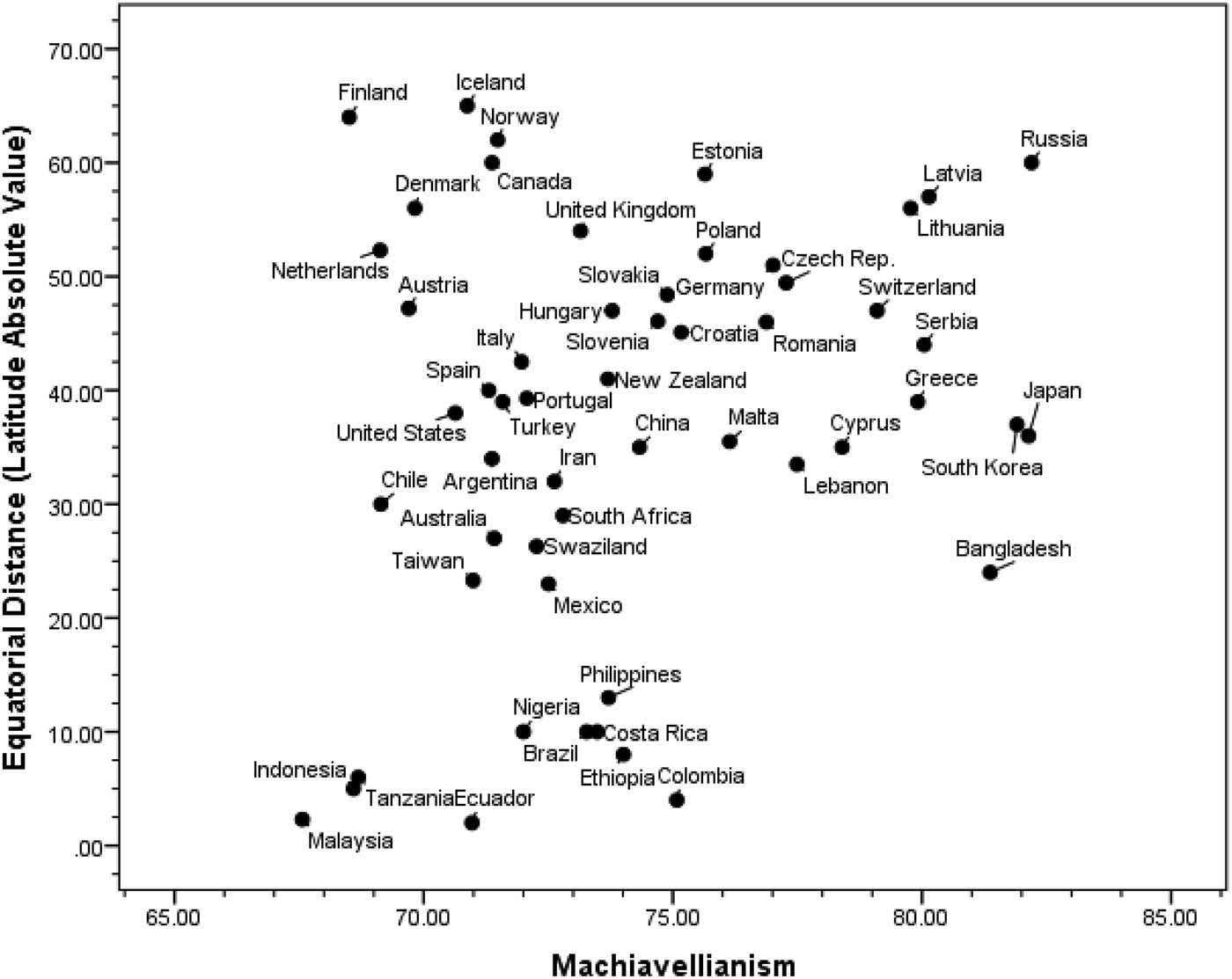
Figure 2. National machiavellianism levels related to distance from the equator across 54 nations from the International Sexuality Description Project 2 (Schmitt 2015).
Van Lange et al. provide a compelling new way of understanding the often cited yet poorly understood relationship between heat and violence at the societal level. Unlike most social psychological models, the authors adopt an evolutionary framework – Life History Theory – that suggests manifestations of violence, aggression, and limited self-control are adaptive responses to the environmental contingencies of sharp seasons and temperature. For instance, in climates like those found in Canada, there is a greater need for cooperation and long-term planning given extreme seasonality. As such, they argue one should expect (and empirically it appears to be the case) that Canadian populations are characterized by slow life history traits such as limited aggression and high levels of future planning.
We argue here, however, that Van Lange et al.'s evidence of mere behavioral manifestations of life history traits fails to adequately test their evolutionary hypothesis because it does not focus on the actual underlying adaptations themselves. Their approach conflates adaptive behavioral responses with actual psychological adaptations. From an evolutionary perspective, behaviors such as violence and cooperation are likely linked to differences in local ecology (Schmitt Reference Schmitt, Weekes-Shackelford and Shackelford2015), but do so by interacting with internal, psychological adaptations that, we would suggest, are the constellations of hormonal, cognitive, neurological, and motivational dispositions that most researchers call personality traits (Jonason & Ferrell Reference Jonason and Ferrell2016). Selection has acted on these traits – not the specific behavioral outputs of the traits – as facultative adaptations, and it is these specially designed dispositions that interact with local ecologies in ways that ultimately produce the patterns of behavior that appear to support the authors' hypotheses.
One set of potential facultative, psychological adaptations that have been successfully studied using a life history framework are the Dark Triad personality traits (Jonason et al. Reference Jonason, Webster, Schmitt, Li and Crysel2012): machiavellianism, narcissism, and psychopathy (Paulhus & Williams Reference Paulhus and Williams2002). The Dark Triad traits are characterized by vanity and self-centeredness (i.e., narcissism), manipulation and cynicism (i.e., machiavellianism), and callous social attitudes and amorality (i.e., psychopathy). These traits predict variance in community, online, and college student samples that reflect both (1) life history behavioral indicators and (2) the psychological adaptations that are precursors to both aggression and cooperation as highlighted by Van Lange et al. For example, these traits are correlated with lower-order aspects of personality that serve to facilitate both cooperation and aggression, such as limited self-control (Jonason & Tost Reference Jonason and Tost2010) and empathy (Wai & Tiliopoulos Reference Wai and Tiliopoulos2012). Psychopathy and narcissism are particularly correlated with various forms of aggression (Jonason & Webster Reference Jonason and Webster2010) and heightened competitiveness (Jonason et al. Reference Jonason, Wee and Li2015b). Conversely, machiavellianism is distinguished by its long-term, tactical, strategic, and pragmatic nature (Jonason & Webster Reference Jonason and Webster2012), which may serve individuals who live in environments where resources are variable and future planning is essential. In addition, the importance placed on physical attractiveness in narcissism might be an adaptive response to higher pathogen loads in warmer climates (i.e., near the equator). Overall, based on this we expect that distance from the equator will be negatively correlated with narcissism and psychopathy (potentially) and positively correlated with machiavellianism.
Thus, we suggest Dark Triad personality traits represent facultative, psychological adaptations that are sensitive to seasonal variance and food shortages. Over evolutionary time, climatological patterns and resource irregularity would be fairly recurrent. Those people who were differentially characterized by these traits across varying environments may have been selected because the traits facilitated context-specific, or in this case climate-specific, survival. It may be useful, and perhaps adds to and improves the authors' assertions, to test ostensible dispositional adaptations – Dark Triad traits – for environmentally contingent links to survival, as opposed to the behaviors that are manifested from recurrent adaptive person × ecology interactions.
To add to and improve on the authors' argument, and the data brought to bear on the CLASH model, we highlight here findings from the International Sexuality Description Project 2 (see Schmitt Reference Schmitt, Weekes-Shackelford and Shackelford2015). ISDP-2 was a collaboration of more than 100 psychologists around the world in which surveys were administered to 36,314 people across more than 50 nations. As part of ISDP-2, participants were administered measures of narcissism (e.g., NPI [Raskin & Terry Reference Raskin and Terry1988]), machiavellianism (e.g., MACH-20 [Christie & Geis Reference Christie and Geis1970]), and psychopathy (e.g., SRPIII [Paulhus et al. Reference Paulhus, Hemphill and Hare2009]). (More details about ISDP-2 methods and samples are available on request.)
At the national level, the shorter the distance from the equator, the higher were the national narcissism levels (r(51) = −0.25, p < .05) (Fig. 1). In contrast, machiavellianism become more evident the greater the distance from the equator (r(52) = 0.24, p < .05) (Fig. 2). Psychopathy was not sensitive to variation in distance from the equator (r = 0.01). The results in the target article, therefore, might be a function of these Dark Triad adaptations for survival under varying levels of climatological threat. That is, the Dark Triad traits – particularly high narcissism and low machiavellianism – may serve as survival mechanisms when the organism is under threat, the time when prioritizing oneself is most important. Prioritizing oneself over and/or at the cost of others is at the core of these traits.
National narcissism levels related to distance from the equator across 53 nations from the International Sexuality Description Project 2 (Schmitt Reference Schmitt, Weekes-Shackelford and Shackelford2015).
National machiavellianism levels related to distance from the equator across 54 nations from the International Sexuality Description Project 2 (Schmitt Reference Schmitt, Weekes-Shackelford and Shackelford2015).
These findings represent a climate-specific, adaptationist view of Dark Triad traits, which is in contrast to most work that has focused on sexual selection arguments of the Dark Triad (Jonason et al. Reference Jonason, Li, Webster and Schmitt2009). Our assertions here might conflict with the pathological view of antisocial traits (Hare Reference Hare1985). Such psychological survival adaptations may be pseudopathologies (Jonason et al. Reference Jonason, Duineveld and Middleton2015a) that confer benefits to the person at the cost of the group (Crawford & Anderson Reference Crawford and Anderson1989).
In conclusion, we agree with the thrust of the CLASH hypothesis, but feel the authors have not presented the best tests of their climate-linked hypotheses. We have presented evidence here that we feel better tests their assertions by examining ostensible psychological preconditions and adaptations for survival. We encourage future work to not conflate manifestations of psychological adaptations with the adaptations themselves because, after all, it is called evolutionary psychology for a reason.