






No CrossRef data available.
Article contents
More than just climate: Income inequality and sex ratio are better predictors of cross-cultural variations in aggression
Published online by Cambridge University Press: 11 May 2017
Abstract
Van Lange et al. argue that variations in climate explain cross-societal variations in violence. We suggest that any approach seeking to understand cross-cultural variation in human behavior via an ecological framework must consider a wider array of ecological variables, and we find that income inequality and sex ratio are better predictors than climate of cross-societal variations in violence.
Information
- Type
- Open Peer Commentary
- Information
- Copyright
- Copyright © Cambridge University Press 2017
Footnotes
1. In additional analysis of the homicide data we used Cook's D to identify data from any nations that might be exerting undue influence. Using the conventional cutoff point of 4/n, we identified potential outliers – Maldives, Honduras, Jamaica, El Salvador, Lesotho – and ran an additional regression model excluding them. Income inequality remained a significant predictor of intentional homicide rates, β = 0.743, p < .001. Adult sex ratio, β = −0.117, ns, and climate, β = 0.076, ns, were not significant predictors in this model. We also used Cook's D to identify outliers in the rape data – Botswana, Sweden, Jamaica, Columbia – and ran an additional regression model excluding them. Income inequality, β = 0.493, p = .026, and adult sex ratio, β = 0.375, p = .032, remained significant predictors of rape rates. Climate remained nonsignificant, β = 0.082, ns.
References
Central Intelligence Agency (2016a) The world factbook. Available at: https://www.cia.gov/library/publications/the-world-factbook/index.html.Google Scholar
Clutton-Brock, T. H. & Parker, G. A. (1995) Sexual coercion in animal societies. Animal Behaviour
49(5):1345–65.Google Scholar
D'Alessio, S. J. & Stolzenberg, L. (2010) The sex ratio and male-on-female intimate partner violence. Journal of Criminal Justice
38(4):555–61.Google Scholar
Daly, M. & Wilson, M. (2001) Risk-taking, intrasexual competition, and homicide. Nebraska Symposium on Motivation
47:1–36.Google Scholar
Emlen, S. T. & Oring, L. W. (1977) Ecology, sexual selection and the evolution of mating systems. Science
197:215–23.Google Scholar
Griskevicius, V., Tybur, J. M., Ackerman, J. M., Delton, A. W., Robertson, T. E. & White, A. E. (2012) The financial consequences of too many men: Sex ratio effects on saving, borrowing, and spending. Journal of Personality and Social Psychology
102(1):69–80.Google Scholar
Grossmann, I. & Varnum, M. E. W. (2015) Social structure, infectious diseases, disasters, secularism, and cultural change in America. Psychological Science
26:311–24.Google Scholar
Kenrick, D. T. & Gomez Jacinto, L. (2013) Economics, sex, and the emergence of society. In: Advances in culture and psychology, vol.
4, ed. Gelfand, M. J., Chiu, C. & Hong, Y., pp. 78–123. Oxford University Press.Google Scholar
Messner, S. F. & Blau, J. R. (1987) Routine leisure activities and rates of crime: A macro-level analysis. Social Forces
65(4):1035–52.Google Scholar
Ouimet, M. (2012) A world of homicides the effect of economic development, income inequality, and excess infant mortality on the homicide rate for 165 countries in 2010. Homicide Studies
16(3):238–58.CrossRefGoogle Scholar
Schacht, R. & Mulder, M. B. (2015) Sex ratio effects on reproductive strategies in humans. Open Science
2(1):140402.Google Scholar
Trent, K. & South, S. J. (2012) Mate availability and women's sexual experiences in China. Journal of Marriage and Family
74(1):201–14.Google Scholar
United Nations Office on Drugs and Crime (UNODC) (2011) Rape [rates ascertained for 2010]. Available at: https://www.unodc.org/documents/data-and-analysis/Crime-statistics/Sexual_violence_sv_against_children_and_rape.xls.Google Scholar
Van de Vliert, E. (2013a) Climato-economic habitats support patterns of human needs, stresses, and freedoms. Behavioral and Brain Sciences
36(05):465–80.Google Scholar
Varnum, M. E. W. & Grossmann, I. (2016a) Socio-ecological changes are linked to changes in the prevalence of contempt over time. Behavioral and Brain Sciences
39.Google Scholar
Varnum, M. E. W. & Grossmann, I. (2016b) Pathogen prevalence is associated with cultural changes in gender equality. Nature Human Behaviour
1:Article 0003.Google Scholar
Wilson, M. & Daly, M. (1997) Life expectancy, economic inequality, homicide, and reproductive timing in Chicago neighbourhoods. BMJ: British Medical Journal
314(7089):1271–74.Google Scholar
World Bank (2015) Income inequality [rates ascertained for 2009, 2010]. Available at: http://data.worldbank.org/indicator/SI.POV.GINI.Google Scholar
World Bank Group (2016b) Intentional homicide [rates ascertained for 2010]. Available at: http://databank.worldbank.org/data/reports.aspx?source=2&series=VC.IHR.PSRC.P5&country=.Google Scholar
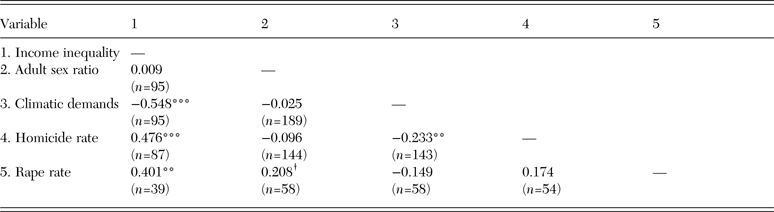
Table 1. Income inequality, adult sex ratio, climatic demands, intentional homicide rates, and rape rates: Correlations
Van Lange et al. present a model wherein ecological variations (climate) predict cross-societal variation in aggression. We agree with Van Lange et al. that an ecological framework can provide ultimate explanations for such variation in aggression, as well as a wide variety of other human behaviors. However, any approach seeking to understand cross-cultural variation in human behavior via an ecological framework would do well to consider a wider array of theoretically relevant ecological variables (e.g., Grossmann & Varnum Reference Grossmann and Varnum2015; Varnum & Grossmann Reference Varnum and Grossmann2016a; Reference Varnum and Grossmann2016b).
To illustrate our point, we draw on established work in behavioral ecology, evolutionary biology, and animal behavior to identify two ecological features that might play a role equal to if not larger than that of climate in explaining cross-cultural variation in the frequency of two types of aggression (e.g., Clutton-Brock & Parker Reference Clutton-Brock and Parker1995; Daly & Wilson Reference Daly and Wilson2001; Emlen & Oring Reference Emlen and Oring1977; Fisher Reference Fisher1930; Griskevicius et al. Reference Griskevicius, Tybur, Ackerman, Delton, Robertson and White2012). Here we focus on income inequality (a marker of the distribution of resources in an ecology) and adult sex ratio (the adult male-to-female ratio in an ecology) as predictors of homicide (typically male-male violence) and rape (typically male-female violence).
Income inequality has been touted as arguably the best predictor of variability in violence across nations, with greater inequality linked to greater (typically male-perpetrated) violence (e.g., Daly & Wilson Reference Daly and Wilson2001; Kenrick & Gomez Jacinto Reference Kenrick, Gomez Jacinto, Gelfand, Chiu and Hong2013; Ouimet Reference Ouimet2012; Wilson & Daly Reference Wilson and Daly1997). Because males experience greater fitness variance, they engage in more risky, frequent, and intense intrasexual competition (e.g., violence) for status and related mating opportunities. Income inequality is thought to exacerbate male mating competition, and thus male violence, by increasing the perceived benefits of high-risk competition, perhaps especially when lower-risk routes to status are unavailable and/or yield unsubstantial gains (e.g., Daly & Wilson Reference Daly and Wilson2001).
Compared with income inequality, the link between biased sex ratios and violence is equivocal; previous research has found variously that male-biased sex ratios are associated with more, less, or no differences in violence (e.g., see Schacht & Mulder Reference Schacht and Mulder2015). There may be a stronger case, however, for linking male-biased sex ratios to higher rates of sexual violence against women. Previous work has argued that more males means more male mating competition, increasing the likelihood that some males resort to rape to obtain mating opportunities and/or to intimate partner violence to prevent the loss of existing relationships (e.g., D'Alessio & Stolzenberg Reference D'Alessio and Stolzenberg2010; Messner & Blau Reference Messner and Blau1987; Thornhill & Palmer Reference Thornhill and Palmer2000; Trent & South Reference Trent and South2012).
We gathered archival data on 2009–2010 income inequality (World Bank 2015), 2010 adult sex ratios (ratio of males to female, aged 15–64 [Central Intelligence Agency 2016a]), and climate (total climatic demands [Van de Vliert Reference Van de Vliert2013a]). Zero-order correlations are presented in Table 1. We tested the relative contribution of these ecological factors to cross-societal variations in rates of intentional homicide (World Bank 2016b) and rape (United Nations Office on Drugs and Crime 2011) in 2010, using multiple regression analyses in which all three predictors were simultaneously entered and only countries with data on all three predictors and the dependent variable were included. Data for rates of intentional homicide and all three predictors were available for 87 countries, and data for rates of rape and all three predictors were available for 39 countries (all data available at https://dataverse.harvard.edu/dataverse/Krems_Varnum_2016_BBS_Commentary).
Income inequality, adult sex ratio, climatic demands, intentional homicide rates, and rape rates: Correlations
† p < .12, *p < .05, **p ≤ .01, ***p ≤ .001.
Multiple regression analysis revealed that the strongest predictor of homicide rates was income inequality, β = 0.402, p = .001. Male-biased sex ratios, β = −.176, p = .070, were marginally associated with homicide rates, but climatic demands were not, β = −0.139, ns.Footnote 1 Income inequality was also the strongest predictor of rape rates, β = 0.571, p = .003. Male-biased sex ratios were also a significant predictor of rape rates, β = 0.363, p = .018, but climatic demands were not, β = 0.219, ns.
Drawing on the cross-disciplinary ecology literatures, we identified two ecological features with established theoretical and empirical links to violence. These features were comparatively better predictors of cross-societal variation in homicide and rape rates than was climate. Although these findings are consistent with the idea that we can use ecology to understand cross-societal variations in aggression, they also illustrate the importance of considering multiple ecological dimensions in such models.