






No CrossRef data available.
Article contents
Stuck in the heat or stuck in the hierarchy? Power relations explain regional variations in violence
Published online by Cambridge University Press: 11 May 2017
Abstract
We contend that an ecological account of violence and aggression requires consideration of societal and cultural settings. Focusing on hierarchical relations, we argue countries with higher (vs. lower) power distance are, on average, located closer to the equator, have more challenging climates (e.g., higher temperature; lower temperature variation), and have a greater prevalence of violence and aggression (e.g., higher homicide rates).
Information
- Type
- Open Peer Commentary
- Information
- Copyright
- Copyright © Cambridge University Press 2017
References
Barkow, J. H., Cosmides, L. & Tooby, J. (eds.) (1995) The adapted mind: Evolutionary psychology and the generation of culture. Oxford University Press.Google Scholar
Bergeron, N. & Schneider, B. H. (2005) Explaining cross-national differences in peer-directed aggression: A quantitative synthesis. Aggressive Behavior
31:116–37. doi: 10.1002/ab.20049.Google Scholar
Bianchi, E. C. & Vohs, K. D. (2016) Social class and social worlds: Income predicts the frequency and nature of social contact. Social Psychological and Personality Science
7:479–86. doi: 10.1177/1948550616641472.Google Scholar
Griskevicius, V., Tybur, J. M., Delton, A. W. & Robertson, T. E. (2011) The influence of mortality and socioeconomic status on risk and delayed rewards: A life history theory approach. Journal of Personality and Social Psychology
100:1015–26. doi: 10.1037/a0022403.CrossRefGoogle ScholarPubMed
Helliwell, J. F. & Huang, H. (2008) How's your government? International evidence linking good government and well-being. British Journal of Political Science
38:595–619. doi: 10.1017/S0007123408000306.Google Scholar
Hofstede, G. H. (1980) Culture's consequences: International differences in work-related values. Sage.Google Scholar
Hofstede, G. H. (n. d.) Country comparison of values. Accessed August 11, 2016. Available at: https://geert-hofstede.com/tools.html.Google Scholar
Kaplan, S. & Berman, M. G. (2010) Directed attention as a common resource for executive functioning and self-regulation. Perspectives in Psychological Science
5:43–57. doi: 10.1177/1745691609356784.Google Scholar
Laitin, D. D., Moortgat, J. & Robinson, A. L. (2012) Geographic axes and the persistence of cultural diversity. Proceedings of the National Academy of Sciences USA
109:10263–68. doi: 10.1073/pnas.1205338109.Google Scholar
Magee, J. C. & Smith, P. K. (2013) The social distance theory of power. Personality and Social Psychology Review
17:158–86. doi: 10.1177/1088868312472732.Google Scholar
Mendoza-Denton, R., Downey, G., Purdie, V. J., Davis, A. & Pietrzak, J. (2002) Sensitivity to status-based rejection: Implications for African American students' college experience. Journal of Personality and Social Psychology
83:896–918. doi: 10.1037/0022-3514.83.4.896.Google Scholar
Moon, A. & Chen, S. (2014) The power to control time: Power influences how much time (you think) you have. Journal of Experimental Social Psychology
54:97–101. doi: 10.1016/j.jesp.2014.04.011.Google Scholar
Oishi, S. (2014) Sociological psychology. Annual Review of Psychology
65:581–609. doi: 10.1146/annurev-psych-030413-152156.Google Scholar
Pearson, C. M., Andersson, L. M. & Porath, C. L. (2000) Assessing and attacking workplace incivility. Organizational Dynamics
29:123–37. doi: 10.1016/S0090-2616(00)00019-X.CrossRefGoogle Scholar
Pollet, T. V. & Nettle, D. (2008) Driving a hard bargain: Sex ratio and male marriage success in a historical US population. Biological Letters
4:31–33. doi: 10.1098/rsbl.2007.0543.Google Scholar
Strelan, P., Weick, M. & Vasiljevic, M. (2014) Power and revenge. British Journal of Social Psychology
53:521–40. doi: 10.1111/bjso.12044.Google Scholar
Tyler, T. R., Lind, E. A. & Huo, Y. J. (2000) Cultural values and authority relations: The psychology of conflict resolution across cultures. Psychology, Public Policy, and Law
6:1138–63. doi: 10.1037/1076-8971.6.4.1138.Google Scholar
United Nations Office on Drugs and Crime (UNODC) (2013) Global study on homicide 2013: Trends, contexts, data. Available at: https://www.unodc.org/gsh.Google Scholar
Uskul, A. K. & Over, H. (2014) Responses to social exclusion in cultural context: Evidence from farming and herding communities. Journal of Personality and Social Psychology
106:752–71. doi: 10.1037/a0035810.CrossRefGoogle ScholarPubMed
Walasek, L. & Brown, G. D. (2015) Income inequality and status seeking: Searching for positional goods in unequal US states. Psychological Science
26:527–33. doi: 10.1177/0956797614567511.CrossRefGoogle Scholar
Weick, M. & Guinote, A. (2010) How long will it take? Power biases time predictions. Journal of Experimental Social Psychology
46:595–604. doi: 10.1016/j.jesp.2010.03.005.Google Scholar
Wood, M. (1998) Socio-economic status, delay of gratification, and impulse buying. Journal of Economic Psychology
19:295–320. doi: 10.1016/S0167-4870(98)00009-9.Google Scholar
World Bank (2011) Climate change knowledge portal: Historical data. Accessed August 11, 2016. Available at: databank.worldbank.org/data/download/catalog/cckp_historical_data_0.xls.Google Scholar
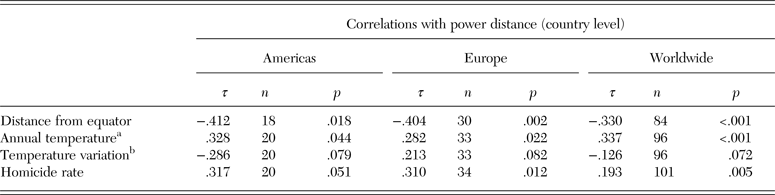
Table 1. (Weick) Associations of power distance with climate and violence (homicide rates) in different geographic regions
The CLASH model seeks to explain regional variations in violence and aggression by focusing on how individuals cope with environmental stressors irrespective of the wider social context. This approach overlooks the fact that environmental challenges affect individuals' relations with others and the very fabric of society, creating variations in culture (e.g., Barkow et al. Reference Barkow, Cosmides and Tooby1995).
In the present commentary we focus on the role of societal structures that originate from the distribution of power and resources (material and social), which, we argue, contribute to regional variations in violence and aggression. In unequal and hierarchical societies, the less privileged are inclined to adopt a shorter life strategy (e.g., Griskevicius et al. Reference Griskevicius, Tybur, Delton and Robertson2011; Moon & Chen Reference Moon and Chen2014), are more oriented towards the present moment (e.g., Magee & Smith Reference Magee and Smith2013; Weick & Guinote Reference Weick and Guinote2010), and are more impulsive (e.g., Wood Reference Wood1998). Thus, contrary to Van Lange et al.'s assertion that “[cultural] explanations focus more on behavioural patterns than on underlying mechanisms” (sect. 2.3, para. 5), there are well-defined routes through which societal and cultural variables can affect violence and aggression. We agree with the authors that “life strategy” (LS), “time orientation” (TO), and “self-control” (SC) can contribute to regional variations in violence and aggression, but we question whether the physical environment (including temperature and temperature variation) contributes to differences in LS, TO, and SC independently of cultural and societal settings.
A consideration of societal and cultural variables enables us to move beyond intra-individual variables (LS, TO, and SC) to consider variables operating at the inter-individual and group levels. In hierarchical societies, factors such as expectations of deference from those of lower rank (e.g., Tyler et al. Reference Tyler, Lind and Huo2000) and the need to demonstrate one's worth (e.g., Mendoza-Denton et al. Reference Mendoza-Denton, Downey, Purdie, Davis and Pietrzak2002) are chief concerns that can exacerbate conflicts. An imbalance in power can also trigger retaliatory aggression in chronically powerless individuals when the opportunity arises (Strelan et al. Reference Strelan, Weick and Vasiljevic2014). All of these factors operate in the context of cultural norms that can further fuel abuse, in particular downward abuse, in hierarchical settings (cf. Pearson et al. Reference Pearson, Andersson and Porath2000). This, combined with the fact that the importance of the social context increases to the extent that people live in harsher and more unequal circumstances (e.g., Bianchi & Vohs Reference Bianchi and Vohs2016; Walasek & Brown Reference Walasek and Brown2015), leads us to believe that the focus on intra-individual variables (LS, TO, and SC) paints an incomplete picture.
Our claim that societal and cultural variables are important for understanding variations in levels of violence and aggression is bolstered by the observation that countries with some of the highest homicide rates – including Honduras, Venezuela, Guatemala, Mexico, and Panama – are not only characterised by high temperatures and low seasonal variations, but also are in the upper quartile of Hofstede's power distance index, which captures the extent to which hierarchies are embedded in society and inequalities are accepted as there to stay (Hofstede Reference Hofstede1980). Conversely, some of the lowest homicide rates can be observed in countries such as Iceland, Switzerland, Sweden, and Denmark—countries with low temperatures and high seasonal variation that are also characterised by low power distance. Bergeron and Schneider (Reference Bergeron and Schneider2005) established an association between power distance and cross-national differences in aggression, but their analysis did not include homicides and other extreme violence, nor did it examine climatological variables. In the present commentary, we sought to fill this gap, also examining for the first time the link between power distance and climate. As shown in Table 1, we found that power distance is associated with higher homicide rates across countries. Crucially, power distance increases with greater proximity to the equator, high average annual temperature, and lower seasonal temperature variation (the latter does not hold for Europe). These data bolster our proposition that social structures and the distribution of power can contribute to geographic and climatological variations in violence.
(Weick) Associations of power distance with climate and violence (homicide rates) in different geographic regions
τ = Kendall's Tau-b correlation coefficient; n=number of countries.
Data sources: power distance (Hofstede, Reference Hofsteden.d.); distance from equator (Laitin et al. Reference Laitin, Moortgat and Robinson2012); annual temperature and temperature variation (World Bank 2011); homicide rates (United Nations Office on Drugs and Crime 2013).
aArithmetric mean and bstandard deviation of average monthly temperatures spanning 1961–1999.
We posit that the association between power distance and violence is mediated by individual-level variables such as LS, TO, and SC, as well as inter-personal and group-level variables such as expectations of deference and concerns about one's social worth. However, power distance may also act as a moderator, operating in concert with other societal and cultural variables to weaken or strengthen the relationship between variables such as LS, TO, SC, and different manifestations of violence and aggression. Future research should explore the precise routes through which power distance contributes to regional variations in violence and aggression.
In sum, we applaud the authors for putting ecology at the forefront of research on violence and aggression. Their approach ties in with a growing body of research (see Oishi [Reference Oishi2014] for a review) showing that economic (e.g., farming/herding see Uskul & Over [Reference Uskul and Over2014]), political (e.g., voice/accountability, see Helliwell & Huang [Reference Helliwell and Huang2008]), environmental (e.g., green spaces, see Kaplan & Berman [Reference Kaplan and Berman2010]), and demographic (e.g., sex ratio, see Pollet & Nettle [Reference Pollet and Nettle2008]) variables affect behaviour. However, an ecological approach to human behaviour is inherently intertwined with societal and cultural factors, which, in our view, need to be considered when seeking to explain regional and climatological variations in violence and aggression.