In the target article, Van Lange et al. attempt to explain the relationship between aggression, violence, and climate differences. They assume that there exists a positive association between average annual temperature and violence. According to Van Lange et al., this is a universal law. To prove this association, they suggest that to adapt to lower temperatures and greater seasonal variation in climate, people adopt a slower life history strategy and a stronger focus on self-control. These psychological characteristics inhibit aggression and diminish violence.
It is necessary to note that Van Lange et al. derive a positive association between average temperature and violence mainly from the differences between countries. However, these differences can easily be explained by social, cultural, and historical variables. To demonstrate that the same mechanism operates within countries they consider the United States and Italy; however, such a small sample may be hardly representative, and the differences within these countries also can be explained by social and historical factors. As there is a certain shortage of data on the differences within countries, we decided to examine the CLASH model using the data on the differences within one country, the Russian Federation.
The Russian Federation is a huge country that consists of 85 regions (federal subjects) with very large climatic differences. The most southern regions are situated at the latitude of Rome and Madrid, but the country also includes Yakutia, which is the coldest place in the Northern Hemisphere. Moreover, many regions have a large seasonal variation in climate, when the difference between the average temperatures in January and July is 40°C–50°C. The population of 83 regions exceeds 100,000. This means that all statistics can be considered representative. Moreover, the population of the Russian Federation is relatively homogenous; ethnic Russians constitute 81%of the population, and Russians predominate in most of the regions (Wikipedia 2016c). This means that the cultural and social differences between regions should be relatively narrow.
We found the average annual temperature and seasonal variation in climate for each region in Wikipedia. When these data were missing for a region,we used the average temperature and seasonal variation for the capital of that region.
The violent crime rate for each region was calculated as follows: Violent crime rate = (murder+assault) per 100,000 in 2014. According to the CLASH model, life expectancy can be considered as an intermediate variable between climate and aggression. Because the vast majority of violent crimes are committed by males, in our analysis we used the regional male life expectancy in 2014. This factor varies up to 20 years for different regions of the Russian Federation. Van Lange et al. discuss the relationship between wealth and the CLASH model, and we decided to add the regional average income in 2014 to the analysis. The wealthiest region exceeded the poorest one as much as 4.7. All of these statistics are from Oxenoit et al. (Reference Oxenoit, Bougakova, Gelvanovski, Glisin, Goriacheva, Gohberg, Ghitkov, Klimanov, Kouznetsova, Koulibina, Skaterschikova and Kharlamova2015).
To evaluate the relations between the variables we applied multiple regression analysis, where violent crime rate was a dependent variable and average annual temperature, seasonal variation, average income, and male life expectancy were independent variables. The results of the analysis are presented in Table 1.
Table 1.
(Prudkov & Rodina) Regression analysis
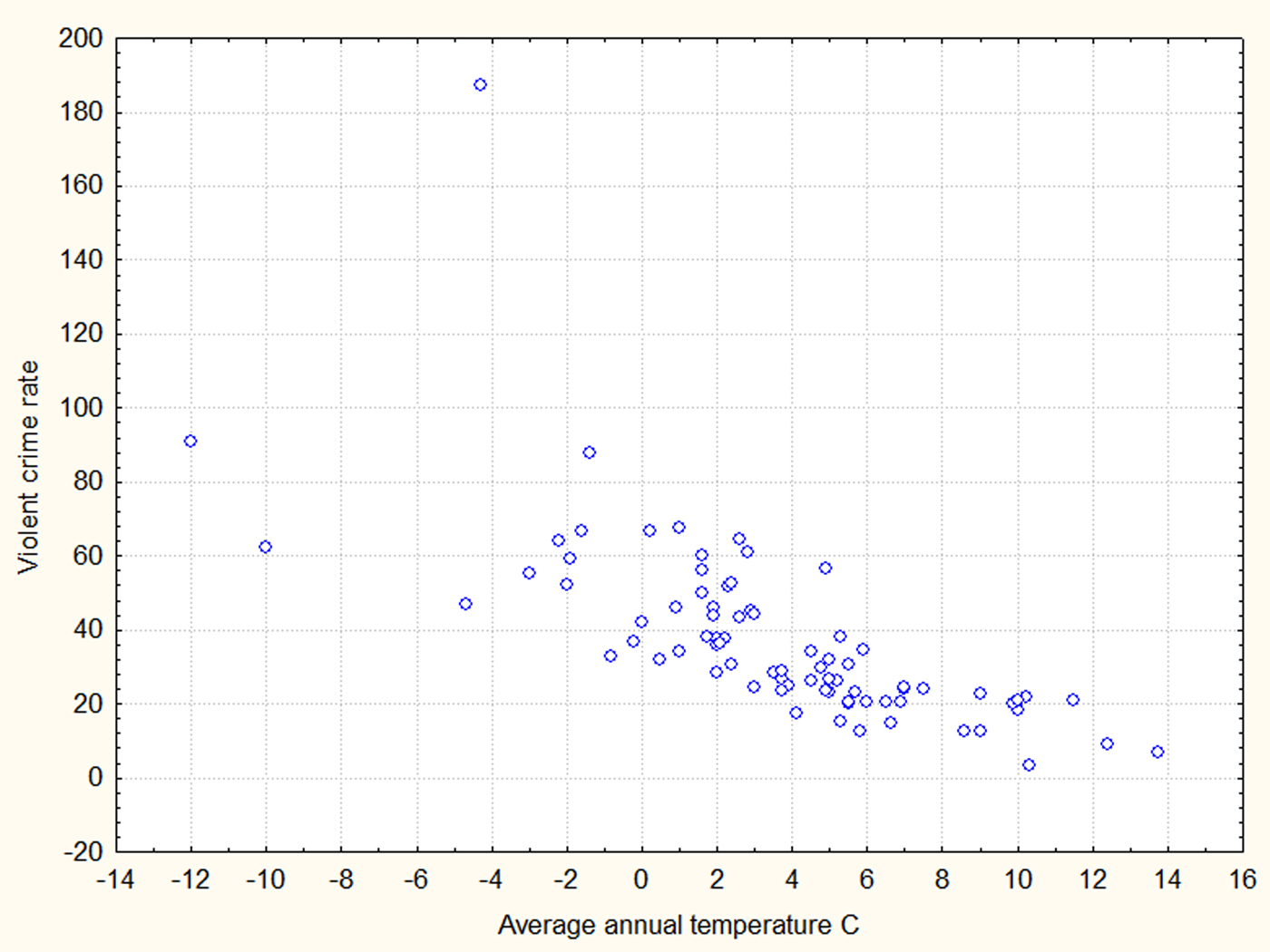
These results are entirely inconsistent with CLASH. The basic assumption of Van Lange et al. is a positive association between violence and average annual temperature. Our association, however, is negative (Fig. 1). The CLASH model expects a negative relation between seasonal variation in climate and violence, but this relation is positive within the Russian Federation.The significance of life expectancy means that violence is connected to life expectancy regardless of annual average temperature. The fact that the regression coefficient between average temperature and average income is not significant may indicate that economic and social factors do not contribute to this dependence within the Russian Federation.
Figure 1.
Average annual temperature versus violent crime rate.
Our approach to the relationship between climate and aggression is as follows. First, it is absolutely incorrect to compare various countries solely on the basis of climatic or psychological variables without taking into consideration cultural, economic, and historical factors. This method inevitably results in wrong conclusions. For example, the number of motor vehicles per 1000 people is 747 in Iceland and 591 in Norway. In contrast, this indicator is 6 in Burundi and 3 in Liberia (Wikipedia 2016b). No one would derive from these facts that heat inhibits the desire to own a car. Van Lange et al. mention that the rate of violent crimes is low in Europe, but they probably forgot that the two world wars started in Europe, not in Latin America. In other words, we do not think that the differences between countries confirm CLASH. Moreover, the data within the Russian Federation, a country with very large climatic differences and a relatively homogenous population, are inconsistent with CLASH. As a result, we conclude the CLASH model is wrong.
Second, humans have evolved under particular climatic conditions that are probably optimal for the functioning of the human organism. Living in an inappropriate (overly hot or overly cold) climate becomes a stressor, which can stimulate impulsivity, irritation, and frustration. These psychological variables may inhibit self-control, thus activating aggression (Anderson et al. Reference Anderson, Anderson, Dorr, DeNeve, Flanagan and Zanna2000). However, the role of climatic variables is limited compared with the roles of social, economic, and cultural factors. These factors fundamentally influence violence and possibly alter the effect of climatic variables. For example, the low violence rate in Scandinavia may partially be explained by a rather high personal income that allows its residents to travel frequently to warmer climates.








In the target article, Van Lange et al. attempt to explain the relationship between aggression, violence, and climate differences. They assume that there exists a positive association between average annual temperature and violence. According to Van Lange et al., this is a universal law. To prove this association, they suggest that to adapt to lower temperatures and greater seasonal variation in climate, people adopt a slower life history strategy and a stronger focus on self-control. These psychological characteristics inhibit aggression and diminish violence.
It is necessary to note that Van Lange et al. derive a positive association between average temperature and violence mainly from the differences between countries. However, these differences can easily be explained by social, cultural, and historical variables. To demonstrate that the same mechanism operates within countries they consider the United States and Italy; however, such a small sample may be hardly representative, and the differences within these countries also can be explained by social and historical factors. As there is a certain shortage of data on the differences within countries, we decided to examine the CLASH model using the data on the differences within one country, the Russian Federation.
The Russian Federation is a huge country that consists of 85 regions (federal subjects) with very large climatic differences. The most southern regions are situated at the latitude of Rome and Madrid, but the country also includes Yakutia, which is the coldest place in the Northern Hemisphere. Moreover, many regions have a large seasonal variation in climate, when the difference between the average temperatures in January and July is 40°C–50°C. The population of 83 regions exceeds 100,000. This means that all statistics can be considered representative. Moreover, the population of the Russian Federation is relatively homogenous; ethnic Russians constitute 81%of the population, and Russians predominate in most of the regions (Wikipedia 2016c). This means that the cultural and social differences between regions should be relatively narrow.
We found the average annual temperature and seasonal variation in climate for each region in Wikipedia. When these data were missing for a region,we used the average temperature and seasonal variation for the capital of that region.
The violent crime rate for each region was calculated as follows: Violent crime rate = (murder+assault) per 100,000 in 2014. According to the CLASH model, life expectancy can be considered as an intermediate variable between climate and aggression. Because the vast majority of violent crimes are committed by males, in our analysis we used the regional male life expectancy in 2014. This factor varies up to 20 years for different regions of the Russian Federation. Van Lange et al. discuss the relationship between wealth and the CLASH model, and we decided to add the regional average income in 2014 to the analysis. The wealthiest region exceeded the poorest one as much as 4.7. All of these statistics are from Oxenoit et al. (Reference Oxenoit, Bougakova, Gelvanovski, Glisin, Goriacheva, Gohberg, Ghitkov, Klimanov, Kouznetsova, Koulibina, Skaterschikova and Kharlamova2015).
To evaluate the relations between the variables we applied multiple regression analysis, where violent crime rate was a dependent variable and average annual temperature, seasonal variation, average income, and male life expectancy were independent variables. The results of the analysis are presented in Table 1.
(Prudkov & Rodina) Regression analysis
These results are entirely inconsistent with CLASH. The basic assumption of Van Lange et al. is a positive association between violence and average annual temperature. Our association, however, is negative (Fig. 1). The CLASH model expects a negative relation between seasonal variation in climate and violence, but this relation is positive within the Russian Federation.The significance of life expectancy means that violence is connected to life expectancy regardless of annual average temperature. The fact that the regression coefficient between average temperature and average income is not significant may indicate that economic and social factors do not contribute to this dependence within the Russian Federation.
Average annual temperature versus violent crime rate.
Our approach to the relationship between climate and aggression is as follows. First, it is absolutely incorrect to compare various countries solely on the basis of climatic or psychological variables without taking into consideration cultural, economic, and historical factors. This method inevitably results in wrong conclusions. For example, the number of motor vehicles per 1000 people is 747 in Iceland and 591 in Norway. In contrast, this indicator is 6 in Burundi and 3 in Liberia (Wikipedia 2016b). No one would derive from these facts that heat inhibits the desire to own a car. Van Lange et al. mention that the rate of violent crimes is low in Europe, but they probably forgot that the two world wars started in Europe, not in Latin America. In other words, we do not think that the differences between countries confirm CLASH. Moreover, the data within the Russian Federation, a country with very large climatic differences and a relatively homogenous population, are inconsistent with CLASH. As a result, we conclude the CLASH model is wrong.
Second, humans have evolved under particular climatic conditions that are probably optimal for the functioning of the human organism. Living in an inappropriate (overly hot or overly cold) climate becomes a stressor, which can stimulate impulsivity, irritation, and frustration. These psychological variables may inhibit self-control, thus activating aggression (Anderson et al. Reference Anderson, Anderson, Dorr, DeNeve, Flanagan and Zanna2000). However, the role of climatic variables is limited compared with the roles of social, economic, and cultural factors. These factors fundamentally influence violence and possibly alter the effect of climatic variables. For example, the low violence rate in Scandinavia may partially be explained by a rather high personal income that allows its residents to travel frequently to warmer climates.