In attempting to explain societal differences in the occurrence of human violence and aggression around the world, the CLASH model proposed by Van Lange et al. integrates the role of the physical environment with a number of important psychological processes, such as time orientation and self-control. Although I applaud the interactionist approach of the CLASH model in advancing our understanding of variation in human violence and aggression both between and within countries, I argue that the relatively narrow definition of “aggression” adopted by the authors hinders theory development in two important ways. First, it restricts the conceptual depth and breadth of the CLASH model. Second, it obscures a more complex empirical relationship between the role of physical geography and worldwide patterns of human violence and aggression. In particular, the authors state that “throughout this article, we use the terms aggression and violence to describe broad classes of behaviour intended to harm others” (sect. 1, para. 5). What is peculiar is that this definition is entirely unidirectional in the sense that it does not include, or allow for, violent behaviours intended to harm one's self.
In this commentary, I argue that the lack of consideration of violent behaviour geared towards one's self (rather than others) is consequential for two primary reasons: (1) the psychological processes associated with violent self-harm are conceptually consistent with the CLASH model in a number of important and interesting ways, yet (2) they also present a challenging empirical puzzle, raising critical questions about the causal role of climate in human aggression.
The human ability to express and experience violent and aggressive thoughts and behaviours is a global phenomenon that need not be restricted exclusively to harming others, as there is near-universal evidence of violent self-harm throughout recorded human history (DeCatanzaro Reference DeCatanzaro1980). Suicides are a notable and increasing cause of human mortality. Indeed, suicide is the 15th leading cause of human deaths worldwide and the 2nd leading cause of death among 15- to 29-year-olds specifically (World Health Organization 2014). In fact, global suicide rates have risen over the last decades, particularly among males (Bertolote & Fleischmann Reference Bertolote and Fleischmann2002).
Van Lange et al. implicate two key psychological processes in understanding aggression and violence: time -orientation (future vs. present) and self-control (high vs. low). Specifically, the authors focus on the type of poor self-control that results in “hot,” impulsive, and angry reactive behaviour. Importantly, however, these psychological mechanisms are not only at play in explaining aggression and hostility towards others, but also in explaining violent self-harm. Indeed, low self-control, high anger, aggression, and impulsivity have all been reported to substantially contribute to suicide risk (Gvion & Apter Reference Gvion and Apter2011; Hawton et al. Reference Hawton, Saunders and O'Connor2012; Horesh et al. Reference Horesh, Rolnick, Iancu, Dannon, Lepkifker, Apter and Kotler1997). Moreover, van Lange et al. cite evidence that, compared with a long “future” time orientation (i.e., a “slow life strategy”), a present (short-term) focus is often associated with higher aggression and violence. In a similar vein, the (in)ability to imagine a positive future is a major factor in depression and suicide risk, and suicidal patients often display reduced future-directed thinking and are significantly more present oriented (Greaves Reference Greaves1971; MacLeod & Byrne Reference MacLeod and Byrne1996). In short, expanding the conceptual definition of violence and aggression to include self-harm would add to the generalizability of the CLASH model, as the same psychological mechanisms that underlie violent harm towards others are associated with violent self-harm.
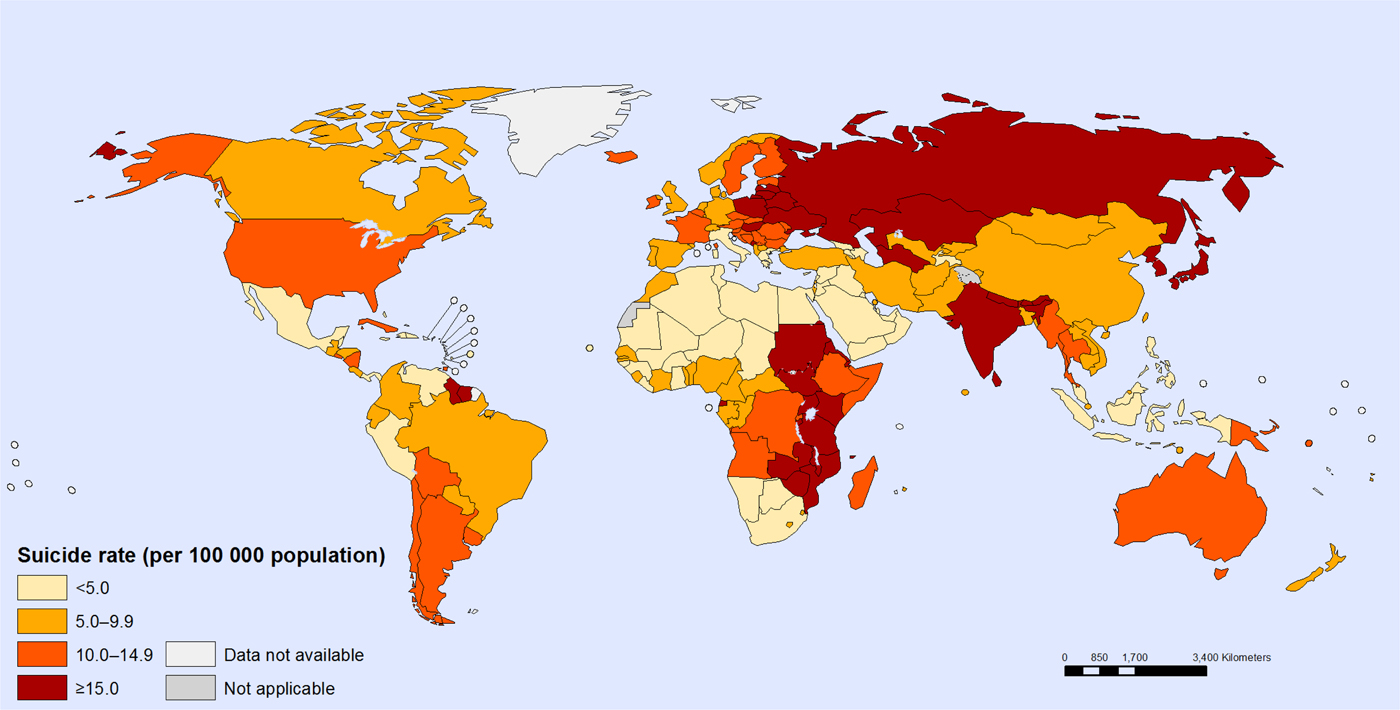
Importantly, the empirical evidence paints a more complicated and nuanced picture. Contrary to van Lange et al.'s review of the evidence that warmer temperatures and closer proximity to the equator are often associated with higher levels of aggression and violence, the geographical relationship between violent self-harm (suicide) and distance to the equator reveals substantially more spatial heterogeneity. To illustrate, the map in Figure 1. shows the most recent age-standardised suicide rates around the world, with the highest suicide rates occurring in countries with lower average temperatures and those more distant from the equator (e.g., Northern Europe, North America, Russia, India, Alaska, Australia etc.). In fact, although year to year variation exists, some of the lowest suicide rates are found in countries on or close to the equator, and standardised differences over many decades indicate a general trend that the further one moves away from the equator, the higher the suicide rate (Davis & Lowell Reference Davis and Lowell2002).
Figure 1.
Age-standardised suicide rates per 100,000 in 2012 around the world. Note: From World Health Organization (2014).
Although van Lange et al. recognise that the between-country evidence is more complex and less consistent, even the within-country evidence for self-harm is less clear-cut. For example, more suicides typically occur in the North of the United States than the South (Lester Reference Lester1986). This is not to say that heat does not play a role in suicide risk; on the contrary, although complex, decades of research from around the world have documented the link between climate variables, such as increased temperature and (less) seasonal variation, and the risk of violent suicide (Deisenhammer et al. Reference Deisenhammer, Kemmler and Parson2003; Maes et al. Reference Maes, Cosyns, Meltzer, De Meyer and Peeters1993). For example, even in traditionally darker and colder areas or so-called “suicide capitals of the world,” such as Alaska and Greenland, suicides tend to peak in late spring and during the summer (Björkstén et al. Reference Björkstén, Kripke and Bjerregaard2009).
So where does that leave us? On the one hand, there is good evidence for the finding that heat, present-time orientations, and low self-control all contribute to violence and aggression in general (i.e., to one's self as well as to others). On the other hand, it is clear that warmer temperatures and less seasonal variation do not cause suicides. Similarly, being closer to the equator is neither a necessary nor sufficient condition to cause harm to either one's self or others. In conclusion, this is a cautionary tale about causality. Geography and climate may very well exacerbate human aggression and violence in general, but the relationship remains complex and varied. The CLASH model would benefit from broadening its definition of aggression and violence, including a more nuanced assessment of the evidence in the light of this empirical puzzle.







In attempting to explain societal differences in the occurrence of human violence and aggression around the world, the CLASH model proposed by Van Lange et al. integrates the role of the physical environment with a number of important psychological processes, such as time orientation and self-control. Although I applaud the interactionist approach of the CLASH model in advancing our understanding of variation in human violence and aggression both between and within countries, I argue that the relatively narrow definition of “aggression” adopted by the authors hinders theory development in two important ways. First, it restricts the conceptual depth and breadth of the CLASH model. Second, it obscures a more complex empirical relationship between the role of physical geography and worldwide patterns of human violence and aggression. In particular, the authors state that “throughout this article, we use the terms aggression and violence to describe broad classes of behaviour intended to harm others” (sect. 1, para. 5). What is peculiar is that this definition is entirely unidirectional in the sense that it does not include, or allow for, violent behaviours intended to harm one's self.
In this commentary, I argue that the lack of consideration of violent behaviour geared towards one's self (rather than others) is consequential for two primary reasons: (1) the psychological processes associated with violent self-harm are conceptually consistent with the CLASH model in a number of important and interesting ways, yet (2) they also present a challenging empirical puzzle, raising critical questions about the causal role of climate in human aggression.
The human ability to express and experience violent and aggressive thoughts and behaviours is a global phenomenon that need not be restricted exclusively to harming others, as there is near-universal evidence of violent self-harm throughout recorded human history (DeCatanzaro Reference DeCatanzaro1980). Suicides are a notable and increasing cause of human mortality. Indeed, suicide is the 15th leading cause of human deaths worldwide and the 2nd leading cause of death among 15- to 29-year-olds specifically (World Health Organization 2014). In fact, global suicide rates have risen over the last decades, particularly among males (Bertolote & Fleischmann Reference Bertolote and Fleischmann2002).
Van Lange et al. implicate two key psychological processes in understanding aggression and violence: time -orientation (future vs. present) and self-control (high vs. low). Specifically, the authors focus on the type of poor self-control that results in “hot,” impulsive, and angry reactive behaviour. Importantly, however, these psychological mechanisms are not only at play in explaining aggression and hostility towards others, but also in explaining violent self-harm. Indeed, low self-control, high anger, aggression, and impulsivity have all been reported to substantially contribute to suicide risk (Gvion & Apter Reference Gvion and Apter2011; Hawton et al. Reference Hawton, Saunders and O'Connor2012; Horesh et al. Reference Horesh, Rolnick, Iancu, Dannon, Lepkifker, Apter and Kotler1997). Moreover, van Lange et al. cite evidence that, compared with a long “future” time orientation (i.e., a “slow life strategy”), a present (short-term) focus is often associated with higher aggression and violence. In a similar vein, the (in)ability to imagine a positive future is a major factor in depression and suicide risk, and suicidal patients often display reduced future-directed thinking and are significantly more present oriented (Greaves Reference Greaves1971; MacLeod & Byrne Reference MacLeod and Byrne1996). In short, expanding the conceptual definition of violence and aggression to include self-harm would add to the generalizability of the CLASH model, as the same psychological mechanisms that underlie violent harm towards others are associated with violent self-harm.
Importantly, the empirical evidence paints a more complicated and nuanced picture. Contrary to van Lange et al.'s review of the evidence that warmer temperatures and closer proximity to the equator are often associated with higher levels of aggression and violence, the geographical relationship between violent self-harm (suicide) and distance to the equator reveals substantially more spatial heterogeneity. To illustrate, the map in Figure 1. shows the most recent age-standardised suicide rates around the world, with the highest suicide rates occurring in countries with lower average temperatures and those more distant from the equator (e.g., Northern Europe, North America, Russia, India, Alaska, Australia etc.). In fact, although year to year variation exists, some of the lowest suicide rates are found in countries on or close to the equator, and standardised differences over many decades indicate a general trend that the further one moves away from the equator, the higher the suicide rate (Davis & Lowell Reference Davis and Lowell2002).
Age-standardised suicide rates per 100,000 in 2012 around the world. Note: From World Health Organization (2014).
Although van Lange et al. recognise that the between-country evidence is more complex and less consistent, even the within-country evidence for self-harm is less clear-cut. For example, more suicides typically occur in the North of the United States than the South (Lester Reference Lester1986). This is not to say that heat does not play a role in suicide risk; on the contrary, although complex, decades of research from around the world have documented the link between climate variables, such as increased temperature and (less) seasonal variation, and the risk of violent suicide (Deisenhammer et al. Reference Deisenhammer, Kemmler and Parson2003; Maes et al. Reference Maes, Cosyns, Meltzer, De Meyer and Peeters1993). For example, even in traditionally darker and colder areas or so-called “suicide capitals of the world,” such as Alaska and Greenland, suicides tend to peak in late spring and during the summer (Björkstén et al. Reference Björkstén, Kripke and Bjerregaard2009).
So where does that leave us? On the one hand, there is good evidence for the finding that heat, present-time orientations, and low self-control all contribute to violence and aggression in general (i.e., to one's self as well as to others). On the other hand, it is clear that warmer temperatures and less seasonal variation do not cause suicides. Similarly, being closer to the equator is neither a necessary nor sufficient condition to cause harm to either one's self or others. In conclusion, this is a cautionary tale about causality. Geography and climate may very well exacerbate human aggression and violence in general, but the relationship remains complex and varied. The CLASH model would benefit from broadening its definition of aggression and violence, including a more nuanced assessment of the evidence in the light of this empirical puzzle.