



R1. Introduction
Our target article advances a theoretical model of CLimate, Aggression, and Self-control in Humans (CLASH). CLASH is based on the broad scientific assumption that climate is an important determinant of culture and human behavior. Although most of the critical empirical tests have yet to be conducted, CLASH was inspired by several general findings that are well documented in the scientific literature. First, there are pervasive differences in aggression and violence within and between countries around the world. Second, differences in aggression and violence are generally not randomly distributed across the planet — they are strongly related to both geographical latitude and temperature: the warmer the climate, the higher the levels of aggression and violence, especially intergroup conflict (see Burke et al. Reference Burke, Hsiang and Miguel2015). Third, in regions with warmer climates, people seem to adopt faster life strategies (e.g., women become mothers sooner and have more children). Fourth, in regions with warmer climates, time matters less; there is a stronger emphasis on the present and a weaker emphasis on the future. Fifth, self-control, which is strongly related to future orientation, may be associated with climate in a similar fashion. Sixth, self-control is one of the strongest predictors of aggression (e.g., Baumeister & Tierney Reference Baumeister and Tierney2011; DeWall et al. Reference DeWall, Finkel and Denson2011) and violence (e.g., Pratt & Cullen Reference Pratt and Cullen2000), especially violent crime (Gottfredson & Hirschi Reference Gottfredson and Hirschi1990; Henry et al. Reference Henry, Caspi, Mofitt and Silva1996). Seventh, there is some evidence that future orientation can reduce aggression (Joireman et al. Reference Joireman, Anderson and Strathman2003) and violent crime (Van Gelder et al. Reference Van Gelder, Hershfield and Nordgren2013; Van Gelder et al. Reference Van Gelder, Luciano, Weulen Krananbarg and Hershfield2015). These seven general findings can help solve what might be labeled as “the aggressive behavior-culture puzzle: the ABC puzzle.” We believe that the tools used to solve this important puzzle should be empirical, logical, and theoretical (see Van Lange Reference Van Lange2013).
There are two general themes in the commentaries: (1) climate should be viewed in the light of social-economic or political-historic variables (e.g., wealth, income inequality, governance), and (2) aggression and violence should be viewed in the light of proximal and ultimate mechanisms. In response to the first theme, we discuss the logical properties of climate, concluding with a brief outline of the relative stability of climate (see Section R2), and provide a discussion of the evidence for CLASH (Section R4) and extensions of CLASH (Section R5). In response to the second theme, we discuss our perspective on cultural evolution, which serves as a conceptual backbone of CLASH (see Section R3). The commentaries discussed boundary conditions (Section R6) and other issues (Section R7) relevant to CLASH. We conclude with some avenues for future research (Section R8) to test hypotheses and implications derived from CLASH.
R2. Logical Properties of Climate
An important feature of climate is that it offers objective parameters such as temperature that are related to aggression and violence levels (Burke et al. Reference Burke, Hsiang and Miguel2015). CLASH is based on the simple fact that any measurable theoretical concept has two statistical properties: (1) it is a measure of central tendency (e.g., mean); and (2) it is a measure of dispersion (e.g., variance). Most previous work has focused on average temperature and has ignored variation in temperature. CLASH focuses on both.
The interesting aspect of seasonal variation is that it is predictable and, therefore, to some degree “controllable.” We do not mean that climate (or weather) can be controlled; we mean that it calls for anticipation, foresight, and long-term planning. For example, future orientation can help one mentally prepare for cold winters (e.g., clothes, food, heat source). Self-control is involved because it often takes effortful and costly action in the present to prepare for the future. To illustrate, in agriculture, the farmer needs to plant seeds in the spring and not eat them all in the early fall.
In addition to the statistical properties of “average” and (predictable) “variation,” there is another objective property of climate – long-term stability. There is indeed evidence that climate has been exceptionally stable for the 10,000 years (because the Earth's orbit around the sun has not changed during this period). However, around 1950, a new era began, often referred to as the “the human epoch,” in which humans started to have a profound effect on the climate by directly contributing to global warming (Richardson et al. Reference Richardson, Steffen and Liverman2011). Therefore, CLASH is based on the assumption that people living in different parts of the world, and even different parts of a country, adapt to different yet stable climatological circumstances. The long-term stability of climate is important in many commentaries discussed here because it implies that climate is unlikely to be strongly influenced by other variables such as social-economic and political-historic variables. Instead, CLASH assumes that climate itself causes aggression and violence, and other variables may serve as mediators (e.g., wealth, income inequality, governance, pathogen stress). In short, the link between climate and other variables should be largely unidirectional in terms of causality.
R3. Culture: Evolution and Adaptation
One key assumption of CLASH is that people create and maintain cultures (e.g., norms, institutes, and markets) that help them adapt to relatively stable climatological circumstances, which, in turn, increases their survival and reproduction. Most tasks for survival and reproduction can be accomplished only by a group or society, not by individuals alone. Thus, it is plausible that individuals adapt “through culture” by developing norms and rules, informal networks, and institutions that favor long-term planning and self-control. Humans are “cultural species” (Henrich Reference Henrich2015b, 2015 p. 3; see also Baumeister Reference Baumeister2005; Boyd & Richerson Reference Boyd and Richerson2005, Reference Boyd and Richerson2009; Carleton & Hsiang Reference Carleton and Hsiang2016). That is, humans have adapted to their environments through many cultural practices, from preparing food to building complex institutions (Carleton & Hsiang Reference Carleton and Hsiang2016). Temperature is the key factor, and humidity may magnify of the effects of temperature (Burke, Sulikowski, Stephen, & Brooks (Burke et al.).
We emphasize cultural evolution because the threats and opportunities relevant to survival and reproduction can be “addressed” using primarily groups rather than individuals. That is, individuals are strongly interdependent in adapting to the threats and opportunities posed by both average and seasonal variation in temperature (Balliet et al. Reference Balliet, Tybur and Van Lange2017; see also Kelley et al. Reference Kelley, Holmes, Kerr, Reis, Rusbult and Van Lange2003; Van Lange & Rusbult Reference Van Lange, Rusbult, Van Lange, Kruglanski and Higgins2012). Examples are collective hunting, food sharing, agriculture, industry, and institutions. Because most tasks are interdependent (rather than independent), individuals adapt to climate not only as individuals, but also as groups and even societies. Thus, it is reasonable to assume that climate, like other features of the physical environment, shapes cultural evolution.
We emphasize culture from two distinct processes – “ultimate” and “proximal” – which help clarify some of broad issues raised by several commentators, most explicitly by Cabeza de Baca, Hertler, & Dunkel (Cabeza de Baca et al.); Campbell; and Daly & Krupp. First, CLASH adopts an evolutionary approach to culture. We acknowledge that cultural evolution should not be regarded as completely independent of genetic evolution, as there is strong evidence for culture-gene co-evolution. Second, we adopt an interdependence approach that complements a classic evolutionary one, by highlighting the “proximal” role of the current environment as a key ingredient in psychological adaptation (Kelley et al. Reference Kelley, Holmes, Kerr, Reis, Rusbult and Van Lange2003; Van Lange & Rusbult Reference Van Lange, Rusbult, Van Lange, Kruglanski and Higgins2012). However, interdependence can lead to conflicts of interests with other families or groups. Therefore, climate may a powerful ultimate property of the environment that shapes features of interdependence that people, as individuals or groups, face in the here and now, as well as in the future.
It is also possible that people adapt in a proximal manner to longstanding differences in culture. These may or may not be ultimately caused by climate differences. For example, societies may differ largely in terms of social-economic variables, such as income inequality. Societies with high income inequality are characterized by low trust, high corruption, and high violence. In contrast, societies with low income inequality are characterized by high trust, low corruption, and low violence. How is one to adapt psychologically to these differences in terms of proximal causes? We believe research on immigrants is informative. There is evidence that first-generation immigrants who move from lower-trust countries (e.g., Turkey, Poland, Italy) to higher-trust countries (e.g., Denmark, Germany Switzerland) are strongly affected by the high levels of trust in the countries to which they immigrate (Dinesen Reference Dinesen2012). They quickly become more trusting, regardless of length of stay (which varied from 1 to 7 years). These findings illustrate the influence of culture on general trust and why genetic differences may be modest (see Van Lange et al. Reference Van Lange, Vinkhuyzen and Posthuma2014). These findings also illustrate the intimate connection between individual characteristics and group-level characteristics, which is key to cultural evolution (e.g., Henrich Reference Henrich2015a; Van Lange Reference Van Lange2015). People are likely to develop trust through social learning and their own direct experience in groups or cultures when it makes sense to do so, for example, if the level of corruption is low and if income inequality is not very high.
In summary, our framework provides an overview of the key assumptions of CLASH, the logic of climate as a determinant of culture, and how culture helps us understand the proximal and ultimate causes of fast versus slow life strategies, future orientation, self-control, and ultimately aggression and violence. This discussion should provide general answers to the many interesting issues raised by the commentators.
R4. Extensions of CLASH
Because climate has not received much scientific attention as a determinant of human behavior, we attempted to provide a simple and parsimonious model by focusing on climate and less on other broad variables, such as wealth. Indeed, in the target article, we discussed the role of wealth as an important variable, because the wealthy are better able to (1) protect themselves against the dangers and harshness of climate and (2) engage in various behaviors inspired by future orientation and self-control (e.g., to save money for the future). This reasoning is in perfect agreement with Van de Vliert & Daan, who note that “climatological determinism” is an oversimplification and that other variables (e.g., wealth) could extend, improve, and enrich CLASH. The inclusion of other variables should enhance the breadth, accuracy, and general interest of CLASH.
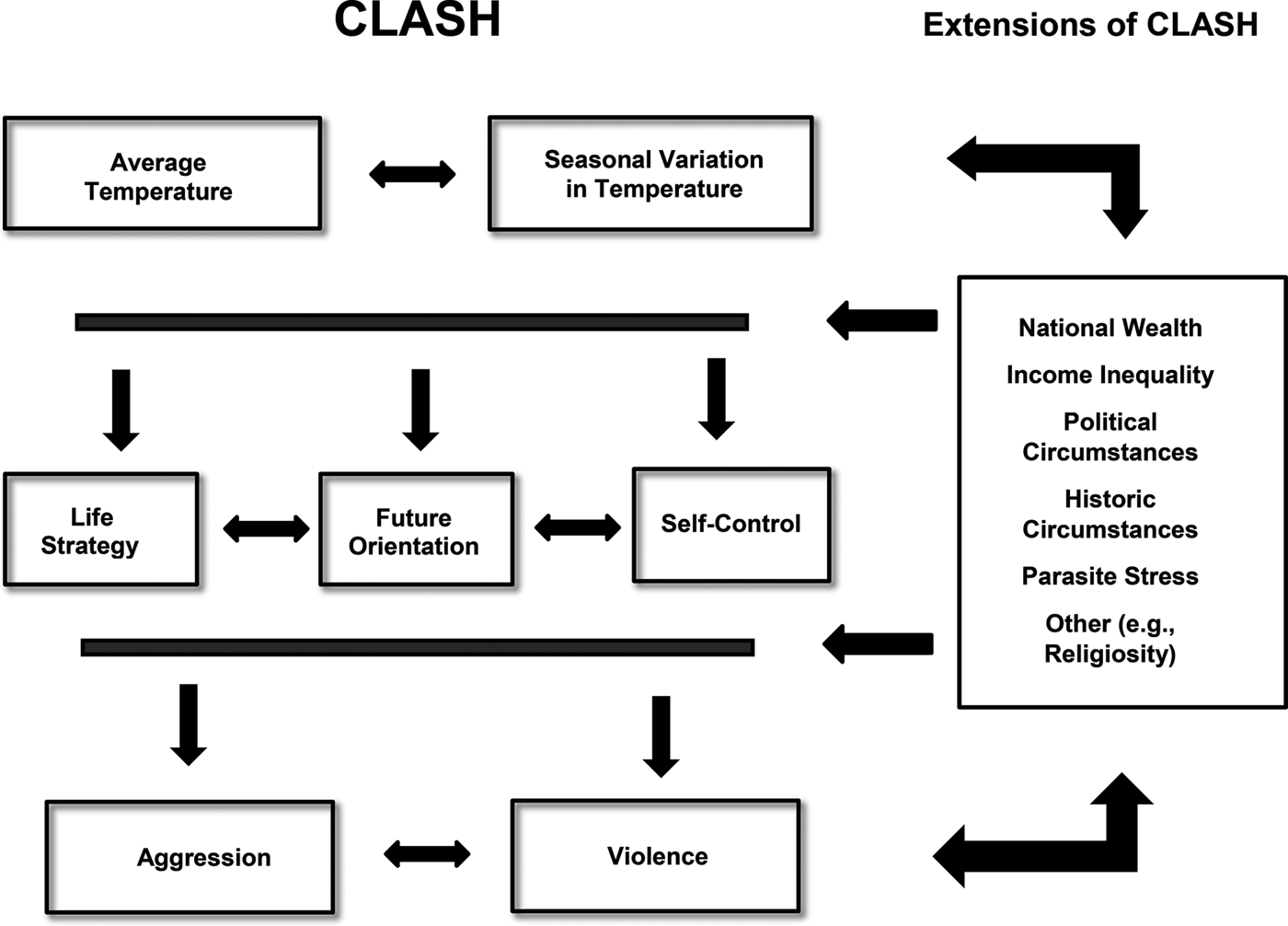
We see at least four broad extensions of CLASH (see Fig. R1, which acknowledges more extensions, such as religiosity). First, it is plausible that climate, in combination with wealth, determines future orientation and self-control. One especially relevant prediction is that monetary resources matter more in demanding climates (e.g., the rich can cope with harsh climates better than can the poor). There is good evidence for this model in other social domains, such as the development of trust in strangers and cooperative enculturation of children (Van de Vliert et al. Reference Van de Vliert, Van der Vegt and Janssen2009). These findings are in line with the Climate-Economic Theory of Freedom (Van de Vliert Reference Van de Vliert2013a) and underline the importance of climate and wealth to issues that are linked to self-control and aggression. Also, we agree with Orosz, Zimbardo, Bőthe, & Tóth-Király (Orosz et al.) that wealth can be a consequence of climate. Because seasonal variation can result in adoption of a culture of planning and self-control, milder climates with seasonal variation can yield more resources and wealth. Thus, wealth can serve as a potential mediator between climate and aggression and violence.
Model of CLimate, Aggression, and Self-control in Humans (CLASH) with extensions.

Second, in addition to wealth, there is strong evidence that income inequality is a powerful determinant of a wide range of variables, including aggression and violence (Kenrick & Gomez Jacinto Reference Kenrick, Gomez Jacinto, Gelfand, Chiu and Hong2013; see Wilkinson & Pickett Reference Wilkinson and Pickett2009). We agree with Krems & Varnum on the importance of income inequality. Whether income inequality outperforms climate as a causal agent is to us a secondary issue. For us, the primary issue is whether income inequality influences life strategy, future orientation, and self-control, which, in turn, influence aggression and violence. Above and beyond climate, income inequality is likely to exert direct effects on aggression and violence because people are inequality averse (e.g., Fehr & Schmidt Reference Fehr and & Schmidt1999; Van Lange Reference Van Lange1999).
Third, we also share the view that political and historic circumstances can shape aggression and violence in critical and enduring ways. It is possible that these circumstances, such as degree of democracy and history of colonialism, are partially shaped by differences in wealth and income equality. Countries around the world differ considerably in terms of wealth (Dohmen et al. Reference Dohmen, Enke, Falk, Huffman and Sunde2015). This has been true in the past, is true now, and will likely be true in the future. Climate may be one of the ultimate causes of wealth and income inequality because the development of productive and sustainable agriculture is partially conditioned by high temperature and lack of water. One might also argue that differences in wealth and income inequality are responsible for political circumstances, such as the historical geography of colonialism (Roscoe; Van Voorhees, Wilson, Calhoun, Elbogen, Beckham, & Kimbrel [Van Voorhees et al.]).
Of course, the determinants and especially the consequences of colonialism are complex. What does a history of power imbalance and intergroup conflict do to a culture? Although answering this complex yet important question is challenging, we agree that it may well be the history of intergroup conflict that underlies the types of aggression and violence that are so strongly associated with temperature (Burke et al.). We also agree that power relations can be a source of conflict and aggression, as Weick, Vasiljevic, Uskul, & Moon (Weick et al.) suggest. Further, Weick et al. suggest there exists a close association between climate and power distance. It is possible that power distance, future orientation, and self-control go hand in hand within the same culture. Thus, although historic and political circumstances represent numerous different facets, it is possible that they are at least partially rooted in climatological differences (see also Van de Vliert & Tol Reference Van de Vliert and Tol2014).
Finally, one natural circumstance that is closely linked to climate is the threat of parasites. Pathogen stress is a concept often used in reference to infectious disease, which is a major source of morbidity and mortality (e.g., Guernier et al. Reference Guernier, Hochberg and Guégan2004; Schaller, Reference Schaller2006, Reference Schaller and Buss2016). According to the evolutionary Parasite Stress Theory of Sociality, humans and other animals adapt to parasite stress by dividing into in-groups and out-groups (Fincher & Thornhill Reference Fincher and Thornhill2012). This leads to in-group favoritism and out-group hostility (Fincher & Thornhill Reference Fincher and Thornhill2012; see also Murray & Schaller Reference Murray and Schaller2016; Schaller Reference Schaller and Buss2016). The Parasite-Stress Theory of Sociality has also been applied to the classic cultural dimension of individualism versus collectivism (Fincher et al. Reference Fincher, Thornhill, Murray and Schaller2008; Hofstede Reference Hofstede2001) – a dimension that is strongly linked to crossing in-group and out-group boundaries (e.g., Gelfand Reference Gelfand2012; Gelfand et al. Reference Gelfand, Bhawuk, Nishii, Bechtold, House, Hanges, Javidan, Dorfman and Gupta2004). For example, intergroup stress is far more intense in collectivistic cultures, which are more prevalent in warmer locations with less seasonal variation.
R5. Evidence for CLASH
Climate is one of the most stable and far-reaching features of our physical environment and shapes the natural, social, economic, and political-historic character of the world around us. Indeed, one could argue that climate is an ultimate cause of culture. Yet wealth, income inequality, political-historic circumstances, pathogen stress, and perhaps other broad variables (e.g., religiosity, age) could all be ascribed the conceptual status of mediators. Therefore, as Mell, Safra, Baumard, & Jacquet (Mell et al.) suggest, it is theoretically possible that the direct (unmediated) impact of climate is negligible. It is also possible that even when numerous mediators are included, climate still has a direct influence on culture. These are empirical questions. But even if any effect of climate completely “disintegrates” (as Mell et al. stated in their abstract) when other variables are included as predictors of aggression and violence, it is still important to understand the causal role of climate. Climate can serve as a conceptual starting point for many processes at the level of culture and society. As noted by Burke et al. (Reference Burke, Hsiang and Miguel2015), variables such as wealth and income inequality are “bad controls” because they may well be shaped by climate.
If climate is irrelevant, then CLASH is a theoretical exercise of no detectable scientific value other than perhaps serving a heuristic (idea-inspiring) function. The same would be true if there is a third variable that influences all of the variables in CLASH. These issues are empirical and testable. In our view, they are worth testing, not only because the role of climate in human behavior has received little empirical attention, but also because fast life strategy, future orientation, self-control, aggression, and violence are essential to the functioning of individuals and societies.
A few commentaries contain new data relevant to CLASH. For example, IJzerman, Čolić, Hennecke, Hong, Hu, Joy-Gaba, Lazarević, Parzuchowski, Ratner, Schubert, Schütz, Stojilović, Weissgerber, Zickfield, & Lindenberg (IJzerman et al.), on the basis of data from 14 countries, maintain that distance from the equator is significantly associated with self-reported self-control (Tangney et al. Reference Tangney, Baumeister and Boone2004) and strongly correlated with hot daily weather (r = –.90). Finding a significant correlation in an analysis in which the variation is rooted in 14 countries can be impressive, even though it may not be robust even if only a few countries are added to the sample (for related complexities, see Pollet et al. Reference Pollet, Tybur, Frankenhuis and Rickard2014). The conclusion that distance from the equator is not a competitive predictor (ranked as 14th) may derive from the limited variance of the 14 countries analyzed in terms of climate and climate-related variables (e.g., pathogen stress).
As noted earlier, we do not think that climate should outperform these broad variables – CLASH was developed to acknowledge the role of climate. Moreover, we want to examine extensions of CLASH to test whether the effects of climate are mediated by other variables (see Section R4 addressing extensions of CLASH). We share the view of IJzerman et al. that CLASH could be enriched by a greater appreciation of social influences (see the later discussion on the role of social development in our response to commentaries by Bulley, Pepper, & Suddendorf (Bulley et al.); Frankenhuis, Fenneman, Van Gelder, & Godoy (Frankenhuis et al.); and Simpson & Griskevicius). Finally, we think that most commentaries, with or without data, point to the potential importance of boundary conditions, which we discuss next.
R6. Boundary Conditions of CLASH
R6.1. Only the Northern Hemisphere?
In their commentary, Fuentes, Kissel, Oka, Sheridan, Kim, & Piscitelli (Fuentes et al.) make the important point that archaeological and paleoanthropological data conflict with CLASH. They note that this evidence suggests that in ancestral times, poverty was not stronger in countries closer to the equator. We acknowledge that the logic and availability of data needed to understand climate in combination with other broad variables in ancestral times pose a serious challenge to the evolutionary aspects of CLASH. What we regard as equally puzzling is that Fuentes et al. provide some evidence that CLASH receives support on the Northern Hemisphere (accounting for 10% of the variance in homicide), but not in the Southern Hemisphere. We limited CLASH to the Northern Hemisphere because of a lack of data (in a relative sense) and because the Northern Hemisphere contains a larger amount of land and a larger number of people. Although there is already some evidence of CLASH in both hemispheres (e.g., see commentary by Van der Vliert & Daan), more research is required to determine whether CLASH applies to both hemispheres. The two hemispheres differ greatly in terms of population density. People and groups do need to interact to aggress, and high density and crowding are associated with high levels of aggression (e.g., Lawrence & Andrews, Reference Lawrence and Andrews2004; Russell, Reference Russell1983).
R6.2. Only humans?
As the name conveys, CLASH was developed as a theoretical model of aggression and self-control in humans. Tops & Van der Linden note that CLASH may not be generalizable to or reconcilable with other animals. From an evolutionary perspective, this may indeed pose challenges. As we outline in the target article, animals are highly responsive to climate. Hibernation, migration, and hoarding are among the most well-known examples. Other animals might also have some “foresight.” One crucial difference between humans and other animals is that aggression is a means for ensuring survival and good reproductive outcomes for many carnivores, but generally not for humans.
R6.3. Only young males?
Marsh correctly notes that most aggression and violence are committed by young people, especially young males. We do not know the strength of the relation between age and distance from the equator (or, more precisely, average temperature and seasonal variation), but even a small relation could serve as a moderator or, perhaps, as a mediator if climate somehow caused this age difference. Krems & Varnum discuss the importance of sex ratio. Simpson & Griskevicius note that survival and reproductive success are determined by competition for status and resources among young men. Although there is an emerging psychological literature indicating than men and women may differ in their expressions of aggression, most forms of physical aggression and violence, especially in intergroup settings, are committed by young men. Thus, CLASH may be especially relevant to young men. In our view, this constitutes a promising topic for future research.
R6.4. Only some parts of the world?
In their commentary, Prudkov & Rodina report evidence that violent crime in Russia is more prevalent in colder climates with more seasonal variation, which contradicts CLASH. We can think of three possible explanations for their findings. First, Russia excludes latitude areas lower than Madrid or Rome (areas where pathogen stress is weak or absent), whereas it includes areas with extremely harsh winters in the north (the average temperature in Yakutia in January is –38.6°C [–37.5°F]). Perhaps this level of harshness overshadows the influence of predictable seasonal variation. Second, although we agree that within-country comparisons allow for some control for social-economic and political-historic variables, it might be speculated that poverty overpowers the role of climate in northern Russia — with its history of communist values and strong centralized government in Moscow. Third, it is also possible that (harsh) climate needs to be viewed in combination with differences in wealth to understand aggression and violence (see Van de Vliert Reference Van de Vliert2013a).
R6.5. Suicide
The connection between aggression and suicide is interesting (Van der Linden). Suicide rates do tend to be higher in countries at high latitudes and with more seasonal variation (see also White et al. Reference White, Arael, Papadopoulos, Lambert and Miller2015). Although suicide is sometimes portrayed as “impulsive,” it may also be planned, often following one or more suicide attempts (Hawton Reference Hawton2007). Thus, the link between self-control (or future orientation, in a more spiritual sense as in an afterlife) and suicide is not entirely clear. Self-harm also differs from other-harm, because other-harm is often motivated by self-protection. Thus, we do not expect parallel results for aggression and self-harm, but consider it interesting that climate might ultimately help us understand yet another big issue – suicide.
R6.6. What about prosocial behavior?
Konrath argues that warmer climates with less variation may also be climates in which more prosociality and helpful behavior are observed. Indeed, there is research indicating the proximal influence of physical warmth on trust and prosocial behavior (e.g., Williams & Bargh Reference Williams and Bargh2008; IJzerman & Semin Reference IJzerman and Semin2009). We suggest that aggression does not exclude prosociality or closeness. Burke et al. (Reference Burke, Hsiang and Miguel2015) reported that intergroup conflict is more prevalent in warmer cultures. It is possible that a strong sense of “in-group love” may sometimes go hand in hand with some “out-group hate” because an emphasis on collectivism tends to lead to a sharper differentiation between us and them (see also Gelfand et al. Reference Gelfand, Bhawuk, Nishii, Bechtold, House, Hanges, Javidan, Dorfman and Gupta2004; Yamagishi & Mifune Reference Yamagishi and Mifune2009). Thus, it is possible that warmth is predictive of intergroup hostility, but with a simultaneous tendency to help those that belong to the in-group, tend to be similar to the self, or are otherwise psychologically close.
R6.7. Prediction, prospection, or both?
In their commentary, Baumeister, Clark, & Kim (Baumeister et al.) thoughtfully argue that predictable seasonal variation can lead to prospection rather than prediction (also see Baumeister et al. Reference Baumeister, Vohs and Oettingen2016) People want not only to predict the future, but also to “prepare” for the future – an important complement to CLASH. Although climate is generally predictable, we agree that people may also “mentally prepare” for the future. For example, in countries far from the equator, especially where the winter is characterized by clouds and rain, with little sunshine, there are people who save money so that they can afford to visit sunny places. We agree that prediction and prospection are both important and complementary and may be related in similar ways to a slow life strategy, future orientation, and high self-control.
To conclude, we agree that the evidence for or against CLASH is hard to evaluate at this point. As with most new programs of research, we start by developing the logic, specifying the model, and outlining extensions and boundary conditions. We do not think it is essential to examine the competitive status of climate relative to other determinants of life strategy, future orientation, self-control, and aggression and violence. The first goal is to provide tests of the hypotheses that can be derived from CLASH and its extensions, which we discuss in Section R9.
R7. Remaining Issues Raised by CLASH
R7.1. Which climates are harsher?
We have assumed that extreme climates, both hot and cold, are harsh. Some commentators raise the possibility that warmer climates are generally less harsh (Baumeister et al., Burke et al., Orosz et al.). Humidity can also magnify the effects of harsh climates (Burke et al.). One parsimonious model is that extreme temperatures are aversive, exhausting, and taxing. One important question is how well people can protect themselves from harsh climates – cold and hot. Importantly, CLASH also explicitly considers other climate-related features of the environment that may be harsh, especially pathogen stress (e.g., Fincher & Thornhill Reference Fincher and Thornhill2012; Murray & Schaller Reference Murray and Schaller2016). Pathogen stress is higher in warmer and hotter climates than in milder and colder climates, because seasonal variation reduces parasite survival. Infectious diseases caused by parasites may also make the environment harsh in a more proximal sense. In addition, coping with seasonal cold and its consequences (e.g., anticipation of food shortage) calls for more planning and self-control than does coping with heat and its consequences (e.g., parasites).
R7.2. Cultural evolution, genes, intelligence, narcissism, and machiavellianism
We highlight the role of culture, in both an “ultimate” and a “proximal” sense. Evolutionarily, we assume that climate influences culture (e.g., institutions, norms, beliefs). We agree that social development is important to consider when talking about culture, as noted by some commentators (Bulley et al., Frankenhuis et al., Simpson & Griskevicius). Culture is strongly embedded in social development, as parenting and education are strongly guided by relatively local institutions, norms, and beliefs. Here too, we believe there is ultimate and proximal influence. As noted by Simpson and Belsky (Reference Simpson, Belsky, Cassidy and Shaver2016), children growing up in harsh and unpredictable environments are likely to receive less sensitive parenting and adapt by adopting a faster life strategy (e.g., earlier sex and parenthood). Proximally, institutions such as schools differ in terms of how much investment in the future is communicated and valued, and so culture may also provide many “nudges” toward a slow versus fast strategy, future orientation, and self-control. Frankenhuis et al. discussed internal predictive adaptive responses (PARs) with a focus on those who have been exposed to similar environmental conditions, but differ in their somatic age. Even under similar conditions, those of higher somatic age tend to adopt a faster life strategy. Thus, life strategy can also be triggered by internal processes. Even if somatic age is higher, on average, in warmer climates, somatic age differences can still be explained by Life History Theory.
It is also interesting that CLASH receives support from cross-national research on bullying (Volk). It may be that power distance and honor (Nowak et al. Reference Nowak, Gelfand, Borkowski, Cohen and Hernandez2016; Weick et al.) play an important role and that such cultural influences may occur early in life. Wiessner provides several cultural illustrations to make the point that “culture matters for life history trade-offs.” Societies also sometimes transition to democratic institutions, which is likely to bring greater equality in income and opportunities. We agree that these transitions are important because they make the environment less harsh and more predictable for the most vulnerable members of society.
In their commentaries, Boutwell & Winegard, Campbell, and Daly & Krupp suggest that we overlooked past work by Rushton (1995; 2000b), who proposed a strong link between genes and traits such as intelligence, and that this would account for race differences. However, Rushton devoted relatively little attention to cultural evolution or proximal processes, which are central tenets of CLASH. Rushton also focused on intelligence, whereas CLASH does not explicitly address intelligence, even though we acknowledge that intelligence is related to future orientation and self-control. And finally, we are not aware of any strong support for the idea that genes explain differences in intelligence between and within the races (see Henrich Reference Henrich2015b).
Sternberg asks whether the concepts of life strategy, future orientation, and self-control could be parsimoniously replaced with (state) general intelligence. We think not. Although intelligence may be related to future orientation and self-control, they are distinct concepts. Self-control can be trained, is contextual (e.g., being silent at a funeral), and is state related (e.g., influenced by exhaustion), whereas general intelligence tends to lack these characteristics. We do think that this point deserves future research, not only because parsimony is important, but also because state intelligence may be linked to climate, or at least heat. For example, heat poses serious challenges to neurocognitive functioning (e.g., Mazloumi et al. Reference Mazloumi, Golbabaei, Khani, Kazemi, Hosseini, Abbasinia and Dehghan2014).
It is fascinating that narcissism is higher in countries closer to the equator (Jonason & Schmitt). It is plausible that warmer climates, food shortage, and high narcissism go together, because narcissists are to place their own needs ahead of others', which could enhance their survival and reproduction. Jonason and Schmitt's reasoning extends CLASH by offering the intriguing possibility that aggression may be more quickly activated in warmer climates with less variation as a means of survival, with enduring food shortage as one of the more important “triggers.” Thus, we suggest that CLASH can be extended in important ways by examining individual differences, including narcissism and traits related to conflicts of interests and situations of scarcity, such as empathy, trust, and prosocial orientation (for a review, see Van Lange et al. Reference Van Lange, Joireman, Parks and Van Dijk2013).
R7.3. Life History Theory concepts
CLASH is partially rooted in concepts of Life History Theory. We agree with Barbaro & Shackelford that Life History Theory is described in somewhat different ways in the literature, which can lead to differences in understanding (and, perhaps, misunderstanding). Also, the concepts of harshness and unpredictability are perhaps in need of further specification and clarification, especially when applied to complex human behaviors such as aggression and violence. The perspective of CLASH is that harshness and unpredictability are relatively independent constructs. However, in our characterization of climates, we described warmer and colder climates as harsh (see above), but colder climates with seasonal variation as being also predictable. This aspect of predictability of seasonal differences in temperature is essential to CLASH because it provides the basis for slower life strategy, future orientation, and self-control. If cold climate were completely unpredictable, CLASH would anticipate that people would adopt faster life strategy, shorter-term orientation, and less self-control. According to CLASH, future orientation and self-control are adaptive only when there is a threshold level of predictability, which ultimately provides the basis for some “control” over the environment.
Cabeza de Baca et al. (last paragraph) clarified their position with the following summary: “Climatic variation ultimately causes evolved biogeographical LH [life history] variation, which proximally explains a complex of biological and behavioral LH traits, among which are future orientation, self-control, violence, and aggression.” This position is quite consistent with CLASH, except that CLASH explicates the power of culture (in an ultimate and proximal manner) in shaping future orientation, self-control, and the likelihood of aggression and violence. We also noted that heat can exert direct effects on all of these variables.
R8. Future Avenues of CLASH
We regard the focus of CLASH on climate as a stable feature of the natural environment that includes the logical properties of a central tendency (mean) and dispersion (variance), as a novel theory. We should also note that research on climate is challenged by the fact that many broad variables may be associated with climate, such as wealth, income equality, pathogen stress, and governance. Rather than providing competitive tests of the predictive value of each variable, we recommend an approach that examines whether (1) climate is associated with aggression and violence (along with life strategy, future orientation, and self-control); (2) climate is associated with several broad variables; and (3) these variables might mediate the effects of climate, which we conceptualize as a long-term stable feature of the natural environment that may shape individuals and culture in very important ways.
One major issue left to explore is what role life strategy plays in climate's shaping of an individual and in understanding violence and aggression. We have emphasized future orientation and self-control as outgrowths of slow life strategies, but there is more to it. The tendency to prioritize risk over safety and to prioritize short-term risky gain over longer-term safety is one central aspect of a fast life strategy (e.g., Frankenhuis et al. Reference Frankenhuis, Panchanathan and Nettle2016). Clearly, morbidity and mortality risks are often strongly involved in intergroup aggression and especially intergroup violence. It may be that individuals who have adopted fast life strategies are those especially likely to initiate conflict, to never “back off,” and perhaps to favor honor over death (e.g., Cohen, Reference Cohen1998; Nisbett Reference Nisbett1993; Nisbett & Cohen Reference Nisbett and Cohen1996; Nowak et al. Reference Nowak, Gelfand, Borkowski, Cohen and Hernandez2016). And as discussed earlier, young men might be especially sensitive to excessive risk taking in various life domains, including intergroup conflict (see Van de Vliert et al. Reference Van de Vliert, Schwartz, Huismans, Hofstede and Daan1999; see also Barbaro & Shackelford, Simpson & Griskevicius, and Wiessner).
Second, although we have reviewed some evidence supporting CLASH, it is clear that the key mediators – fast versus slow life strategies, future orientation, self-control – still need to be empirically addressed. The link between climate and self-control is one that is most strongly in need of empirical investigation. Although self-control can be measured in various ways, we suggest that it is important to focus on the behavioral aspects of self-control. For example, paradigms such as the “marshmallow test” seem very suitable for assessment of the development of self-control (Mischel, Reference Mischel, Van Lange, Kruglanski and Higgins2012; Mischel et al. Reference Mischel, Shoda and Peake1988). Generation of adult versions of behavioral self-control, as well as behavioral measures that address self-control in intergroup contexts, is clearly an important way in which key hypotheses of CLASH can be tested. Also, inspired by several commentators (e.g., Campbell, Sternberg, Cabeza de Baca et al., Jonason & Schmitt) we suggest that cross-national research on personality, such as assessments of conscientiousness (De Vries & Van Gelder Reference De Vries and Van Gelder2013), along with measures of (state) intelligence, “dark” personalities (narcissism, machiavellianism, psychopathy, sadism), trust, and prosociality, may help illuminate whether the mediators of CLASH need to be refined or revised.
Finally, to broaden the implications of CLASH beyond aggression and violence, it may be promising to examine other cultural expressions of life strategy, long-term orientation, and self-control. For example, in recent research we found that professional soccer coaches are more quickly fired and hired in warmer countries with less seasonal variation (Van Lange et al. Reference Van Lange, Bien, Rinderu and Van Doesum2016). Further, Volk found evidence in a sample of 40 countries that the severity of bullying may also be related to climate. We agree with Volk that it would be interesting to examine what the ultimate and proximate mechanisms might be, whether they are related to in-group and out-group differences, and whether bullying and its escalating forms are a matter of “thoughtful” action or impulse. It is possible that self-control failure accounts for the more severe forms of bullying.
Future research might also assess various expressions of life strategy, future orientation, and self-control. For example, commitment to insurance and financial planning (e.g., retirement packages), setting of longer-term health goals (e.g., successfully dieting), long-term commitment to large organizations (Solinger et al. Reference Solinger and W. Roe2008), tendency to resist bribes and corruption (Köbis et al. Reference Köbis, Van Prooijen, Righetti and Van Lange2016), and commitment to other collective goals (e.g., environmental issues [Parks et al. Reference Parks, Joireman and Van Lange2013]).
R9. Concluding Remarks
CLASH provides a novel theoretical basis for understanding climatological influence on culture and human behavior to help understand the differences in aggression and violence around the world. Empirically, CLASH is young. Only time will tell whether CLASH, and its extensions, will be substantiated, modified, or replaced by alternative theories. At the very least, we hope it is a fertile theory that will spawn research so that CLASH has the potential to grow and mature. We greatly appreciate the thoughtful comments of those who responded to our target article. Their comments have helped identify potential weaknesses of the model, gaps in the model that need to be filled, important boundary conditions, and topics for future research.
CLASH also addresses one of the most pressing topics of our day – climate change. When people think about the consequences of climate change, they normally focus on weather, crops, islands sinking, glaciers melting, and polar bears losing their habitat. People rarely think about increasing levels of aggression and violence as consequences of climate change (Plante et al. Reference Plante, Allen and Anderson2017). Between the years 1880 and 2015, the 16 hottest years have been the last 16 years, with 2015 being the hottest ever (National Centers for Environmental Information 2015). As time goes on, temperatures are likely to increase further, whereas variation is likely to decrease further. This is bad news for the planet, and not just for the crops either. Climate-related aggression and violence levels in humans are also likely to increase.
CLASH is novel because of its focus on climatological influences, its link with psychological concepts such as time orientation and self-control, and its ambition to extend to social-economic, political-historic, and climate-related environmental variables. As the title conveys, CLASH emphasizes how climate might shape culture, how culture in turn shapes individuals and groups, and how individuals and groups sometimes behave in an aggressive and violent manner. Clearly, cultural differences are all around us, from language, cognition, and affect to norms, institutions, and markets. Climate provides a new, broad scientific perspective that helps us understand, and perhaps appreciate, cultural differences. We believe that understanding aggression is one of the most important steps in reducing hostility and conflict, as well as in promoting trust and cooperation between “we” and “them” in a world that is growing smaller and smaller – and warmer and warmer.
Acknowledgments
We thank Willem Frankenhuis, Hannes Rush, Josh Tybur, and three reviewers for their exceptionally helpful comments regarding the target article and discussions about CLASH.



Target article
Aggression and violence around the world: A model of CLimate, Aggression, and Self-control in Humans (CLASH)
Related commentaries (28)
A climate of confusion
Aggression, predictability of the environment, and self-regulation: Reconciliation with animal research
An alternative interpretation of climate data: Intelligence
Bullying when it's hot? The CLASH model and climatic influences on bullying
CLASH's life history foundations
Climate is not a good candidate to account for variations in aggression and violence across space and time
Culture matters for life history trade-offs
Dimensions of environmental risk are unique theoretical constructs
Does distance from the equator predict self-control? Lessons from the Human Penguin Project
Hell on earth? Equatorial peaks of heat, poverty, and aggression
Inconsistent with the data: Support for the CLASH model depends on the wrong kind of latitude
More than just climate: Income inequality and sex ratio are better predictors of cross-cultural variations in aggression
Postcolonial geography confounds latitudinal trends in observed aggression and violence
Pragmatic prospection emphasizes utility of predicting rather than mere predictability
Reply to Van Lange et al.: Proximate and ultimate distinctions must be made to the CLASH model
Russian data refute the CLASH model
Sociocultural discourse in science: Flawed assumptions and bias in the CLASH model
Stuck in the heat or stuck in the hierarchy? Power relations explain regional variations in violence
The CLASH model in broader life history context
The CLASH model lacks evolutionary and archeological support
The importance of being explicit
The paradoxical effect of climate on time perspective considering resource accumulation
The role of adolescence in geographic variation in violent aggression
The role of climate in human aggression and violence: Towards a broader conception
Using foresight to prioritise the present
Warm coffee, sunny days, and prosocial behavior
Where the psychological adaptations hit the ecological road
Why the CLASH model is an unconvincing evolutionary theory of crime
Author response
The Logic of Climate and Culture: Evolutionary and Psychological Aspects of CLASH