Latitude determines the amplitudes of winter cold versus summer heat, cooler nights versus warmer days, and the consequent temporal variation of thermoregulation in endothermic species. Within this thermal maze, Van Lange et al. have creatively mapped out a conceptual path marked by latitude and leading from smaller seasonal variation in temperature – much warmer winters with somewhat hotter summers – to greater human aggression. A shining virtue of the CLASH model is the emphasis Van Lange et al. place on the equator as a biogeographic divide (e.g., sect. 1, para. 8). By implication, the equator comes to stand out as a boundary link between distinct hemispheric labs for studying human adaptation to latitude-related conditions including heat and poverty.
On the shadow side, theories like the CLASH model can be criticized for preaching climatic determinism and dwarfing the gigantic impact of poverty on hostile conflict and violent behavior (Van de Vliert et al. Reference Van de Vliert2013b). Actually, aggression against people and ecosystems is most prevalent in poor populations threatened by demanding cold or hot climates and least prevalent in rich populations challenged by equivalently demanding cold or hot climates (Van de Vliert Reference Van de Vliert2011a; Reference Van de Vliert2016). Although the current earth system offers endothermic species more variation in cold demands than in heat demands, the current world economy offers humankind more wealth in colder regions and more poverty in hotter regions (cf. sect. 5.1), with the likely contemporary consequence of greater aggression at lower latitudes.
Addressing this clash between the CLASH model and climato-economic modeling, we concentrate on Van Lange et al.'s geographic criterion, distance from the equator, which hints at research opportunities for replication across hemispheres and making use of equatorial turning points in latitudinal gradients. We first highlight the descriptive and illustrative qualities of the opposite directions of the latitudinal gradients of heat stability, economic poverty, and societal aggression on the northern and southern sides of the equatorial divide. Then we report that the effect of the latitudinal gradient of heat stability on the latitudinal gradient of societal aggression is mediated by the latitudinal gradient of economic poverty, and that heat tempers rather than fuels poverty-induced aggression.
We use a country's midrange distance from the equator purely as a north-south coordinate for description. The centerpiece of the CLASH model, the seasonal variation in temperature, is measured here as the sum of a country's average cold downward deviation and average hot upward deviation from 220C (~72°F; see Van de Vliert [Reference Van de Vliert2013b, pp. 505–07]), and is then multiplied by −1 to represent heat stability. Poverty is the average of a country's log-transformed income per capita in 2000, 2002, and 2004 (United Nations Development Programme [UNDP] 2002; 2004; 2006) multiplied by −1. Aggression is the average of three standardized national measures: the 2010 index of domestic conflict and violence (http://www.visionofhumanity.org/#/page/indexes/global-peace-index/2010), press repression from 2005 to 2008 (Van de Vliert Reference Van de Vliert2011a), and business costs of crime and violence in 2006 and 2007 (World Economic Forum 2007) (Cronbach's α reliability is 0.704).
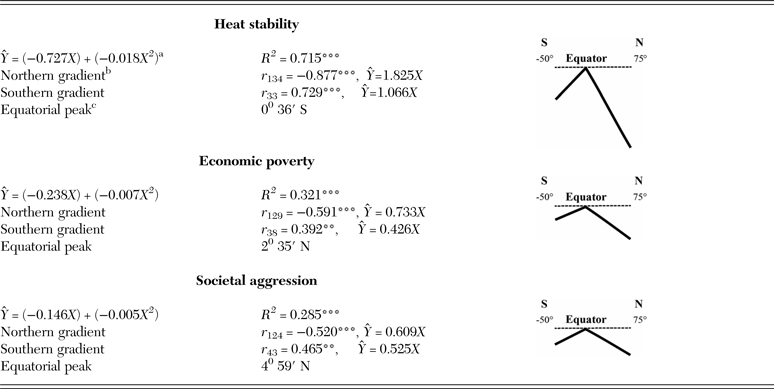
Table 1 indicates that latitude (X) is an adequate descriptor of heat stability, economic poverty, and societal aggression (Ŷ), and that the opposite directions of the latitudinal gradients in the Northern and Southern Hemispheres create intersecting peaks near the equator. It is unlikely that this consistent pattern of steeper northern gradients, flatter southern gradients, and near-equatorial turning points occurs randomly, also because heat stability (r = 0.339) and economic poverty (r = 0.651) are positively related to societal aggression (p's < .001).
Table 1.
The equatorial peaks of heat, poverty, and aggression.
Unconditional process analysis with 1000 bootstrap samples for constructing bias-corrected confidence intervals (Hayes Reference Hayes2013, model 4) reveals that the impact of heat stability on societal aggression is not a direct effect (lower limit confidence interval [LLCI] = −0.018, upper limit confidence interval [ULCI] = 0.190), but is completely mediated by economic poverty (LLCI = 0.111, ULCI = 0.283; total R
2
= 0.433). Faster life strategy – represented by the fertility rate 2000–2005 (source: UNDP 2006) – does not have an extra mediation effect (LLCI = −0.203, ULCI = 0.002; ΔR
2
= 0.014, total R
2
= 0.447). This mediation by poverty rather than fertility suggests a climato-economic revision of the CLASH model.
Conditional process analysis (Hayes Reference Hayes2013, model 74) cumulatively uncovers that the sizable effect of poverty on aggression is slightly modified by heat (LLCI = −0.284, ULCI = −0.078; ΔR
2
= 0.041, total R
2
= 0.474). Higher levels of poverty are associated with decreasingly higher levels of aggression at higher levels of heat (LLCI = 0.163, ULCI = 0.452 at the 10th percentile of heat; LLCI = 0.106, ULCI = 0.272 at the 50th percentile of heat; LLCI = 0.056, ULCI = 0.199 at the 90th percentile of heat). The interaction of hellish heat and abject poverty thus appears to temper aggression, which remains nevertheless high relative to the levels of aggression in richer regions. This climato-economic interaction also amends the CLASH model.
Van Lange et al. focus on the Northern Hemisphere but nevertheless think it necessary “to extend the model to both hemispheres” (sect. 1, para. 8). Along this line, we reran the last analysis on the 124 Northern Hemisphere countries (above 40 59′ N), and used the resulting regression equation for the prediction of societal aggression in the 43 Southern Hemisphere countries (below 40 59′ N). The positive relationship between predicted aggression and measured aggression (r = 0.443, p < .01) supports both the generalizability of our findings across hemispheres and the importance of the equator as a biogeographic divide.
Summarizing by metaphor, we view the CLASH model as a rickety lighthouse radiating flashes of insight. The most brilliant flashes of insight concern people's differing degrees of future orientation and self-control along the north-south axis of locations of residence. These biogeographic beams of light may navigate scientists toward latitudinal, equatorial, and hemispheric upgradings of climato-economic modeling of human behavior.







Latitude determines the amplitudes of winter cold versus summer heat, cooler nights versus warmer days, and the consequent temporal variation of thermoregulation in endothermic species. Within this thermal maze, Van Lange et al. have creatively mapped out a conceptual path marked by latitude and leading from smaller seasonal variation in temperature – much warmer winters with somewhat hotter summers – to greater human aggression. A shining virtue of the CLASH model is the emphasis Van Lange et al. place on the equator as a biogeographic divide (e.g., sect. 1, para. 8). By implication, the equator comes to stand out as a boundary link between distinct hemispheric labs for studying human adaptation to latitude-related conditions including heat and poverty.
On the shadow side, theories like the CLASH model can be criticized for preaching climatic determinism and dwarfing the gigantic impact of poverty on hostile conflict and violent behavior (Van de Vliert et al. Reference Van de Vliert2013b). Actually, aggression against people and ecosystems is most prevalent in poor populations threatened by demanding cold or hot climates and least prevalent in rich populations challenged by equivalently demanding cold or hot climates (Van de Vliert Reference Van de Vliert2011a; Reference Van de Vliert2016). Although the current earth system offers endothermic species more variation in cold demands than in heat demands, the current world economy offers humankind more wealth in colder regions and more poverty in hotter regions (cf. sect. 5.1), with the likely contemporary consequence of greater aggression at lower latitudes.
Addressing this clash between the CLASH model and climato-economic modeling, we concentrate on Van Lange et al.'s geographic criterion, distance from the equator, which hints at research opportunities for replication across hemispheres and making use of equatorial turning points in latitudinal gradients. We first highlight the descriptive and illustrative qualities of the opposite directions of the latitudinal gradients of heat stability, economic poverty, and societal aggression on the northern and southern sides of the equatorial divide. Then we report that the effect of the latitudinal gradient of heat stability on the latitudinal gradient of societal aggression is mediated by the latitudinal gradient of economic poverty, and that heat tempers rather than fuels poverty-induced aggression.
We use a country's midrange distance from the equator purely as a north-south coordinate for description. The centerpiece of the CLASH model, the seasonal variation in temperature, is measured here as the sum of a country's average cold downward deviation and average hot upward deviation from 220C (~72°F; see Van de Vliert [Reference Van de Vliert2013b, pp. 505–07]), and is then multiplied by −1 to represent heat stability. Poverty is the average of a country's log-transformed income per capita in 2000, 2002, and 2004 (United Nations Development Programme [UNDP] 2002; 2004; 2006) multiplied by −1. Aggression is the average of three standardized national measures: the 2010 index of domestic conflict and violence (http://www.visionofhumanity.org/#/page/indexes/global-peace-index/2010), press repression from 2005 to 2008 (Van de Vliert Reference Van de Vliert2011a), and business costs of crime and violence in 2006 and 2007 (World Economic Forum 2007) (Cronbach's α reliability is 0.704).
Table 1 indicates that latitude (X) is an adequate descriptor of heat stability, economic poverty, and societal aggression (Ŷ), and that the opposite directions of the latitudinal gradients in the Northern and Southern Hemispheres create intersecting peaks near the equator. It is unlikely that this consistent pattern of steeper northern gradients, flatter southern gradients, and near-equatorial turning points occurs randomly, also because heat stability (r = 0.339) and economic poverty (r = 0.651) are positively related to societal aggression (p's < .001).
The equatorial peaks of heat, poverty, and aggression.
a Ŷ = dependent variable (heat, poverty, aggression). X = centered midrange latitude.
bNorthern gradients are geometrically represented as right downward slopes, southern gradients as left upward slopes.
cThe peaks are located at X m + (–b 1 / 2b 2), with X m = mean midrange latitude (190 35′ N).
*p < .05, **p < .01, ***p < .001.
Unconditional process analysis with 1000 bootstrap samples for constructing bias-corrected confidence intervals (Hayes Reference Hayes2013, model 4) reveals that the impact of heat stability on societal aggression is not a direct effect (lower limit confidence interval [LLCI] = −0.018, upper limit confidence interval [ULCI] = 0.190), but is completely mediated by economic poverty (LLCI = 0.111, ULCI = 0.283; total R 2 = 0.433). Faster life strategy – represented by the fertility rate 2000–2005 (source: UNDP 2006) – does not have an extra mediation effect (LLCI = −0.203, ULCI = 0.002; ΔR 2 = 0.014, total R 2 = 0.447). This mediation by poverty rather than fertility suggests a climato-economic revision of the CLASH model.
Conditional process analysis (Hayes Reference Hayes2013, model 74) cumulatively uncovers that the sizable effect of poverty on aggression is slightly modified by heat (LLCI = −0.284, ULCI = −0.078; ΔR 2 = 0.041, total R 2 = 0.474). Higher levels of poverty are associated with decreasingly higher levels of aggression at higher levels of heat (LLCI = 0.163, ULCI = 0.452 at the 10th percentile of heat; LLCI = 0.106, ULCI = 0.272 at the 50th percentile of heat; LLCI = 0.056, ULCI = 0.199 at the 90th percentile of heat). The interaction of hellish heat and abject poverty thus appears to temper aggression, which remains nevertheless high relative to the levels of aggression in richer regions. This climato-economic interaction also amends the CLASH model.
Van Lange et al. focus on the Northern Hemisphere but nevertheless think it necessary “to extend the model to both hemispheres” (sect. 1, para. 8). Along this line, we reran the last analysis on the 124 Northern Hemisphere countries (above 40 59′ N), and used the resulting regression equation for the prediction of societal aggression in the 43 Southern Hemisphere countries (below 40 59′ N). The positive relationship between predicted aggression and measured aggression (r = 0.443, p < .01) supports both the generalizability of our findings across hemispheres and the importance of the equator as a biogeographic divide.
Summarizing by metaphor, we view the CLASH model as a rickety lighthouse radiating flashes of insight. The most brilliant flashes of insight concern people's differing degrees of future orientation and self-control along the north-south axis of locations of residence. These biogeographic beams of light may navigate scientists toward latitudinal, equatorial, and hemispheric upgradings of climato-economic modeling of human behavior.