






No CrossRef data available.
Article contents
Climate is not a good candidate to account for variations in aggression and violence across space and time
Published online by Cambridge University Press: 11 May 2017
Abstract
We agree with Van Lange et al. that climate is likely to affect individuals' social behavior in many ways. However, we suspect that its impact on physiology and psychology is so remote that its predictive power disintegrates almost completely through the causal chain underlying aggression and violence.
Information
- Type
- Open Peer Commentary
- Information
- Copyright
- Copyright © Cambridge University Press 2017
References
Baumard, N. & Chevallier, C. (2015) The nature and dynamics of world religions: A life history approach. Proceedings of the Royal Society of London B
282:20151593. doi: 10.1098/rspb.2015.1593.Google ScholarPubMed
Baumard, N., Hyafil, A., Morris, I. & Boyer, P. (2015) Explaining the axial age: How energy capture favored ascetic wisdoms and moralizing religions. Current Biology
25:10–15. doi: 10.1016/j.cub.2014.10.063.Google Scholar
Burke, M., Hsiang, S. M. & Miguel, E. (2015) Climate and conflict. Annual Review of Economics
7:577–617.Google Scholar
Federal Bureau of Investigation (FBI) (2013) Uniform crime reporting. Crime in the United States. Accessed August 7, 2016. Available at: https://ucr.fbi.gov/crime-in-the-u.s/2013/crime-in-the-u.s.-2013/tables/4tabledatadecoverviewpdf/table_4_crime_in_the_united_states_by_region_geographic_division_and_state_2012-2013.xls.Google Scholar
Hsiang, S. M., Burke, M. & Miguel, E. (2013) Quantifying the influence of climate on human conflict. Science
341(6151):. doi: 10.1126/science.1235367.Google Scholar
PediaCities (2013) New York City crime map. Accessed August 7, 2016. Available at: http://nyc.pediacities.com/fsmaps/NYCCrimeMap/.Google Scholar
Richards, P. (1999) Homicide statistics, Research Paper 99/56, Table 1. House of Commons Library.Google Scholar
Statistics Bureau, Ministry of Internal Affairs and Communications (2016a) Population and households: 2-1. Population by sex, population increase and decrease, population density (1872–2009). Accessed May 7, 2016. Available at: http://www.stat.go.jp/english/data/chouki/02.htm.Google Scholar
Statistics Bureau, Ministry of Internal Affairs and Communications (2016b) Justice and police: 28-1. Penal code crime cases known to the police and cases cleared up by type of crime (1924–2004). Accessed May 7, 2016. Available at: http://www.stat.go.jp/english/data/chouki/28.htm.Google Scholar
United Nations Office on Drugs and Crimes [UNODC] (2016) Crime and criminal justice (2008–2012). Accessed May 7, 2016. Available at: https://data.unodc.org/#state:0.Google Scholar
World Bank Group (2016a) Climate Change Knowledge Portal (2008–2012). Accessed May 7, 2016. Available at: http://sdwebx.worldbank.org/climateportal/index.cfm?page=downscaled_data_download&menu=historical.Google Scholar
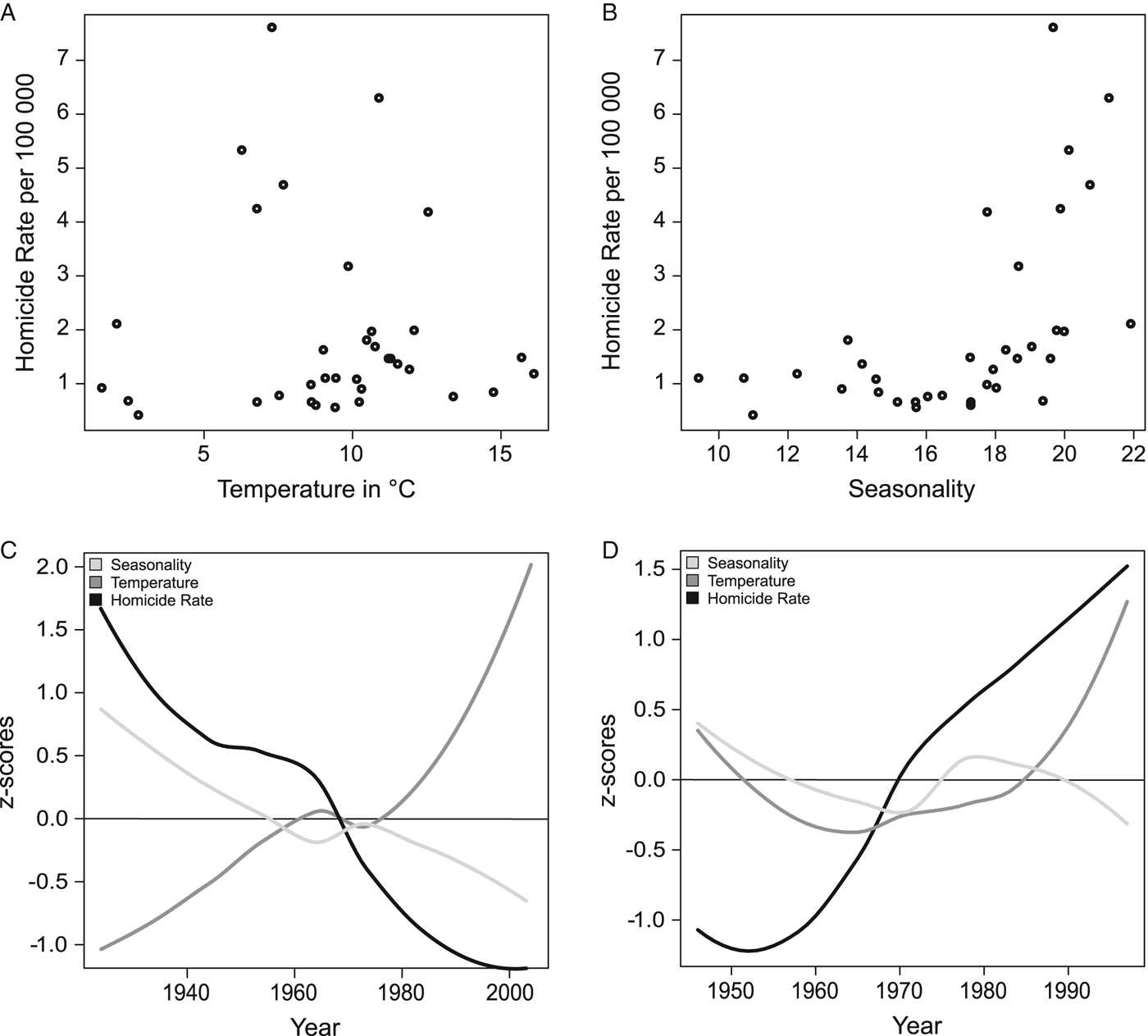
Figure 1. (A,B) Homicide rates averaged for the 2008–2012 period for countries (N=35) constituting geographic Europe, as a function of (A) temperature and (B) seasonality. (C,D) Year-by-year evolution of homicide rate, temperature, and seasonal variation for (C) Japan and (D) Great Britain.
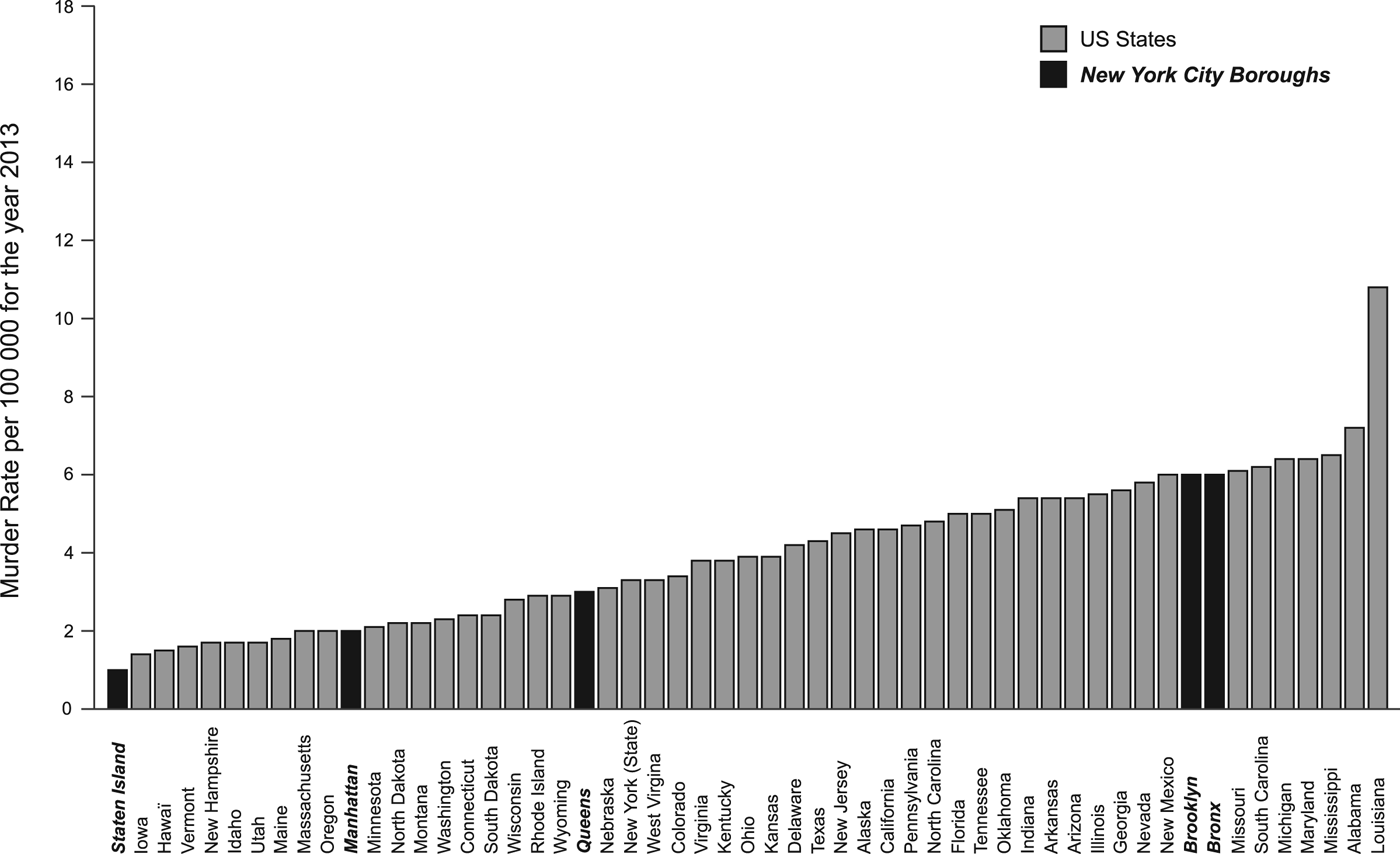
Figure 2. Murder rates measured for the year 2013 in all 50 states of the United States and in the five boroughs of New York City.
Using data about current and past patterns of aggression and human sociality, we show that the causal role of climate vanishes once one switches from a worldwide perspective to a more local one, and that it becomes quasi-irrelevant once a historical dimension is considered. Evolutionary models in biology provide explanations of variations in traits that are generalizable across both space and time. We believe that this criterion of relevance is, however, not met by CLASH.
We start our demonstration by testing whether climate predicts interpersonal violence during a restricted period within geographic Europe (Fig. 1A,B), an area that is similar in size and culture to the United States. Except for Russia, all major European countries with available climatic and homicide data for the 2008–2012 period were included (35 countries, sources: World Bank (The World Bank Group 2016a; United Nations Office on Drugs and Crimes [UNODC] 2016). Following methodological recommendations from studies that inspired the target article (Burke et al. Reference Burke, Hsiang and Miguel2015; Hsiang et al. Reference Hsiang, Burke and Miguel2013), we ran a series of correlations between interpersonal violence (measured by the homicide rate [Burke et al. Reference Burke, Hsiang and Miguel2015]) and either yearly average temperature or seasonal variations in temperature (i.e., the difference between the average temperature for the three summer months and the three winter months). We included only countries where CLASH was applicable (average year temperature under 24°C). Contrary to CLASH's predictions, both year-by-year and periodwise analyses revealed that interpersonal violence did not vary with temperature (all r values < .12, all t(34) values < 0.67, all p values > .25) (Fig. 1A) and, more surprisingly, increased with seasonality (all r values > .39, all t(34) values > 2.49, all p values < .018) (Fig. 1B).
(A,B) Homicide rates averaged for the 2008–2012 period for countries (N=35) constituting geographic Europe, as a function of (A) temperature and (B) seasonality. (C,D) Year-by-year evolution of homicide rate, temperature, and seasonal variation for (C) Japan and (D) Great Britain.
We then tested whether climatic variables predicted homicide rates in elapsed time periods (Fig. 1C,D) using historical records from two geographically distant countries of the temperate zone: Japan (1924–2004 [Statistics Bureau, Ministry of Internal Affairs and Communications 2016a; 2016b; The World Bank Group 2016a]) and Great Britain (1951–1999 [Richards Reference Richards1999; The World Bank Group 2016a]). For representational purposes, all three variables were expressed in units of standard deviations of their respective means over the whole period (z-score transformed). Figure 1C and D represent the trend for each variable across the time record, with ranges and standard deviations differing between Great Britain (homicide rate per 100,000: 0.58–2.06, SD = 0.42; temperature: 7.55°C–9.52°C, SD = 0.47; seasonality: 7.54°C–14.01°C, SD = 1.28) and Japan (homicide rate per 100,000: 0.97–4.14, SD = 0.98; temperature: 10.11°C–12.71°C, SD = 0.56; seasonality: 17.5°C–22.95°C, SD = 1.09). The impact of temperature and seasonal variations on homicide rates was the strict opposite of CLASH's predictions for Japan (average temperature: r = –.52, t(79) = –5.43, p < .001; seasonality: r = .22, t(79) = 1.99, p = .049) (Fig. 1C), whereas no effect was observed for Great Britain (both r values < .18, both t(45) values < 1.26, both p values > .215) (Fig. 1D). Figure 1D illustrates the importance of considering historical data to avoid spurious correlations when trying to find determinants of trait variations: during the 1990s, homicide rate and temperature positively covaried in Great Britain, but it is seen by going back further in time that the rise in homicides preceded the temperature increase and that the relationship was actually reversed in the 1950s.
One could argue that testing countries with relatively homogeneous temperate climates is inappropriate because small climatic variance might not include the critical threshold at which more dramatic levels of violence occur. If true, then deviations from the mean could be pure noise. However, we believe that this is not the case. Figure 2 indeed illustrates the difference in murder rates measured for the year 2013 (Federal Bureau of Investigation [FBI] 2013) in all 50 states of the United States and in the five boroughs of New York City (Pediacities NYC) and shows that variations observed at a very local scale (city) can be of similar magnitude as variations observed at a very global scale (continent). We doubt that it is reasonable to posit that climate differences act as a major predictor, at the expense of other explanatory variables such as, for example, differences in income.
Murder rates measured for the year 2013 in all 50 states of the United States and in the five boroughs of New York City.
In addition to these empirical arguments, we raise a more fundamental concern: CLASH cannot satisfyingly account for major transitions in the evolution of human sociality such as, for instance, the replacement of asocial religions by prosocial ones. Recent work indeed demonstrates that the best explanatory factor of this phenomenon is an increase in affluence (energy capture per capita, urbanization rate, population growth), a variable highly predictive of individuals' level of resources (Baumard et al. Reference Baumard, Hyafil, Morris and Boyer2015). This is in line with the life history framework, which predicts that individuals enjoying higher levels of resources engage in slower life strategies that are characterized by high investments in long-term goals, including cooperative goals. The early emergence of belief systems promoting prosociality can thus be better understood as the consequence of historical changes in the distribution of resources (Baumard & Chevallier Reference Baumard and Chevallier2015), rather than climate. It becomes especially striking when one considers that prosocial religions appeared in different civilizations located in arid, semi-arid, and tropical zones of the world (Eastern Mediterranean, Mesopotamia, Northern India) long before they emerged in more temperate areas.
In sum, between-individual differences in life strategies – whose acceleration eventually leads to greater violence – are more likely to depend on ecological dimensions whose fluctuations matter more than climate for survival and reproduction in complex social worlds. All things being equal, climate differences ought to be part of the general explanation, but we doubt that they should constitute the core feature of evolutionary models of aggressive and violent behaviors.