To save content items to your account,
please confirm that you agree to abide by our usage policies.
If this is the first time you use this feature, you will be asked to authorise Cambridge Core to connect with your account.
Find out more about saving content to .
To save content items to your Kindle, first ensure no-reply@cambridge.org
is added to your Approved Personal Document E-mail List under your Personal Document Settings
on the Manage Your Content and Devices page of your Amazon account. Then enter the ‘name’ part
of your Kindle email address below.
Find out more about saving to your Kindle.
Note you can select to save to either the @free.kindle.com or @kindle.com variations.
‘@free.kindle.com’ emails are free but can only be saved to your device when it is connected to wi-fi.
‘@kindle.com’ emails can be delivered even when you are not connected to wi-fi, but note that service fees apply.
When Megawati Soekarnoputri became the President of Indonesia in July 2001, there were strong expectations. But so far, fundamental economic and political reforms have yet to be undertaken. The deadly Bali bombings on 12 October 2002 presented a wake-up call for the Megawati government. Terrorism on an international scale had now hit home. Now, more than ever, there is greater urgency on the part of the Megawati government to tackle the myriad of political and economic problems plaguing the country. This volume features some of the major issues that faced the Megawati government even before the devastating Bali attacks. The contributors include academics, practitioners and activists, offering a diversity of views.
The rapid pace of economic development in Southeast Asia has involved a changing and often volatile relationship between traditional structures and values, and new structures associated with state and administrative power. In this volume, a variety of original perspectives is offered on crucial subjects, including region, the bureaucracy, the state and non-governmental organizations.
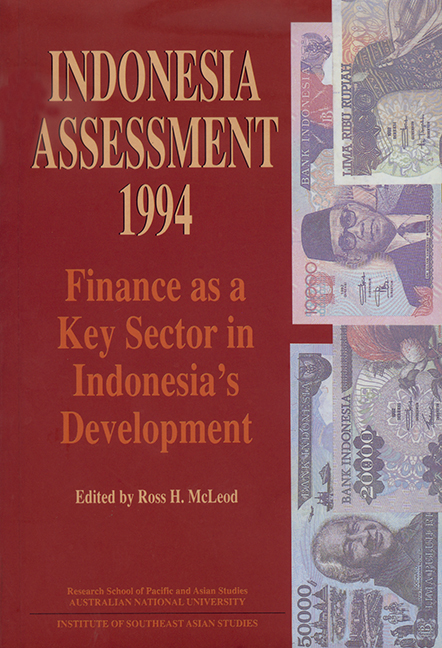
This volume is based on "Indonesia Update 1994", the latest in the series of anual conferences on Indonesia held at the Australian National University. It presents overviews of economic and political developments, together with a collection of papers on the role of the finance sector. Indonesia Assesment 1994 contains the Keynote Address to the conference by Professor Dr Ali Wardhana, Special Adviser to the President, former Minister of Finance, and former Coordinating Minister for Economics, Finance and Industry. Three present or former directors of the central bank joint Professor Wardhana to contribute wide-ranging discussions of the process of financial policy reform as seen from the inside. They are joined by a range of other contributors drawn mainly from academic circle in Indonesia, Australia and elsewhere, and some from the private sector. Indonesia Assesment 1994 provides the most complete available coverage of the current state of the financial sector in Indonesia and the policies which affect it. This volume will be an invaluable reference for policy-makers, academics, and all those interested in the finance sector and in economic and political developments in Indonesia. The editor is a Fellow at the ANU's Indonesia Project, with many years of research and consulting experience in the Indonesian financial system.
Born in Malacca in 1918, Dr Goh Keng Swee reached maturity at a time when European colonialism was breathing its last. By the time this keen-eyed Malayan became self-governing Singapore's first Minister of Finance in 1959, he had made a name for himself as the colony's foremost social scientist, having carried out groundbreaking surveys on urban poverty and housing. He immediately initiated pioneering projects that laid the ground for the island's economic success. When Singapore separated from Malaysia in 1965, Dr Goh took charge of building an army from scratch.His contributions to the infrastructure of Singapore in the fields of Finance, Defence and Education are well recorded. What is less understood was the man's legendary practical sense. This work avoids reliance on secondary accounts and concentrates strongly on Dr Goh's own words to comprehend his potent and proactive powers of reasoning, and in the process captures the history of Singapore as well.
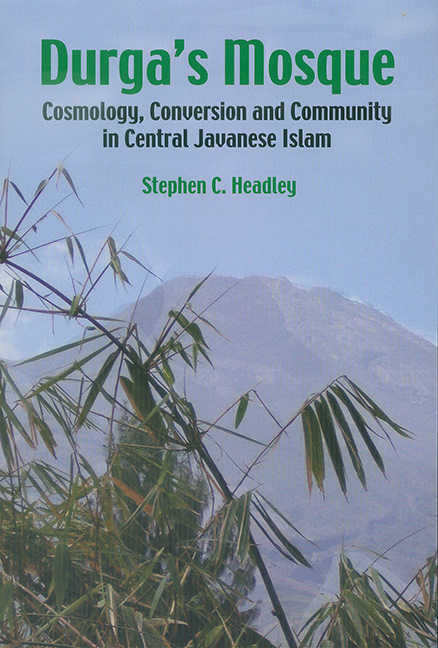
For two decades now, Stephen C. Headley has been one of the most original and systematic ethnographers of Javanese religion and cultural history. No one in contemporary Javanese ethnography has combed through the annals of nineteenth and twentieth century scholarship with as careful an eye for the variety of Javanese traditions. None combines this historical ethnography with as careful and unusual body of contemporary ethnography. Headley's new book brings these long-developed skills to bear on contemporary religious change in the Surakarta region of Central Java. In his analysis of the Durga ritual complex, Headley sheds light on one of the most unusual court traditions to have survived in an era of deepening Islamization. Headley's analysis of this ritual complex, and its implications for our understanding of popular Javanese religion, deserves to be read by all serious students of Java, as well as anyone interested in religion in Indonesia. However, Headley moves well beyond this unusual ritual complex, to take us through the twists and turns of religious culture and politics in what is one of the richest but also most troubled of cultural regions in Java. The result is a rich, multi-layered, and fascinating study, one that changes forever our understanding of Javanese tradition in a Java becoming Islamic. Robert Hefner, Institute on Religion and World Affairs, Boston University.
In the first edition, the themes of hope, optimism, and progress of neoliberalism were examined in Asia and America. The second edition, Globalization: Power, Authority, and Legitimacy in Late Modernity, analyses the new pessimism that has descended on the globalized world. The America that was once the bastion of hope, optimism and progress is now showing clear signs of a superpower in decline. The first sign of the American decline since 1941 in Pearl Harbor was the destruction of the World Trade Center in New York City on 11 September 2001. The other signs are the Vietnamization of Iraq, a nuclear stand-off with North Korea, increasing trade imbalances with China and India, a stalemate with terrorists in Afghanistan, the challenge of European protectionism, a belligerent politics in the Middle East, overt American dependence on fossil fuels, and the mushrooming of various subprime crises into an escalating global recession. This second edition incorporates the latest developments in terms of culture, wealth and terrorism around the world and provides possible solutions to salvage the American Dream.
A bomb attack on a hotel. A bomb in a taxi. Or a bus. Like the London 7 July 2005 bomb attacks. Or if a plot to bomb an MRT station succeeds. How would we react? Would Singaporeans stay calm? And united? Or would ethnic fault lines crack? Building networks of trust in good times is crucial. Building social resilience is important in keeping Singapore united in a crisis. That is what the Community Engagement Programme, or CEP, sets out to do. This book describes the Singapore experience in reaching out to hearts and minds. As we fortify our hearts of resilience, the CEP is a book that continues to be written.
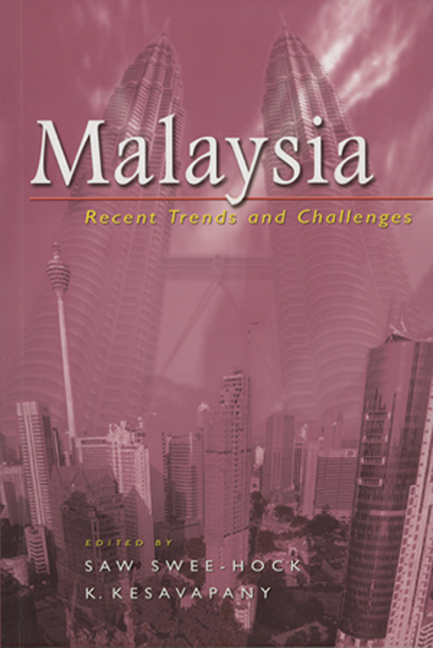
This book documents the trends and challenges that are taking place in the more important sectors of Malaysia. The chapters, written by specialists with an intimate knowledge of the country, cover major topics such as population trends and patterns, Islam Hadhari, Bangsa Malaysia, politics and the 2004 general election, civil service reforms, corporate governance, educational reforms, the impact of globalisation on the economy, and Malaysia's relations with Singapore. Recent developments in these areas are likely to have a profound bearing on Malaysia and its neighbours in the years ahead. The book provides readers with a greater appreciation and a deeper understanding of Malaysia, which is undergoing significant changes and challenges.
This book is a study of the political development of the Malaysian state of Sabah under the administration of Parti Bersatu Rakyat Jelata Sabah (Berjaya – Sabah People's United Party), which controlled the state legislature between 1976 and 1985. It attempts to disentangle the three dominant themes within social scientific studies of Sabah: the issues of federalism, the politics of ethnicity, and the political economy of development. The book argues that the emergence of a developmental discourse under the Berjaya regime in Sabah can largely be traced to its failure to reconcile the localized ethnic politics of Sabah with the demands of a strong central state and thus the need to find an alternative strategy of political support and control. While this strategy proved effective when developmental growth was high during the first Berjaya administration (1976–81), the relative collapse of the state economy from 1982 onwards exposed its ethnic predilections and prefigured declining support for the regime, particularly among the non-Muslim bumiputera groups. Despite the consolidation of federal support for Berjaya under the Mahathir administration, the unravelling of the Berjaya project was by this stage unstoppable. In the final analysis, the attempt to create a more compliant state administration under Berjaya came undone precisely because it failed to take into account the localized dimension of politics in Sabah.
The principal cause of the 1930s depression in Southeast Asia lay outside the region - through a sharp contraction in demand for the region's major commodity exports. But it had important internal causes too: an oversupply of primary commodities and an increasing scarcity of new agricultural land leading to higher rents and lower wages, rising indebtedness and increasing landlessness. This work thoroughly analyses the pre-war depression. It also looks at the changes in the basic structures of the economies of Southeast Asia that were of long-term importance, such as the role of the state in the economy. The authors also draw similarities and contrasts between the 1930s depression and the 1990s Asian crisis.
"Irene Ng has written a book that gives a comprehensive portrayal of Mr Rajaratnam - one of Singapore's outstanding leaders who played a crucial part in the momentous and crisis-ridden transition to independence. This is a book about the man and his wisdom. One would fail to appreciate him until one reads this absorbing book and reflects on the acuity and breadth of his insights and his wisdom." - S. R. Nathan, President of Singapore"In the course of a 33-year career in diplomacy, I met many great leaders. Having done so, I can confidently assert that S. Rajaratnam was one of the greatest leaders I met. Sadly, few in Singapore understand how great Rajaratnam was. This well-researched comprehensive volume by Irene Ng therefore fills a real need. Both Singaporeans and non-Singaporeans will benefit a lot from reading it." - Kishore Mahbubani, Dean, Lee Kuan Yew School of Public Policy, National University of Singapore "Rajaratnam is one of the founding fathers of modern Singapore. He was Singapore's first and longest serving foreign minister. He was a rebel and a revolutionary. He was an intellectual and a man of action. In this wonderful book, Irene Ng tells the story of this remarkable leader of Singapore. I found the book both enjoyable and insightful." - Tommy Koh, Ambassador-At-Large, Singapore
A burgeoning Japanese role in the Asia-Pacific region has been one of the most contentious issues to the Southeast Asian countries in recent years with its positive and negative implications. It is thus timely and significant to come to terms with Japan's "design" in the region from a historical perspective. Attributing Japan's active involvement in Southeast Asian affairs to the proclamation of the so-called Fukuda Doctrine of August 1977, this study traces the origins of Japan's political role in the region and analyses the development and effects of the very first Japanese foreign policy doctrine. As perhaps the most exclusive scrutiny on the Fukuda Doctrine as well as on Japan-ASEAN relations, this study renders a comprehensive history of Japan-Southeast Asia relations in the post-war period.
Despite unprecedented levels of global interconnectedness, little academic attention has been paid to how governments actively deal with the challenges globalization poses for national identity. This book investigates the Singapore Government's approach to the construction of national identity and the shifting ways in which Singapore has been imagined in official discourses.The hallmarks of Singapore's nation-building project have been the state's efforts to manage ethnic differences and ensure the economic well-being of its citizenry. Unlike other global cities which are embedded in a larger nation-state, Singapore is both a global city and a nation-state. Singapore embodies a curious contradiction: while global cities are often theorized as transient spaces, contradictorily, the nation-state needs to be bounded in order to remain viable.This book focuses on the global/national nexus: the tensions between the necessity to embrace the global to ensure economic survival, yet needing a committed population to support the perpetuation of the nation-state and its economic success. It critically explores how the government has been responding to the challenges of globalization through policy initiatives and official rhetoric to create a "space" for affective identification with the Singaporean nation-state and how Singaporeans relate to and articulate their sense of identity and belonging to Singapore within the context of globalization.
This study re-examines some of the issues, challenges and policy options facing the Singapore economy in the light of the 1985-86 recession. Particular attention is paid towards reappraising the role of the government as an entrepreneur in economic activity, in macro-economic management, in savings and investment, and in the labour market. This is done in the context of and alongside an assessment of Singapore's linkages with the global economy and its future comparative advantage in a dynamic international environment.
An early crossroad in life is choosing a field of study at the university. That will lay the foundation for the rest of our lives. This book recorded the career choices of the first batch of 557 engineering graduates from the Nanyang Technological Institute (NTI) as NTU was known in 1985. Engineering was then the only discipline offered. The passage of 25 years yielded deep insights as these pioneers reflected on the impact of their engineering education on their careers.Demonstrating the reach and significance of engineering will arouse the curiousity and imagination of the young, especially those good at maths and science. Our lIfe stories showcase the options open to an engineering graduate. If this book inspires some to take up an engineering education in general and at NTU in particular, it will have achieved its purpose.
This is the most comprehensive account of the internal dynamics of the young intellectual generation of NU advocating for pluralism and democracy within Islam in Indonesia, during Gus Dur's leadership of PBNU. Because of the author's unique vantage point, her sometimes sharp criticism of this movement and its internal dynamics is extremely useful to those who continue to advocate for reform, within NU and in Indonesia generally. - Ahman Suaedy, Executive Director, Wahid Institute, Jakarta"Robin Bush provides an authoritative, insightful and engaging account of the political and intellectual world of Nahdlatul Ulama. She carefully analyses the tumultuous and often tangled dynamics within NU from the 1980s to the post-Soeharto period and unearths deeper historical and cultural resonances in explaining the organisation's outlook and actions. This is a valuable work for anyone seeking to understand contemporary Islamic politics in Indonesia." - Greg Fealy, Fellow and Senior Lecturer in Indonesian Politics, Australian National University, Canberra
This collection of essays has been prepared as a tribute to Clive S. Kessler, Professor of Sociology at the University of New South Wales for over twenty years and a member of staff of the London School of Economics and Political Science, University of London, and the Barnard College, Columbia University, New York. Written by colleagues and graduate students, the essays are divided into three sections: Islam, Society and Politics. They focus on Professor Kessler's analyses of Malaysia. Each essay draws on aspects of his published research, taking his insights as points of departure for new studies. Professor Kessler's ideas and observations are thus extended, complemented and updated in ways which emphasize the depth and extent of his influence on contemporary research on Malaysia.
There are a number of excellent studies by eminent Myanmar economists as well as scholars from abroad covering different post-war periods and/or various aspects of development in Myanmar. What this book does is to bring them altogether, as it were, under one roof by recasting bits and pieces of their work according to the author's own understanding. In doing so, a holistic approach was adopted in order to have a well-rounded account of developments over the past fifty years or more. In addition, an attempt has also been made to present the major developments at different periods of time between 1948 and 2000 in a simple, but not over simplified, reader-friendly format so as to reach as wide an audience as possible. It is the author's ardent wish that not only students and policy-makers, but Myanmar people in all walks of life will read the book, discuss it, and work together for a better future.
"This is an excellent book which will have a major impact on the current debate about the relationship between Islam and politics in Indonesia. Its greatest strength is its innovative characterization of three Indonesian Muslim models of polity, as opposed to the normal two, Islamic state and secular state. Assyaukanie brilliantly delineates a third model, which he calls the Religious Democratic State, in the process greatly clarifying our understanding of the previous models, which he now proposes to label the Islamic Democratic State and the Liberal Democratic State. Another strength of the book is methodological. Each of its arguments is solidly grounded in the thoughts and actions of particular players, Indonesian Muslim thinkers and activists." - Professor R. William Liddle, Ohio State University, United States of America
Indonesia is the world's largest archipelagic state. In 2001 it embarked on a "big bang" decentralization involving a major transfer of administrative, political and financial authority to its districts, now numbering more than 500. Together with the rapid transition from authoritarian to democratic rule in the late 1990s, this initiative has transformed the country's political, social and business life. While national government is the major area of contestation, power has shifted irreversibly away from the centre. How this significantly increased regional autonomy works will have a crucial bearing on the future of the Indonesian nation-state.This volume features contributions by over 40 writers with deep expertise on Indonesia. The book provides a timely, comprehensive and analytical assessment of the country's regional development dynamics in the post-decentralization environment. It explores historical, political and development patterns at the regional level; the relationship between decentralization and governance; local-level perspectives; migration, cities and connectivity; and the challenges confronting the peripheral regions of Aceh and Papua.