To save content items to your account,
please confirm that you agree to abide by our usage policies.
If this is the first time you use this feature, you will be asked to authorise Cambridge Core to connect with your account.
Find out more about saving content to .
To save content items to your Kindle, first ensure no-reply@cambridge.org
is added to your Approved Personal Document E-mail List under your Personal Document Settings
on the Manage Your Content and Devices page of your Amazon account. Then enter the ‘name’ part
of your Kindle email address below.
Find out more about saving to your Kindle.
Note you can select to save to either the @free.kindle.com or @kindle.com variations.
‘@free.kindle.com’ emails are free but can only be saved to your device when it is connected to wi-fi.
‘@kindle.com’ emails can be delivered even when you are not connected to wi-fi, but note that service fees apply.
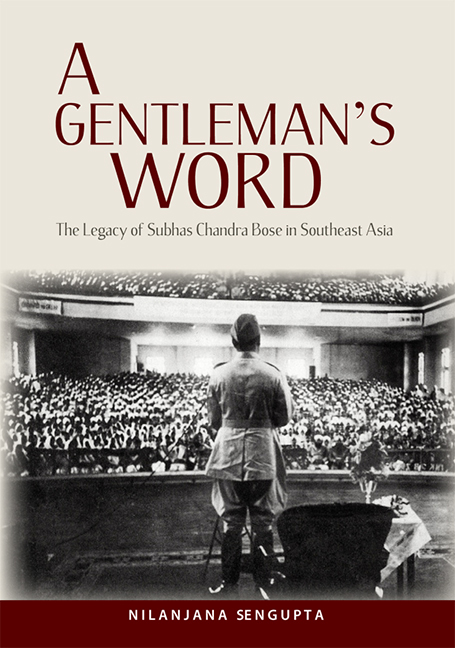
The great Indian nationalist leader Subhas Chandra Bose arrived in Singapore in 1943 to revitalize the Indian National Army (INA). Taking the opportunity of the Japanese occupation of parts of Southeast Asia, he launched armed struggle against British colonial rule in India. Two years later, that attempt failed at the eastern gates of India. Yet, it was a temporary failure because the INA helped set in motion a series of developments within India. These would culminate in its freedom in a further two years. Bose is household name in India. He is remembered in Southeast Asia as well, particularly among Indians. However, while his contributions to India's independence movement have been recorded exhaustively, less is known about the legacy that he left behind in Southeast Asia.This book seeks to fill that gap in the international understanding of a great Indian nationalist and pan-Asianist. It records how participation in the nationalist struggle invested Southeast Asian Indians with a rare sense of dignity and helped foster a mushrooming of militant trade unions, making it difficult for the returning British planters to perpetuate their control over what had been a docile workforce. The INA's Rani of Jhansi movement proved to be a pioneering effort at drawing Southeast Asian Indian women out of their traditional roles and expectations. It inspired some of them to take up mainstream roles for the cause of equality and emancipation. A Gentleman's Word retraces this journey of self-discovery of those who were inspired by Subhas Chandra Bose.
Realpolitik Ideology presents path-breaking research on the Indonesian military (TNI) going beyond traditional scholarship on the TNI's dual function or dwifungsi which has been one of the dominating fields of analysis in Indonesian studies since the 1970s. Addressed to political scientists, sociologists, historians, anthropologists and defence practitioners, this book interprets security policy in terms of its social roots asserting that the realpolitik behaviour of the TNI has strong 'socio-cultural' undertones, which in turn shape the development of military doctrine. The argument made in the book is that only through a better understanding of the doctrines that reinforced the military's significant presence in Indonesian affairs and their subsequent restructuring can Indonesia's policy-makers attempt meaningful reform of the TNI. Readable, accessible and yet exhaustively researched, Realpolitik Ideology examines the origins and development of ideas on security from the point of view of the TNI and explains why civil/military relations are still fraught with uncertainty, and why the recent changes in military ideology, removal of military posts in the legislature, ongoing divestment of its business, and other measures still do not guarantee that the military will not intervene in the affairs of state. Among its many valuable contributions, this book details: - the background to Indonesian concepts of national security - internal operations and the weak infrastructural power of the state, with an excellent discussion on the intelligence agencies- concepts for external defence, according to the TNI, including Indonesia's important but little-known contribution to UN peacekeeping missions- defence and national security planning - the most recent laws relating to national security and the role of the military in Indonesia. Realpolitik Ideology offers suggestions about how to redefine concepts of national security to increase civil and democratic space and accountabilities and redress the historic imbalances between the civilian government and the military in Indonesia.
The argument here is that, although Indonesia would appear to be the natural leader in Southeast Asia, it has been singularly unsuccessful in putting its stamp on ASEAN. If anything, ASEAN has been put on Indonesia's bebas dan aktif (independent and active) foreign policy stamp through Indonesia's deference to self-constructed obligations to ASEAN solidarity and consensus. ASEAN's political incoherence on regional security matters suggests that, for Indonesia, strategic independence from the immobilism of ASEAN decision making would put bebas dan aktif back into play in pursuit of Indonesian national security interests.
With a distinguished career spanning more than four decades, Professor Desmond Ball is one of the world's greatest scholars of strategy and defence, Australia's home-grown giant. In this collection of essays, leading political, media and academic figures, including former United States President Jimmy Carter, pay tribute to his remarkable contributions. From a base at the Australian National University in Canberra, Professor Ball has unflinchingly researched topics from Cold War nuclear strategy and the defence of Australia to spy scandals and Southeast Asian paramilitaries. His roaming intellect, appetite for getting the facts and commitment to publishing on sensitive topics ensure he is a towering figure who has provided impeccable service to Strategic Studies, the Asia-Pacific region and the Australian community.
Singapore is America's closest security partner in Southeast Asia. The United States has decided to help India become a major world power in the twenty-first century, an objective that is furthered by the nuclear agreement between them. Singapore's relationship with India is an increasingly pertinent feature of Southeast Asia's political and strategic landscape. Whether these three realities, taken together, lay the basis of a triangular relationship among Singapore, America, and India is the question that this book seeks to answer. The book begins with a review of the notion of Pax Americana and goes on to describe the state of bilateral relations among the three countries as they have evolved since the end of the Cold War. Subsequently, it analyses three core issues – the Global War on Terror, the rise of China, and the agency of democracy in international relations – that play a defining role in relations among Singapore, the United States, and India. The book concludes by suggesting some directions in which these relations might move.
“Different under God is the first substantial, comprehensive and scientific analysis of Christianity in Singapore, covering religious, social and political attitudes. This survey by Terence Chong and Hui Yew-Foong will be enthusiastically welcomed by today’s sociologists and historians in the future. An important and timely contribution to the sociology of religion and to the study of Singapore.”—Bryan S. Turner, Presidential Professor of Sociology, the Graduate Centre, the City, University of New York, USA“This is a landmark study of Christianity in Singapore that is sorely needed today, not only to confirm many scholarly guesses, but also to dispel public stereotypes of Christians as homogeneously sheep-like or militant. Scholars and Singaporeans beware, Terence and Yew-Foong have started a fire that will enliven public discourse on religion and society for years to come.”—Daniel P.S. Goh, Assistant Professor of Sociology, National University of Singapore“Analysing individual and discussion-group responses from churchgoers in both mainline denominations and independent churches, this study grapples with a number of highly-relevant, even sensitive issues in contemporary Christianity: issues of moral values and attitudes (including those on sexuality and sexual orientation), money and giving, organizational belonging, governance, and others. While some of the findings and conclusions may reinforce broad perceptions of Christianity and churches in Singapore, others were quite eye-opening. Also useful for researchers, the study contains important data on respondents’ socio-economic backgrounds. All in all it is a most welcome scholarly contribution, and I expect that it will be a well-cited resource for future scholarship.” —Robbie B.H. Goh, Professor of English Literature, National University of Singapore
This book is the first on the history of the marine fisheries of Southeast Asia. It takes as its central theme the movement of fisheries into new fishing grounds, particularly the diverse ecosystems that make up the seas of Southeast Asia. This process accelerated between the 1950s and 1970s in what the author calls 'the great fish race'. Catches soared as the population of the region grew, demand from Japan and North America for shrimps and tuna increased, and fishers adopted more efficient ways of locating, catching, and preserving fish. But the great fish race soon brought about the severe depletion of one fish population after another, while pollution and the destruction of mangroves and coral reefs degraded fish habitats. Today the relentless movement into new fishing grounds has come to an end, for there are no new fishing grounds to exploit. The frontier of fisheries has closed. The challenge now is to exploit the seas in ways that preserve the diversity of marine life while providing the people of the region with a source of food long into the future.
This book takes a multi-disciplinary approach to the great financial crisis of 2007-09. It combines the disciplines of economics, finance, sociology and politics to analyse the causes, consequences and challenges of the crisis. The authors propose that the causes of the crisis should be understood at three inter-related levels - the level of theory and ideology; the level of financial industry practices and malpractices; and finally the level of structural imbalances in the international economy. Above all, the book is historical and holistic in perspective. This book is an excellent read for the critical layman interested in understanding the causes that underlie the global financial crisis. The authors combine the inquisitive and critical mind of a scholar and the lucid writing style of a journalist. The book provides a perspective on the crisis that is both practical and down to earth and at the same time, rigorous and holistic. Khor Hoe Ee, Chief Economist, Abu Dhabi Council for Economic Development, and former Assistant Managing Director, Economics, Monetary Authority of Singapore The authors trace the rise of finance and its domination over the real economy, the consequences of financial innovation and deregulation for systemic fragility, and the failure of conventional economic and financial theory to analyse and anticipate the consequent dangers. Their main original contribution is to relate these Western market developments to recent trends in the East Asian region and to call for appropriate systemic reforms, not only to avoid similar future crises, but also to address other underlying development and analytical problems. K.S. Jomo, Assistant Secretary General, Department of Economic and Social Affairs, United Nations In linking wealth and income distribution to financial instability, this book makes an important point that is often missed in the debate on the crisis. Central Banks have become strongly opposed to the idea of accommodating wage demands with the help of monetary easing, but they have been increasingly tolerant, or even supportive, of debt-financed consumption and asset inflation. Indeed, by serving to concentrate wealth further in the hands of a small rentier class, while protecting that class from the risks of debt defaults, they are only adding to systemic pressures that give rise to serious financial crises.Yilmaz Akyuz, Special Economic Advisor, South Centre, and former Chief Economist at United Nations Conference for Trade and Development
This book deals with Singapore's transition from a British Crown Colony to a state in the Federation of Malaysia, and expulsion from the Federation to become a separate independent nation. For the leaders of Singapore's PAP Government, Malaysia was a traumatic experience. Yet, but for it, they might never have found the resolve and the secret of building this extraordinary nation, this nation based on Singapore alone that they and an entire generation had once believed an impossibility.This story of nation-building deals with topics on national (army) service, economic development, education in schools and in universities, housing and home ownership. It deals also with issues of ethnicity and national identity in the context of challenges from within and without, in the latter case from globalization and global Islamism.
Indonesia is the world's largest archipelagic state, with more than 18,000 islands and over 7.9 million square kilometres of sea. The marine frontier presents the nation with both economic opportunities and political and strategic challenges. Indonesia has been affected more than most countries in the world by a slow revolution in the management of its waters. Whereas Indonesia's seas were once conceived administratively as little more than the empty space between islands, successive governments have become aware that this view is outmoded. The effective transfer to the seas of regulatory regimes that took shape on land, such as territoriality, has been an enduring challenge to Indonesian governments. This book addresses issues related to maritime boundaries and security, marine safety, inter-island shipping, the development of the archipelagic concept in international law, marine conservation, illegal fishing, and the place of the sea in national and regional identity.
This book is an innovative analysis of regime maintenance and transformation in Malaysia. It goes beyond familiar approaches centred on communal politics, or the corporate workings of Malaysia Inc., to stress the importance of power maintenance -- tracing a path from consociational bargaining, to authoritarian UMNO dominance, to Dr Mahathir's personal dominance.
Prof Leong Wai Kum not only demystifies the provisions of the Women's Charter, she also situates the Charter in Singapore's political context at the time. The author gives a balanced view of the Charter by highlighting the progressive provisions as well as its shortcomings. Outstanding is her personal view that the Charter provides a moral view of marriage as being "an equal cooperative partnership of different efforts". She also holds the view that the Charter elevates the status of women as it gives equal importance to women's unpaid work and men's paid work. The Charter enshrines and elevates the institution of marriage. At the same time it also gives the reader an impression of the state's approach to familial relationships. This is a must read book for those who are interested in gender issues. Cheng U Wen Lena Founder Member and 1st President of AWARE The author affirms the primacy of the Women's Charter as a radically progressive legislation ahead of its time in the ideals that guided the drafters and in regulating family law in Singapore. It provides thoughtful, practical suggestions, invaluable insights, rationalises the provisions of the Charter, comments on its many strengths and some of its shortcomings. Perhaps the most valuable and appealing insight that the author highlights is that the Charter offers a moral message that calls on men and women to treat each other as equal partners, discharge their obligation jointly and generally behave with consideration towards one another. I would encourage all those planning to get married to study The Singapore Women's Charter: 50 Questions. Constance Singam Writer, Social Activist, Past President of AWARE The Women's Charter is arguably one of Singapore's most important pieces of legislation as it fundamentally altered the social fabric of the country. It also has a very real and direct impact on the lives of many Singaporeans today. This book is therefore to be warmly welcomed as it deals with 50 questions that are commonly asked about the Women's Charter. Written in a clear, succinct and yet scholarly manner by Singapore's leading family law academic, the book will be helpful to Singaporeans who either need to understand the Charter better or who have an interest in how the law seeks to regulate the institution of marriage in Singapore. Prof Tan Cheng Han Dean of Law Faculty, National University of Singapore This book is a clear and concise guide to how the Women's Charter protects women and families in Singapore. It looks behind and beyond the word of the law to consider the effect and effectiveness of the statute. Undoubtedly the book is a useful tool for understanding how this legislation helps strengthen and preserve the Singapore family. Laura Hwang President, Singapore Council of Women's Organisations
In this book, the focus is on how developing economies in Southeast Asia ride on the wave of globalization that brings about benefits and economic growth with expanding trade and investment linkages. The central concept used in this study is production networks and industrial clusters. With examples from Indonesia and Malaysia (electronics industry), Singapore (biomedical science industry), and Thailand (automotive industry), the book explains how production networks and industrial clusters have played crucial roles in their industrial development.This book also discusses the progress of regional economic cooperation as well as the development of supply chain management and logistics in Southeast Asia, which facilitate the extension of production networks into a broader area.
This study of the so-called "Green Revolution" in the rice bowl region of Malaysia aims to provide an interpretation of recent changes in the Malaysian agrarian structure, and to make an analytical and theoretical contribution to the long-standing intellectual debate on the "agrarian question". By joining the micro-world of household social structure and economy to the macro-world of changes in production relations, it traces out a specific trajectory of agrarian development in Malaysia.
This book focuses on the defence policy of the Nakasone administration and attempts to provide an explanation for the policy measures which its administration implemented or initiated. It suggests that the widening disparity between economic interests and political power forced Japan to review the traditional bases for defence policy making and prompted the search for a balance that would allow the country a more active role in the international sphere. The book is organized around the central theme that Nakasone's defence policy can be understood as an attempt to rehabilitate Japan as a 'normal' state and end the state of affairs that had relegated it to a unique, and low, position.
The Republic of Korea's global expansion has been mirrored by its interest and presence in Southeast Asia. From trade, investment, aid, tourism, to the cultural "Korean wave", its various roles have blossomed and its influence has grown. The ASEAN region has not only affected Korean foreign policy, but also many aspects of Korean life, from the migration of Southeast Asian industrial workers to marriages and the curricula of academic institutions. This volume explores various aspects of these new relationships and their importance to all concerned parties. It brings together a group of specialists who have documented the growing interlocking roles between Korea and ASEAN and its constituent states in detail. These developments have profound implications for relations in the East and Southeast Asian regions, and for the world as a whole.
The creation of a national school of Islamic law in Indonesia has been on the legal agenda for the past fifty years. This book is a summary of what has been achieved. The material shows us a complex range of references for syariah. These include the formal structures of a "new fiqh", philosophies of law, transmissions of syariah through tertiary curricula and the Friday sermon in mosques, a bureaucratic form for conducting the Hajj, and contemporary debates on syariah values as expressions of public morality. Together these references indicate just how elusive the meaning of syariah has become in contemporary Indonesia.
The book analyses modern tendencies in the development of regional economic cooperation in East Asia which is considered by regional countries as their response to growing challenges of globalization. Trying to protect their national interests by collective efforts they are promoting regional commercial, investment, and financial cooperation as measures aimed at improving the efficiency of their economies. These steps however are not regarded as a counterweight to globalization but merely directed against most negative manifestations of the latter and in fact are realized as one of the forms of globalization at the regional level.
"This book entitled ASEAN-U.S. Relations: What Are the Talking Points? is a result of a workshop organized by the ASEAN Studies Centre of the Institute of Southeast Asian Studies. The workshop was timely then, as the two sides, all of ASEAN, and the United States held their first-ever summit in Singapore in November 2009, heralding a new era of renewed engagement. The United States is very important for ASEAN, as a guarantor of regional stability and a vast market for ASEAN products. At the same time, ASEAN has gained more public attention from the United States, particularly since the advent of the Obama administration. This publication will serve as a reminder that ASEAN and the United States have shared many benefits as well as concerns for many years. Their continued engagement will undoubtedly ensure regional peace and order. I highly recommend this book to those who are interested in ASEANs external relations." –Professor Charnvit KasetsiriFormer Rector of Thammasat University and Visiting Professorial Fellow, ISEAS"Much has been made in the last few years of Washington's 're-engagement' with ASEAN, warmer ties with several Southeast Asian states, and the review of U.S. policy towards Myanmar. What explains this change and where are U.S.-ASEAN ties headed in the future? This timely collection of short essays and speeches by eleven leading academics and senior officials provides valuable background to what it calls a 'new era' in U.S. policy and thoughtfully explores where future challenges and opportunities might lie. The chapters are practically focused and forward looking, offering critical perspectives as well as policy recommendations. Covering security issues, aid, Myanmar, the South China Sea, and the evolving U.S. role in regional institutions, ASEAN-U.S. Relations: What Are the Talking Points? will be essential reading for anyone wanting to understand the changing dynamics of American policy in Southeast Asia."– Dr David CapieSenior Lecturer in International RelationsVictoria University of Wellington, New Zealand
Democratization in Indonesia has altered the political decision-making processes in many ways. It has also brought about tremendous change to the role of the Indonesian parliament in the country's political system. Once characterized as a powerless rubber stamp, the parliament has developed into a comprehensive and more representative body able to fulfil its functions more adequately. In the literature on democratic transition, the impact of parliaments on regime changes and on the democratic reorganization of the most important state institutions and regulations is usually neglected. In the Indonesian case, however, the national parliament was one of the most decisive actors and is therefore the focus of this book. The author analyses the parliament's contribution towards the process of democratization. Thus, this book contributes not only to research on the Indonesian democratization process, but also to the comparative research on parliaments in transition processes in general.