Most cited
This page lists all time most cited articles for this title. Please use the publication date filters on the left if you would like to restrict this list to recently published content, for example to articles published in the last three years. The number of times each article was cited is displayed to the right of its title and can be clicked to access a list of all titles this article has been cited by.
Contents
- Cited by 1

Strongly nonlinear waves in an axisymmetric jet of ferrofluid surrounded by a non-magnetisable fluid
-
- Published online by Cambridge University Press:
- 29 December 2025, A10
-
- Article
-
- You have access
- HTML
- Export citation
- Cited by 1
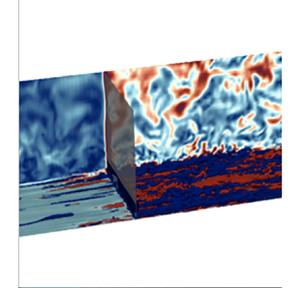
Flat plate boundary layer accelerated by shock wave propagation
-
- Published online by Cambridge University Press:
- 07 December 2022, A20
-
- Article
-
- You have access
- HTML
- Export citation
- Cited by 1
Wave boundary layers in a stratified fluid
-
- Published online by Cambridge University Press:
- 07 November 2017, pp. 512-537
-
- Article
-
- You have access
- HTML
- Export citation
- Cited by 1

Acoustic microstreaming and shear stress produced by the interaction of an oscillating gas bubble with a viscoelastic particle
-
- Published online by Cambridge University Press:
- 03 April 2025, A24
-
- Article
-
- You have access
- HTML
- Export citation
- Cited by 1
Impulsively started flow separation in wavy-walled tubes
-
- Published online by Cambridge University Press:
- 25 March 1998, pp. 1-22
-
- Article
-
- You have access
- Export citation
- Cited by 1

Inferring activity from the flow field around active colloidal particles using deep learning
-
- Published online by Cambridge University Press:
- 27 August 2025, R1
-
- Article
-
- You have access
- HTML
- Export citation
-
Active colloidal particles create flow around them due to non-equilibrium processes on their surfaces. In this paper, we infer the activity of such colloidal particles from the flow field created by them via deep learning. We first explain our method for one active particle, inferring the
 $2s$ mode (or the stresslet) and the
 $3t$ mode (or the source dipole) from the flow field data, along with the position and orientation of the particle. We then apply the method to a system of many active particles. We find excellent agreements between the predictions and the true values of activity. Our method presents a principled way to predict arbitrary activity from the flow field created by active particles.


- Cited by 1
A pulsating sphere in a rotating fluid
-
- Published online by Cambridge University Press:
- 28 March 2006, pp. 571-576
-
- Article
- Export citation
- Cited by 1

Physical aspects of Tollmien–Schlichting wave acoustic receptivity due to sharp-edged rectangular bumps and gaps investigated via subsonic high-fidelity simulations
-
- Published online by Cambridge University Press:
- 28 April 2025, A59
-
- Article
-
- You have access
- HTML
- Export citation
-
The acoustic receptivity of Tollmien–Schlichting (TS) waves due to two-dimensional sharp-edged rectangular bumps and gaps in a compressible boundary layer was investigated by direct numerical simulations. The conclusions were based on a new procedure proposed for obtaining the receptivity amplitudes which appeared to be more robust and accurate than previous ones. The procedure is particularly important for the correct evaluation of the receptivity of gaps. The receptivity amplitudes for gaps were smaller than those for bumps, except for the nominally zero height/depth roughness element, where, consistent with a linear behaviour, they had the same absolute value. The procedure also revealed in detail the behaviour in the region downstream of the roughness element where the TS wave is formed (the formation region). This region extends for approximately
 $50\delta ^*_{b}$, regardless of bump height or gap depth. For bumps, the receptivity scaled superlinearly with bump height while for the gaps it scaled sublinear with depth. This behaviour is associated with the different velocity profiles caused by bumps and gaps in the formation region. We also discussed issues regarding comparison with experiments. Investigation of the effect of compressibility confirmed that, in the subsonic regime, the receptivity reduces with Mach number. Finally, we addressed the receptivity scaling with the acoustic wave amplitude. It was found that the receptivity scales linearly with the acoustic wave amplitude in a range for which experiments available in the literature indicated a superlinearly scaling. Reasons for these conflicting results are discussed.

- Cited by 1

On the convection velocity in high-Reynolds-number pipe flow
-
- Published online by Cambridge University Press:
- 15 December 2025, A24
-
- Article
-
- You have access
- HTML
- Export citation
-
The convection velocity in high-Reynolds-number pipe flow was investigated using two-point correlations obtained from two laser Doppler velocimetry systems. The Reynolds number ranged from
 ${\textit{Re}}_{{\tau}}=3000$ to 20 800, and profiles were obtained from
 $y/R=0.002$ up to the pipe centre, where
 $R$ is the pipe radius. This study examines the scaling behaviour of convection velocity profiles derived from raw velocity signals, and the convection characteristics of very large-scale motions (VLSMs) and large-scale motions extracted via scale-separated or time-resolved velocity signals. The profiles show that convection velocities from raw signals exceed the local mean velocity near the wall and gradually approach it toward the centre. These profiles can be scaled using inner variables, namely
 $y^+$ and
 $\Delta x^+$, where
 $\Delta x^+$ represents the measurement distance. Scale-separated convection velocities for VLSM-scale structures – defined as those larger than
 $5R$ – were higher than the unfiltered values and remained nearly constant up to
 $y^+ \leq 2000$ at
 ${\textit{Re}}_{{\tau}} \approx 20\,000$. In this constant region, the convection velocity of VLSMs scaled well with the bulk velocity
 $U_{\textit{b}}$, taking values of approximately
 $0.85U_{\textit{b}}$. Furthermore, analysis of the time-resolved data highlights that, when applying Taylor’s frozen turbulence hypothesis, it is essential to consider both the scale dependence and the temporal fluctuations of the convection velocity, which reflect the underlying spatio-temporal dynamics of the flow structures. The present study provides valuable data for discussions on converting frequency-domain measurements into wavenumber space using Taylor’s hypothesis.


- Cited by 1

Wall-initiated premixed gas-phase flame: A new flame propagation regime in mixtures below the flammability limit and its relation to the Stefan phase-transition propagation problem
-
- Published online by Cambridge University Press:
- 01 October 2026, A7
-
- Article
-
- You have access
- HTML
- Export citation
-
A new mode of flame propagation from a wall in a mixture below the flammability limit is described. We consider a simple chemistry model in which the reaction rate vanishes for temperatures below some critical cutoff value. Two models for flame initiation by the wall are considered. The first model assumes heat release by the wall over a finite time, after which it becomes adiabatic. The second model assumes that the wall temperature changes according to a given law. Unlike the standard flame propagation mode, in which the flame propagates at a constant velocity through the unburned mixture, and which is not possible under the considered conditions, in the new mode the flame moves at a speed inversely proportional to the square root of time. It is found that the value of the fuel Lewis number,
 $\textit{Le}$, is determinant: the new mode of propagation exists only if
 $\textit{Le}\lt 1$. The influence of thermal expansion on the existence of this new propagation regime is investigated. It is interesting to note that the flame structure resembles the classical Stefan solution for phase-transition front propagation. However, the fundamental difference is that in the classical phase-transition front propagation problem the Lewis number is infinite, in our nomenclature, while the new flame propagation regime arises at
 $\textit{Le}\lt 1$.


- Cited by 1
FLM volume 781 Cover and Back matter
-
- Published online by Cambridge University Press:
- 06 October 2015, pp. b1-b8
-
- Article
-
- You have access
- Export citation
- Cited by 1

Mechanism of the wavy leading edge on reducing the self-noise from a cambered airfoil at a moderate Reynolds number
-
- Published online by Cambridge University Press:
- 07 July 2026, A26
-
- Article
-
- You have access
- HTML
- Export citation
- Cited by 1
FLM volume 897 Cover and Front matter
-
- Published online by Cambridge University Press:
- 29 June 2020, p. f1
-
- Article
-
- You have access
- Export citation
- Cited by 1
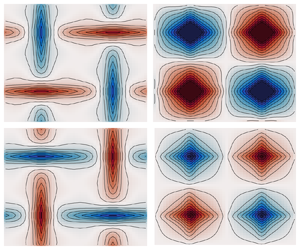
Ineffective diffusivity
-
- Published online by Cambridge University Press:
- 02 October 2023, F1
-
- Article
-
- You have access
- HTML
- Export citation
- Cited by 1

Shear viscosity of bubble suspensions under time-varying pressures
-
- Published online by Cambridge University Press:
- 23 March 2026, A33
-
- Article
-
- You have access
- HTML
- Export citation
-
The rheology of bubble suspensions is critical for the prediction and control of bubbly flows in various industrial processes. It is well known that bubble suspensions exhibit shear-thinning behaviour due to bubble shape deformation under pure shear, but the shear rheological response to dilatation under time-varying pressure remains unexplored. Here, we propose a constitutive equation for dilute bubble suspensions that accounts for both shear and dilatational effects, demonstrating that bubble compressibility can significantly influence the shear viscosity under time-varying pressures. Under constant-rate pressure variations, compression leads to a progressive reduction in viscosity, whereas decompression induces an increase. This peculiar compression-thinning behaviour arises microscopically from the fact that a shrinking bubble surface effectively weakens the flow resistance of the surrounding liquid. Under oscillatory pressure, the amplitude of the dilatation-induced viscosity grows with frequency, and the phase shift of the shear stress response transitions from
 $-\pi /2$ to
 $-\pi$. Notably, viscosity troughs emerge during oscillation cycles, leading to transient flow resistance lower than that in pure shear, indicating a potential route for drag reduction when combined with shear-thinning. These findings highlight bubble compressibility as a controllable factor for tuning bubbly flow rheology, with potential for enhanced flow efficiency in practical applications.


- Cited by 1

Collective behaviour of clusters of free-to-move cylinders in the wake of a fixed cylinder
-
- Published online by Cambridge University Press:
- 21 May 2026, A31
-
- Article
-
- You have access
- Open access
- HTML
- Export citation
- Cited by 1
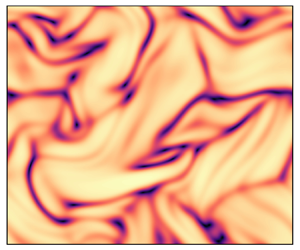
Variational bounds and nonlinear stability of an active nematic suspension
-
- Published online by Cambridge University Press:
- 30 May 2024, A5
-
- Article
-
- You have access
- HTML
- Export citation
- Cited by 1

PROFESSOR PAUL H. STEEN 22 July 1952 – 4 September 2020
-
- Published online by Cambridge University Press:
- 05 January 2021, E1
-
- Article
-
- You have access
- HTML
- Export citation
- Cited by 1
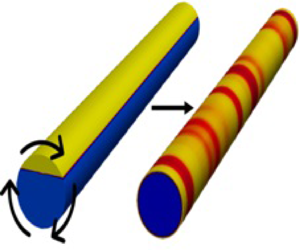
Mechanism for axial pattern formation of concentrated suspension in a horizontal rotating cylinder
-
- Published online by Cambridge University Press:
- 16 April 2024, A8
-
- Article
-
- You have access
- Open access
- HTML
- Export citation
-
We have performed numerical simulations to investigate the phenomenon of axial pattern formation exhibited by a non-neutrally buoyant concentrated suspension. Continuum modelling of the concentrated suspension is done using the suspension balance model to identify the underlying mechanism of the phenomenon. We demonstrate that axial concentration variations become amplified to axial bands owing to the influence of the second normal stress difference (
 $N_2$), and the first normal difference (
 $N_1$) accentuates the effect of
 $N_2$. We demonstrate that the end walls of the rotating cylinder are necessary to prevent the smearing out of axial bands but are not a direct cause of the phenomenon.


- Cited by 1

Influence of plume activity on thermal convection in a rectangular cell
-
- Published online by Cambridge University Press:
- 04 May 2026, A41
-
- Article
-
- You have access
- HTML
- Export citation
-
We present three-dimensional direct numerical simulations of turbulent Rayleigh–Bénard convection in a closed rectangular box whose width
 $L_y$ and length
 $L_x$ are 0.8 and 2.4 times the height
 $H$, respectively. The Rayleigh number
 $\textit{Ra}$ varies from
 $10^5$ to
 $10^{10}$, and the Prandtl number is unity. The advantages of the present configuration are: (a) a relatively stable unidirectional large-scale circulation, consisting of two counter-rotating rolls, fills the cell and fixes the thermal plume ejection- and shear-dominated regions, in contrast to those in closed cylindrical cells. (b) The regions of plume ejection are essentially independent of the sidewalls so that their autonomous existence can be studied. This is because there is some space, or ‘fetch’, for the velocity and thermal boundary layers to develop along the length. (c) This geometry allows one to study the influence of locally thin and thick boundary layers (which follow larger or smaller plume activity) on the scaling of convection properties. In regions of larger plume activity (defined by an incessant movement of plumes), the temperature fluctuation as well as the normalised thermal and viscous dissipation rates decay more slowly with
 $\textit{Ra}$ than in regions of lower activity. Both viscous and thermal boundary layers thin down rapidly with increasing distance from the plume ejection region. The local thicknesses of both boundary layers decline more rapidly with
 $\textit{Ra}$ in the ejection region than in regions of impact and shear, where they are similar to each other. Despite these details, the global heat transport laws are practically the same as those in other configurations of low to moderate aspect ratios.


