Most cited
This page lists all time most cited articles for this title. Please use the publication date filters on the left if you would like to restrict this list to recently published content, for example to articles published in the last three years. The number of times each article was cited is displayed to the right of its title and can be clicked to access a list of all titles this article has been cited by.
Contents
- Cited by 29
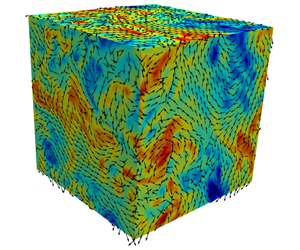
Inverse cascade of energy in helical turbulence
-
- Published online by Cambridge University Press:
- 18 May 2020, A13
-
- Article
-
- You have access
- HTML
- Export citation
- Cited by 29

Analysis of unsteady flow effects on the Betz limit for flapping foil power generation
-
- Published online by Cambridge University Press:
- 14 September 2020, A30
-
- Article
-
- You have access
- HTML
- Export citation
-
A control volume based analytical method for calculating the efficiency
 $\eta$ of flapping foil power generators was developed for single and tandem foil configurations. Ignoring unsteady effects and non-uniform pressures resulted in theoretical limits identical to the Betz (
 $\eta =16/27$ for a single turbine) and Newman (
 $\eta =16/25$ for tandem turbines) limits. Inclusion of unsteady flow and non-uniform pressure distributions produced theoretical efficiency maxima in excess of these limits. Simulation of single and tandem foil cases to determine the magnitude of these effects showed that the Betz limit would not be exceeded by a single foil system in practice, but that it is conceivable that a tandem foil system could exceed the Newman limit due to the strong unsteady vortex wake of the upstream turbine entraining additional energy into the path of the downstream turbine and maintaining pressures in the wake below ambient.


- Cited by 29
Rheological evaluation of colloidal dispersions using the smoothed profile method: formulation and applications
-
- Published online by Cambridge University Press:
- 03 March 2016, pp. 590-619
-
- Article
-
- You have access
- HTML
- Export citation
- Cited by 29
A new perspective on realizability of turbulence models
-
- Published online by Cambridge University Press:
- 23 July 2004, pp. 191-210
-
- Article
-
- You have access
- Export citation
- Cited by 29
Modelling smooth- and transitionally rough-wall turbulent channel flow by leveraging inner–outer interactions and principal component analysis
-
- Published online by Cambridge University Press:
- 29 January 2019, pp. 407-453
-
- Article
-
- You have access
- HTML
- Export citation
-
Direct numerical simulations (DNS) of turbulent channel flow over rough surfaces, formed from hexagonally packed arrays of hemispheres on both walls, were performed at friction Reynolds numbers
 $Re_{\unicode[STIX]{x1D70F}}=200$,
 $400$ and
 $600$. The inner normalized roughness height
 $k^{+}=20$ was maintained for all Reynolds numbers, meaning all flows were classified as transitionally rough. The spacing between hemispheres was varied within
 $d/k=2$–
 $4$. The statistical properties of the rough-wall flows were contrasted against a complementary smooth-wall DNS at
 $Re_{\unicode[STIX]{x1D70F}}=400$ and literature data at
 $Re_{\unicode[STIX]{x1D70F}}=2003$ revealing strong modifications of the near-wall turbulence, although the outer-layer structure was found to be qualitatively consistent with smooth-wall flow. Amplitude modulation (AM) analysis was used to explore the degree of interaction between the flow in the roughness sublayer and that of the outer layer utilizing all velocity components. This analysis revealed stronger modulation effects, compared to smooth-wall flow, on the near-wall small-scale fluctuations by the larger-scale structures residing in the outer layer irrespective of roughness arrangement and Reynolds number. A predictive inner–outer model based on these interactions, and exploiting principal component analysis (PCA), was developed to predict the statistics of higher-order moments of all velocity fluctuations, thus addressing modelling of anisotropic effects introduced by roughness. The results show excellent agreement between the predicted near-wall statistics up to fourth-order moments compared to the original statistics from the DNS, which highlights the utility of the PCA-enhanced AM model in generating physics-based predictions in both smooth- and rough-wall turbulence.


- Cited by 29
Velocity–vorticity correlation structure in turbulent channel flow
-
- Published online by Cambridge University Press:
- 24 February 2014, pp. 291-307
-
- Article
-
- You have access
- Open access
- Export citation
-
A new statistical coherent structure (CS), the velocity–vorticity correlation structure (VVCS), using the two-point cross-correlation coefficient
 $R_{ij}$ of velocity and vorticity components,
 $u_i$ and
 $\omega _j~ (i, j = 1, 2, 3)$ , is proposed as a useful descriptor of CS. For turbulent channel flow with the wall-normal direction
 $y$ , a VVCS study consists of using
 $u_i$ at a fixed reference location
 $y_r$ , and using
 $|R_{ij} (y_r; x, y, z)|\geqslant R_0$ to define a topologically invariant high-correlation region, called
 $\mathit{VVCS}_{ij}$ . The method is applied to direct numerical simulation (DNS) data, and it is shown that the
 $\mathit{VVCS}_{ij}$ qualitatively and quantitatively captures all known geometrical features of near-wall CS, including spanwise spacing, streamwise length and inclination angle of the quasi-streamwise vortices and streaks. A distinct feature of the VVCS is that its geometry continuously varies with
 $y_r$ . A topological change of
 $\mathit{VVCS}_{11}$ from quadrupole (for smaller
 $y_r$ ) to dipole (for larger
 $y_r$ ) occurs at
 $y^{+}_r=110$ , giving a geometrical interpretation of the multilayer nature of wall-bounded turbulent shear flows. In conclusion, the VVCS provides a new robust method to quantify CS in wall-bounded flows, and is particularly suitable for extracting statistical geometrical measures using two-point simultaneous data from hotwire, particle image velocimetry/laser Doppler anemometry measurements or DNS/large eddy simulation data.


- Cited by 29
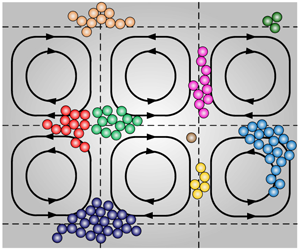
An efficient cellular flow model for cohesive particle flocculation in turbulence
-
- Published online by Cambridge University Press:
- 24 February 2020, R3
-
- Article
-
- You have access
- HTML
- Export citation
-
We propose a one-way coupled model that tracks individual primary particles in a conceptually simple cellular flow set-up to predict flocculation in turbulence. This computationally efficient model accounts for Stokes drag, lubrication, cohesive and direct contact forces on the primary spherical particles, and allows for a systematic simulation campaign that yields the transient mean floc size as a function of the governing dimensionless parameters. The simulations reproduce the growth of the cohesive flocs with time, and the emergence of a log-normal equilibrium distribution governed by the balance of aggregation and breakage. Flocculation proceeds most rapidly when the Stokes number of the primary particles is
 $O(1)$. Results from this simple computational model are consistent with experimental observations, thus allowing us to propose a new analytical flocculation model that yields improved agreement with experimental data, especially during the transient stages.

- Cited by 29
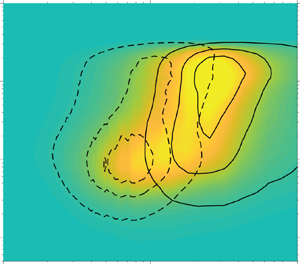
Decomposition of the mean friction drag on an NACA4412 airfoil under uniform blowing/suction
-
- Published online by Cambridge University Press:
- 07 December 2021, A31
-
- Article
-
- You have access
- HTML
- Export citation
-
The application of drag-control strategies on canonical wall-bounded turbulence, such as periodic channel and zero- or adverse-pressure-gradient boundary layers, raises the question on how to distinguish consistently the origin of control effects under different reference conditions. We employ the RD identity (Renard & Deck, J. Fluid Mech., vol. 790, 2016, pp. 339–367) to decompose the mean friction drag and investigate the control effects of uniform blowing and suction applied to an NACA4412 airfoil at chord Reynolds numbers
 $Re_c=200\,000$ and
 $400\,000$. The connection of the drag reduction/increase by using blowing/suction with the turbulence statistics (including viscous dissipation, turbulence kinetic energy production and spatial growth of the flow) across the boundary layer, subjected to adverse or favourable pressure gradients, is examined. We found that the inner and outer peaks of the contributions associated with the friction-drag generation show good scaling with either inner or outer units, respectively. They are also independent of the Reynolds number, control scheme and intensity of the blowing/suction. The small- and large-scale structures are separated with an adaptive scale-decomposition method, namely the empirical mode decomposition (EMD), which aims to analyse the scale-specific contribution of turbulent motions to friction-drag generation. Results unveil that blowing on the suction side of the airfoil is able to enhance the contribution of large-scale motions and to suppress that of small scales; however, suction behaves contrarily. The contributions related to cross-scale interactions remain almost unchanged with different control strategies.


- Cited by 29
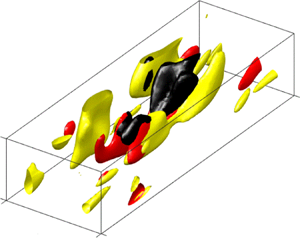
Minimal multi-scale dynamics of near-wall turbulence
-
- Published online by Cambridge University Press:
- 26 February 2021, A8
-
- Article
-
- You have access
- HTML
- Export citation
- Cited by 29
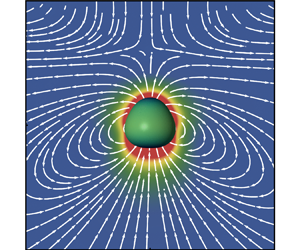
Optimal swimmers can be pullers, pushers or neutral depending on the shape
-
- Published online by Cambridge University Press:
- 12 July 2021, R5
-
- Article
-
- You have access
- Open access
- HTML
- Export citation
- Cited by 29
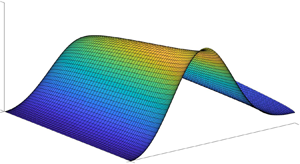
Thermocapillary instabilities in a liquid layer subjected to an oblique temperature gradient
-
- Published online by Cambridge University Press:
- 13 November 2020, A12
-
- Article
-
- You have access
- Open access
- HTML
- Export citation
-
Stability analysis of a liquid layer subjected to an oblique temperature gradient (OTG) is carried out. The general linear stability analysis reveals a stabilization effect of the imposed horizontal component (horizontal temperature gradient, HTG) of the OTG on the long-wave instabilities introduced by the vertical component (vertical temperature gradient, VTG) of the OTG. This stabilization is due to the VTG induced by the prescribed HTG, which counteracts the imposed VTG. The induced VTG arises due to the presence of advection of the energy. As a result of the stabilization, the long-wave mode forms an island of instability in the
 $\eta$–
 $Ma_c$ plane, where
 $\eta$ and
 $Ma_c$ are the ratio of the strength of the imposed HTG to imposed VTG components of the OTG, and the critical Marangoni number, respectively. However, for sufficiently high
 $\eta$, a new class of modes emerge with the critical Marangoni number scaling as
 $Ma_c \sim 1/\eta$. These modes originate as a result of the interaction between the thermocapillary flow caused by the imposed HTG on the one hand, and the VTG on the other, and remain the dominant modes of instability at higher
 $\eta$. The long-wave analysis is carried out and, in its framework, the nonlinear evolution equation is derived, and, based on it, linear and weakly nonlinear analyses are performed. An increase in
 $\eta$ changes the type of bifurcation from subcritical to supercritical. The numerical solution of the evolution equation around the critical parameter values validates the predictions of the weakly nonlinear analysis. The present study illustrates a possible use of imposing the HTG to prevent dry-spot formation and rupture of the film caused by the imposed VTG.


- Cited by 28
Secondary convection in a Hele Shaw cell
-
- Published online by Cambridge University Press:
- 29 March 2006, pp. 675-687
-
- Article
- Export citation
- Cited by 28
On the steady streaming flow due to high-frequency vibration in nearly inviscid liquid bridges
-
- Published online by Cambridge University Press:
- 10 January 1998, pp. 147-174
-
- Article
-
- You have access
- Export citation
- Cited by 28
Some aerodynamic aspects of coin-like cylinders
-
- Published online by Cambridge University Press:
- 10 April 1998, pp. 73-84
-
- Article
-
- You have access
- Export citation
- Cited by 28
Experimental survey of linear and nonlinear inertial waves and wave instabilities in a spherical shell
-
- Published online by Cambridge University Press:
- 25 January 2016, pp. 589-616
-
- Article
-
- You have access
- HTML
- Export citation
-
We experimentally study linear and nonlinear inertial waves in a spherical shell with a radius ratio of
 ${\it\eta}=1/3$ . The shell rotates with a mean angular velocity
 ${\it\Omega}_{0}$ around its vertical axis. This rotation is overlaid by a time-periodic libration of the inner sphere in the range
 $0<{\it\omega}_{lib}<2{\it\Omega}_{0}$ to excite inertial waves with a defined frequency. In the first part, we investigate linear inertial waves. The influence of the libration amplitude and the libration frequency on the waves and further the efficiency of the forcing to excite linear inertial waves will be discussed. For this, qualitative data from Kalliroscope visualisation in a meridional laser plane, as well as quantitative particle image velocimetry (PIV) data in a horizontal plane, have been analysed. A simple two-dimensional ray-tracing model is applied for the meridional plane to interpret the visualisations with respect to energy focusing and wave attractors. For sufficiently high/low libration amplitudes/frequencies, the Stewartson layer, a vertical shear layer tangential to the inner sphere’s equator, becomes unstable. This so-called ‘supercritical’ regime, where centrifugal and shear instabilities occur, allows for nonlinear wave coupling. PIV analyses in the horizontal laser plane in the corotating frame show low-frequency structures that correspond to Rossby-wave instabilities of the Stewartson layer. Some of these are travelling retrograde and are trapped near the Stewartson layer, others are travelling prograde filling the whole gap outside the Stewartson layer. Since libration can be viewed as a time-periodic variation of differential rotation, we assume that these two different structures are related to either the retrograde
 $(Ro_{d}<0)$ or the prograde
 $(Ro_{d}>0)$ phase of the libration cycle. The experimental results confirm theoretical, numerical as well as other experimental studies on Stewartson-layer instabilities.


- Cited by 28
Analysis of complex singularities in high-Reynolds-number Navier–Stokes solutions
-
- Published online by Cambridge University Press:
- 17 April 2014, pp. 381-421
-
- Article
-
- You have access
- Export citation
-
Numerical solutions of the laminar Prandtl boundary-layer and Navier–Stokes equations are considered for the case of the two-dimensional uniform flow past an impulsively-started circular cylinder. The various viscous–inviscid interactions that occur during the unsteady separation process are investigated by applying complex singularity analysis to the wall shear and streamwise velocity component of the two solutions. This is carried out using two different methodologies, namely a singularity-tracking method and the Padé approximation. It is shown how the van Dommelen and Shen singularity that occurs in solutions of the Prandtl boundary-layer equations evolves in the complex plane before leading to a separation singularity in finite time. Navier–Stokes solutions, computed at different Reynolds numbers in the range
 $10^3 \leq Re \leq 10^5$ , are characterized by the presence of various complex singularities that can be related to different physical interactions acting over multiple spatial scales. The first interaction developing in the separation process is large-scale interaction that is visible for all the Reynolds numbers considered, and it signals the first relevant differences between the Prandtl and Navier–Stokes solutions. For
 $Re\geq O(10^4)$ , a small-scale interaction follows the large-scale interaction. The onset of these interactions is related to the characteristic changes of the streamwise pressure gradient on the circular cylinder. Even if these interactions physically differ from that prescribed by the Prandtl solution, and they set a possible limit on the comparison of Prandtl solutions with Navier–Stokes solutions, it is shown how the asymptotic validity of boundary-layer theory is strongly supported by the results that have been obtained through the complex singularity analysis.


- Cited by 28
Attenuation and dispersion of sound in bubbly fluids via the Kramers—Kronig relations
-
- Published online by Cambridge University Press:
- 26 April 2006, pp. 61-72
-
- Article
- Export citation
- Cited by 28
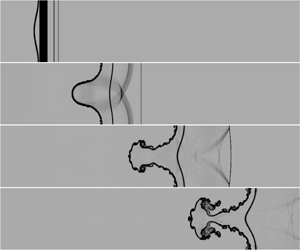
Interfacial instability at a heavy/light interface induced by rarefaction waves
-
- Published online by Cambridge University Press:
- 07 January 2020, A42
-
- Article
-
- You have access
- HTML
- Export citation
- Cited by 28
Convective flows with multiple spatial periodicities
-
- Published online by Cambridge University Press:
- 21 April 2006, pp. 253-272
-
- Article
- Export citation
- Cited by 28
The behaviour of a laminar compressible boundary layer near a point of zero skin-friction
-
- Published online by Cambridge University Press:
- 28 March 2006, pp. 117-128
-
- Article
- Export citation
