Refine search
Actions for selected content:
44 results
Trimmed strong laws and distributional limits for exponentially mixing systems
- Part of
-
- Journal:
- Ergodic Theory and Dynamical Systems , First View
- Published online by Cambridge University Press:
- 26 October 2026, pp. 1-58
-
- Article
-
- You have access
- Open access
- HTML
- Export citation
-
The Birkhoff ergodic theorem establishes pointwise convergence for integrable observables, but for $f\notin L^1$
 , no normalization yields almost sure convergence. This paper investigates trimmed ergodic sums, where the largest observations are removed, for observables with polynomial tails satisfying $\mathbb {P}(f>t)\,t^{1/\alpha }\to c>0$
 as $t\to \infty $
 , in exponentially mixing dynamical systems. We prove trimmed strong laws of large numbers when $\alpha \geq 1$
 , extending known results from the independent and identically distributed case. We further establish distributional limit theorems for both lightly and intermediately trimmed sums in the regime $\alpha>1/2$
 , showing convergence to an explicitly described non-standard law and to a normal distribution, respectively. The proofs rely on approximating trimmed sums by truncated ergodic sums and exploiting the system’s exponential mixing properties.


SRB measures and the fiber leaf condition
- Part of
-
- Journal:
- Ergodic Theory and Dynamical Systems , First View
- Published online by Cambridge University Press:
- 23 October 2026, pp. 1-33
-
- Article
-
- You have access
- HTML
- Export citation
-
In this paper, we study (Sinai–Ruelle–Bowen) SRB measures for random dynamical systems and their associated skew-product transformations. Extending Burguet’s variational method [SRB measures for $C^\infty $
 surface diffeomorphisms. Invent. Math. 235(3) (2024), 1019–1062], we establish the existence of random SRB measures under a fiber leaf condition, which ensures recurrent hyperbolic behavior along unstable leaves within generic fibers. The construction is based on geometric-time techniques and Følner averaging, leading to invariant measures that satisfy the relative Pesin entropy formula. We further identify a spectral-gap condition relating the Lyapunov spectra of the base and fiber dynamics, under which the random SRB measure coincides with an SRB measure for the smooth skew-product system.

Non-statistical behavior via statistical instability: non-statistical Anosov–Katok diffeomorphisms
- Part of
-
- Journal:
- Ergodic Theory and Dynamical Systems , First View
- Published online by Cambridge University Press:
- 19 October 2026, pp. 1-27
-
- Article
-
- You have access
- HTML
- Export citation
Dynamics on Markov surfaces: classification of stationary measures
- Part of
-
- Journal:
- Ergodic Theory and Dynamical Systems / Volume 46 / Issue 12 / December 2026
- Published online by Cambridge University Press:
- 07 August 2026, pp. 2969-2992
- Print publication:
- December 2026
-
- Article
-
- You have access
- Open access
- HTML
- Export citation
-
Consider the four-punctured sphere $\mathbb {S}_4^2$
 . Each choice of four traces, one for each puncture, determines a relative character variety for the representations of the fundamental group of $\mathbb {S}_4^2$
 in ${\textsf {SL}}_2(\mathbb {C})$
 . We classify the stationary probability measures for the action of the mapping class group ${\textsf {Mod}}(\mathbb {S}_4^2)$
 on these character varieties.


Exponential mixing of measures of maximal entropy for certain skew products
- Part of
-
- Journal:
- Ergodic Theory and Dynamical Systems / Volume 46 / Issue 10 / October 2026
- Published online by Cambridge University Press:
- 01 June 2026, pp. 2620-2644
- Print publication:
- October 2026
-
- Article
-
- You have access
- HTML
- Export citation
Compactifications and measures for rational maps
- Part of
-
- Journal:
- Forum of Mathematics, Sigma / Volume 14 / 2026
- Published online by Cambridge University Press:
- 27 April 2026, e66
-
- Article
-
- You have access
- Open access
- HTML
- Export citation
Feldman–Katok pseudometric and the GIKN non-hyperbolic ergodic measures
- Part of
-
- Journal:
- Ergodic Theory and Dynamical Systems / Volume 46 / Issue 8 / August 2026
- Published online by Cambridge University Press:
- 07 April 2026, pp. 2018-2046
- Print publication:
- August 2026
-
- Article
-
- You have access
- Open access
- HTML
- Export citation
-
We introduce Feldman–Katok convergence for invariant measures of a topological dynamical system. This can be seen as a counterpart to the convergence with respect to the $\bar {f}$
 -metric for finite-state stationary processes (shift-invariant measures on a symbolic space). Feldman–Katok convergence is based on a dynamically defined Feldman–Katok pseudometric. This convergence is stronger than weak$^*$
 convergence. We prove that Feldman–Katok convergence preserves ergodicity and makes the Kolmogorov–Sinai entropy lower semicontinuous, thereby preserving zero entropy. We apply our findings to non-hyperbolic (having at least one vanishing Lyapunov exponent) ergodic measures constructed using the GIKN method as axiomatized by Bonatti, Díaz and Gorodetski [Nonlinearity, 23 (2010), 687–705]. The GIKN method, originally introduced by Gorodetski, Ilyashenko, Kleptsyn and Nalsky [Functional Analysis and its Applications, 39 (2005), 21–30], has been widely adapted to produce non-hyperbolic ergodic measures for diffeomorphisms of compact manifolds. We prove that an ergodic measure satisfying the conditions provided by the axiomatized GIKN method is the Feldman–Katok limit of a sequence of periodic measures, which implies that it is either a periodic measure or a loosely Kronecker measure (a measure Kakutani equivalent to an aperiodic ergodic rotation on a compact group) and has zero entropy. This classifies all these measures up to Kakutani equivalence and confirms that geometric constructions of non-hyperbolic measures via periodic approximations based on the axiomatized GIKN method presented in Bonatti et al. [op. cit.] systematically produce zero-entropy systems.


$\mathbf {\textit {U}}$
 -Gibbs measure rigidity for partially hyperbolic endomorphisms on surfaces
- Part of
-
- Journal:
- Ergodic Theory and Dynamical Systems / Volume 46 / Issue 8 / August 2026
- Published online by Cambridge University Press:
- 26 March 2026, pp. 2076-2130
- Print publication:
- August 2026
-
- Article
-
- You have access
- HTML
- Export citation
-
We prove that, for a $C^2$
 partially hyperbolic endomorphism of the 2-torus which is strongly transitive, given an ergodic u-Gibbs measure that has positive center Lyapunov exponent and has full support, then either the map is special (has only one unstable direction per point) or the measure is the unique absolutely continuous invariant measure. We can apply this result in many settings, in particular, obtaining uniqueness of u-Gibbs measures for every non-special perturbation of irreducible linear expanding maps of the torus with simple spectrum. This gives new open sets of partially hyperbolic systems displaying a unique u-Gibbs measure.


On the ergodicity of anti-symmetric skew products with singularities and its applications
- Part of
-
- Journal:
- Ergodic Theory and Dynamical Systems / Volume 46 / Issue 6 / June 2026
- Published online by Cambridge University Press:
- 06 March 2026, pp. 1431-1493
- Print publication:
- June 2026
-
- Article
-
- You have access
- Open access
- HTML
- Export citation
Counting closed geodesics on rank-one manifolds without focal points
- Part of
-
- Journal:
- Ergodic Theory and Dynamical Systems / Volume 46 / Issue 3 / March 2026
- Published online by Cambridge University Press:
- 03 November 2025, pp. 857-884
- Print publication:
- March 2026
-
- Article
-
- You have access
- HTML
- Export citation
-
In this article, we consider a closed rank-one Riemannian manifold M without focal points. Let
 $P(t)$ be the set of free-homotopy classes containing a closed geodesic on M with length at most t, and
 $\# P(t)$ its cardinality. We obtain the following Margulis-type asymptotic estimates: where h is the topological entropy of the geodesic flow. We also show that the unique measure of maximal entropy of the geodesic flow has the Bernoulli property.
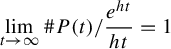 $$ \begin{align*}\lim_{t\to \infty}\#P(t)/\frac{e^{ht}}{ht}=1\end{align*} $$


Modulus of continuity of invariant densities and entropies for piecewise expanding maps
- Part of
-
- Journal:
- Ergodic Theory and Dynamical Systems / Volume 45 / Issue 10 / October 2025
- Published online by Cambridge University Press:
- 07 April 2025, pp. 2976-2991
- Print publication:
- October 2025
-
- Article
-
- You have access
- Open access
- HTML
- Export citation
Geometric properties of disintegration of measures
- Part of
-
- Journal:
- Ergodic Theory and Dynamical Systems / Volume 45 / Issue 5 / May 2025
- Published online by Cambridge University Press:
- 11 October 2024, pp. 1619-1648
- Print publication:
- May 2025
-
- Article
-
- You have access
- HTML
- Export citation
Shub’s example revisited
- Part of
-
- Journal:
- Ergodic Theory and Dynamical Systems / Volume 45 / Issue 3 / March 2025
- Published online by Cambridge University Press:
- 23 September 2024, pp. 894-914
- Print publication:
- March 2025
-
- Article
-
- You have access
- HTML
- Export citation
-
For a class of robustly transitive diffeomorphisms on
 ${\mathbb T}^4$ introduced by Shub [Topologically transitive diffeomorphisms of
 $T^4$. Proceedings of the Symposium on Differential Equations and Dynamical Systems (Lecture notes in Mathematics, 206). Ed. D. Chillingworth. Springer, Berlin, 1971, pp. 39–40], satisfying an additional bunching condition, we show that there exists a
 $C^2$ open and
 $C^r$ dense subset
 ${\mathcal U}^r$,
 $2\leq r\leq \infty $, such that any two hyperbolic points of
 $g\in {\mathcal U}^r$ with stable index
 $2$ are homoclinically related. As a consequence, every
 $g\in {\mathcal U}^r$ admits a unique homoclinic class associated to the hyperbolic periodic points with index
 $2$, and this homoclinic class coincides with the whole ambient manifold. Moreover, every
 $g\in {\mathcal U}^r$ admits at most one measure of maximal entropy, and every
 $g\in {\mathcal U}^{\infty }$ admits a unique measure of maximal entropy.


On the Hausdorff dimension of invariant measures of piecewise smooth circle homeomorphisms
- Part of
-
- Journal:
- Ergodic Theory and Dynamical Systems / Volume 44 / Issue 12 / December 2024
- Published online by Cambridge University Press:
- 11 April 2024, pp. 3599-3629
- Print publication:
- December 2024
-
- Article
-
- You have access
- Open access
- HTML
- Export citation
Regularity and linear response formula of the SRB measures for solenoidal attractors
- Part of
-
- Journal:
- Ergodic Theory and Dynamical Systems / Volume 44 / Issue 10 / October 2024
- Published online by Cambridge University Press:
- 06 February 2024, pp. 2782-2831
- Print publication:
- October 2024
-
- Article
-
- You have access
- HTML
- Export citation
-
We show that a class of higher-dimensional hyperbolic endomorphisms admit absolutely continuous invariant probabilities whose densities are regular and vary differentiably with respect to the dynamical system. The maps we consider are skew-products given by
 $T(x,y) = (E (x), C(x,y))$, where E is an expanding map of
 $\mathbb {T}^u$ and C is a contracting map on each fiber. If
 $\inf |\!\det DT| \inf \| (D_yC)^{-1}\| ^{-2s}>1$ for some
 ${s<r-(({u+d})/{2}+1)}$,
 $r \geq 2$, and T satisfies a transversality condition between overlaps of iterates of T (a condition which we prove to be
 $C^r$-generic under mild assumptions), then the SRB measure
 $\mu _T$ of T is absolutely continuous and its density
 $h_T$ belongs to the Sobolev space
 $H^s({\mathbb {T}}^u\times {\mathbb {R}}^d)$. When
 $s> {u}/{2}$, it is also valid that the density
 $h_T$ is differentiable with respect to T. Similar results are proved for thermodynamical quantities for potentials close to the geometric potential.


Conditional mixing in deterministic chaos
- Part of
-
- Journal:
- Ergodic Theory and Dynamical Systems / Volume 44 / Issue 6 / June 2024
- Published online by Cambridge University Press:
- 18 August 2023, pp. 1693-1723
- Print publication:
- June 2024
-
- Article
-
- You have access
- HTML
- Export citation
On bifurcation of statistical properties of partially hyperbolic endomorphisms
- Part of
-
- Journal:
- Ergodic Theory and Dynamical Systems / Volume 44 / Issue 3 / March 2024
- Published online by Cambridge University Press:
- 18 April 2023, pp. 933-944
- Print publication:
- March 2024
-
- Article
-
- You have access
- HTML
- Export citation
-
We give an example of a path-wise connected open set of
 $C^{\infty }$ partially hyperbolic endomorphisms on the
 $2$-torus, on which the (unique) Sinai–Ruelle–Bowen (SRB) measure exists for each system and varies smoothly depending on the system, while the sign of its central Lyapunov exponent changes.


Sensitivity and historic behavior for continuous maps on Baire metric spaces
- Part of
-
- Journal:
- Ergodic Theory and Dynamical Systems / Volume 44 / Issue 1 / January 2024
- Published online by Cambridge University Press:
- 07 February 2023, pp. 1-30
- Print publication:
- January 2024
-
- Article
-
- You have access
- HTML
- Export citation
Invariant family of leaf measures and the Ledrappier–Young property for hyperbolic equilibrium states
- Part of
-
- Journal:
- Ergodic Theory and Dynamical Systems / Volume 43 / Issue 11 / November 2023
- Published online by Cambridge University Press:
- 21 December 2022, pp. 3603-3635
- Print publication:
- November 2023
-
- Article
-
- You have access
- Open access
- HTML
- Export citation
-
The manifold M is a Riemannian, boundaryless, and compact manifold with
 $\dim M\geq 2$, and f is a
 $C^{1+\beta }$ (
 $\kern0.3pt\beta>0$) diffeomorphism of M.
 $\varphi $ is a Hölder continuous potential on M. We construct an invariant and absolutely continuous family of measures (with transformation relations defined by
 $\varphi $), which sit on local unstable leaves. We present two main applications. First, given an ergodic homoclinic class
 $H_\chi (p)$, we prove that
 $\varphi $ admits a local equilibrium state on
 $H_\chi (p)$ if and only if
 $\varphi $ is ‘recurrent on
 $H_\chi (p)$’ (a condition tested by counting periodic points), and one of the leaf measures gives a positive measure to a set of positively recurrent hyperbolic points; and if an equilibrium measure exists, the said invariant and absolutely continuous family of measures constitute as its conditional measures. An immediate corollary is the local product structure of hyperbolic equilibrium states. Second, we prove a Ledrappier–Young property for hyperbolic equilibrium states: if
 $\varphi $ admits a conformal family of leaf measures and a hyperbolic local equilibrium state, then the leaf measures of the invariant family (respective to
 $\varphi $) are equivalent to the conformal measures (on a full measure set). This extends the celebrated result by Ledrappier and Young for hyperbolic Sinai–Ruelle–Bowen measures, which states that a hyperbolic equilibrium state of the geometric potential (with pressure zero) has conditional measures on local unstable leaves which are absolutely continuous with respect to the Riemannian volume of these leaves.


A QUANTITATIVE EVALUATION OF LAGRANGIAN COHERENT STRUCTURE DETECTION METHODS BASED ON COMPUTATIONAL AND EXPERIMENTAL LIMITATIONS
- Part of
-
- Journal:
- Bulletin of the Australian Mathematical Society / Volume 107 / Issue 1 / February 2023
- Published online by Cambridge University Press:
- 05 December 2022, pp. 173-174
- Print publication:
- February 2023
-
- Article
-
- You have access
- HTML
- Export citation