Refine search
Actions for selected content:
330 results
Revisiting creeping viscoelastic cross-slot flow: global linear stability and structural sensitivity analyses
-
- Journal:
- Journal of Fluid Mechanics / Volume 1046 / 10 November 2026
- Published online by Cambridge University Press:
- 03 November 2026, A26
-
- Article
-
- You have access
- Open access
- HTML
- Export citation
Motion of a spherical particle in viscosity-stratified plane Couette flow
-
- Journal:
- Journal of Fluid Mechanics / Volume 1046 / 10 November 2026
- Published online by Cambridge University Press:
- 03 November 2026, R2
-
- Article
-
- You have access
- Open access
- HTML
- Export citation
Effective slip, plug formation and interface depinning in Bingham flow over superhydrophobic grooves
-
- Journal:
- Journal of Fluid Mechanics / Volume 1045 / 25 October 2026
- Published online by Cambridge University Press:
- 19 October 2026, A36
-
- Article
-
- You have access
- Open access
- HTML
- Export citation
-
We examine the Poiseuille flow of viscoplastic fluids over superhydrophobic surfaces with transverse air-filled grooves, focusing on the deformation dynamics of the liquid–air interface and the resulting flow regimes. By combining a creeping-flow semianalytical model and finite Reynolds two-phase numerical simulations, we quantify how viscoplastic rheology, governed by the Bingham number (
 $B$), interacts with capillary and inertial forces, represented by the capillary number (
 $\textit{Ca}$) and Reynolds number (
 $R$), as well as groove geometry characterized by the aspect ratio (
 $d$), to dictate meniscus behaviour. The analysis covers groove aspect ratios ranging from shallow (
 $d \sim O(10^{-3})$) to deep (
 $d \sim O(1)$). The results reveal distinct interface morphologies, including flat (pinned at groove edges), deflected (pinned), depinned and collapsed states, depending on
 $d$,
 $\textit{Ca}$,
 $R$ and
 $B$. For large groove aspect ratios, the interface remains flat in the creeping-flow limit but undergoes deformation and eventually a pinned-to-depinned transition at finite inertia. This transition is well described by the effective Reynolds number
 $R^* = R/(1 + B)$, with
 $R^* \approx 30 B^{-1}$ and
 $R^* \approx 50 B^{-1}$ for the constant-contact-angle cases
 $\varTheta = 95^\circ$ and
 $\varTheta = 120^\circ$, respectively. With finite contact-angle hysteresis, the corresponding dynamic-contact-angle transition follows
 $R^* \approx 32B^{-1}$. On the other hand, for moderately shallow grooves and small
 $B$, interface deformation increases with
 $\textit{Ca}$, with depinning occurring at
 $\textit{Ca} \approx O(1)$; for very shallow grooves (
 $d \lesssim 10^{-2}$), the interface collapses at
 $\textit{Ca} \lesssim 1$, before depinning.


Shear-induced electrophoretic migration perpendicular to the electric field
-
- Journal:
- Journal of Fluid Mechanics / Volume 1044 / 10 October 2026
- Published online by Cambridge University Press:
- 15 October 2026, R2
-
- Article
-
- You have access
- Open access
- HTML
- Export citation
-
Recent experiments have shown that microparticles subjected simultaneously to electrophoresis and pressure-driven flow undergo lateral migration. Although fluid inertia has been proposed to explain this phenomenon, it remains negligible in these regimes, leaving the underlying mechanism an open question. In this work, we demonstrate that concentration polarisation alone can account for this effect. By modelling a dielectric particle with finite surface conductance in a shear flow, we show that the flow breaks the symmetry of the ionic cloud in the direction perpendicular to the applied electric field. The resulting asymmetry induces lateral migration through coupled electrophoretic and diffusiophoretic mechanisms. Our analytical expression predicts migration velocities of the order of
 ${\unicode{x03BC}}\mathrm{m\,s}^{-1}$ and reveals a reversal in the migration direction for Dukhin numbers of order unity.

Merging molecular dynamics with homogenisation: a novel strategy for the modelling of nano-filtration phenomena
-
- Journal:
- Journal of Fluid Mechanics / Volume 1044 / 10 October 2026
- Published online by Cambridge University Press:
- 14 October 2026, A27
-
- Article
-
- You have access
- Open access
- HTML
- Export citation
Capillary electrophoresis biosignature analysis in diverse gravitational environments using a flight-format Microfluidic Organic Analyzer
-
- Journal:
- International Journal of Astrobiology / Volume 25 / 2026
- Published online by Cambridge University Press:
- 06 October 2026, e15
-
- Article
-
- You have access
- Open access
- HTML
- Export citation
Analytical solutions for three-dimensional flow fields actuated by standing surface acoustic waves
-
- Journal:
- Journal of Fluid Mechanics / Volume 1042 / 10 September 2026
- Published online by Cambridge University Press:
- 08 September 2026, A49
-
- Article
-
- You have access
- Open access
- HTML
- Export citation
Vortex dynamics during pinch-off of micro-droplets
-
- Journal:
- Journal of Fluid Mechanics / Volume 1042 / 10 September 2026
- Published online by Cambridge University Press:
- 07 September 2026, A21
-
- Article
-
- You have access
- Open access
- HTML
- Export citation
Diffusiophoresis and diffusioosmosis in a junction device with a long microchannel: colloid dynamics and particle characterisation
-
- Journal:
- Flow: Applications of Fluid Mechanics / Volume 6 / 2026
- Published online by Cambridge University Press:
- 01 September 2026, E26
-
- Article
-
- You have access
- Open access
- HTML
- Export citation
Swelling-induced flow evolution in shallow compliant microchannels
-
- Journal:
- Journal of Fluid Mechanics / Volume 1041 / 25 August 2026
- Published online by Cambridge University Press:
- 26 August 2026, A7
-
- Article
-
- You have access
- Open access
- HTML
- Export citation
Diffusiophoresis of a non-polar fluid droplet laden with soluble ionic surfactants
-
- Journal:
- Journal of Fluid Mechanics / Volume 1040 / 10 August 2026
- Published online by Cambridge University Press:
- 10 August 2026, A55
-
- Article
-
- You have access
- Open access
- HTML
- Export citation
Adiabatic-section flow in axial-groove heat pipes with varying meniscus curvature
-
- Journal:
- Journal of Fluid Mechanics / Volume 1040 / 10 August 2026
- Published online by Cambridge University Press:
- 03 August 2026, A27
-
- Article
-
- You have access
- HTML
- Export citation
Theory of Taylor bubble pinch-off in planar coflow
-
- Journal:
- Journal of Fluid Mechanics / Volume 1039 / 25 July 2026
- Published online by Cambridge University Press:
- 14 July 2026, A1
-
- Article
-
- You have access
- Open access
- HTML
- Export citation
-
Two-fluid capillary flows in channels and pipes form a fundamental problem in fluid mechanics with widespread applications in physical, biological and microfluidic systems. A key phenomenon in such flows is the generation of long capsular bubbles, known as Taylor bubbles. A simple configuration that forms Taylor bubbles is coflow, where two fluids (one viscous, the other inviscid) are injected concurrently into a pipe or channel, producing a periodic pinch-off of inviscid bubbles at a regular frequency. By considering a lubrication theory for the necking region between the bubble injection nozzle and the developing Taylor bubble, we conduct a mathematical study of the formation of two-dimensional Taylor bubbles, yielding analytical insight into injection-driven pinch-off dynamics and the parametric control of its frequency. A key result is to demonstrate a quasi-static limiting theory of the necking dynamics for small capillary numbers. The theory is based on coupling an outer near-static regime of the pinching film with an apparent dynamic contact line that matches the necking zone to the film surrounding the Taylor bubble. This asymptotic structure, which becomes more refined in the limit of small capillary number, reveals a fundamental link between capillary pinch-off dynamics and the quasi-static regimes underlying spreading droplets. The theory yields a prediction for the dimensionless pinch-off time,
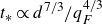 $t_* \propto d^{7/3} / q_F^{4/3}$, where
 $q_F$ represents the flux of viscous fluid and
 $d$ the size of the capillary. The study thereby yields new mathematical understanding of flow regimes that underlie bubble generation in capillary systems from first principles, and the first step towards application of quasi-static analysis to more complex axisymmetric and three-dimensional examples of capillary pinch-off.


Pumping and steady streaming driven by two-frequency oscillations of a cylinder
-
- Journal:
- Journal of Fluid Mechanics / Volume 1038 / 10 July 2026
- Published online by Cambridge University Press:
- 08 July 2026, A34
-
- Article
-
- You have access
- Open access
- HTML
- Export citation
Numerical study on the magnetic field-induced dynamics of microparticles in a microchannel by three-dimensional lattice Boltzmann simulation
-
- Journal:
- Journal of Fluid Mechanics / Volume 1038 / 10 July 2026
- Published online by Cambridge University Press:
- 07 July 2026, A18
-
- Article
-
- You have access
- HTML
- Export citation
-
Microfluidic systems integrated with magnetic manipulation of microparticles, serving as a functional component, have been extensively used in various applications, including biomedical diagnostics and targeted drug delivery. Microparticle dynamics in confined microchannels is governed by hydrodynamic viscous effects, magnetic dipole interactions and enhanced interactions with microchannel boundaries, while an in-depth understanding of the underlying mechanisms is still evolving. This work presents a systematic investigation on the dynamic response of microparticles suspended in a quasi-stationary liquid within a microchannel under an external magnetic field using a three-dimensional lattice Boltzmann model (LBM). The hydrodynamic viscous effects and the two-way fluid–structure interaction are fully resolved in this model. A dimensionless analysis of the microparticle dynamic equation is performed first, leading to the identification of two key characteristic parameters central to this work: the magnetic number
 $N_{\textit{mag}}$, which characterises the synergy of the hydrodynamic viscous effect and the magnetic dipole interaction, and the particle–wall separation distance
 $R/l$, which accounts for the microchannel wall interaction. Further, a series of LBM simulations with different
 $N_{\textit{mag}}$ and
 $R/l$ are carried out. The results suggest that the spatial trajectories of microparticles remain unaffected in response to variation in
 $N_{\textit{mag}}$, while their aggregation times demonstrate a linear dependence on the reciprocal of
 $N_{\textit{mag}}$ when released from the same initial position. Moreover, vortices generated by the motion of microparticles within microchannels tend to migrate toward the microparticles themselves as they approach the microchannel walls. As a result, microparticles experience an enhanced hydrodynamic viscous effect, which prolongs their aggregation time and leads to slight deviations in their spatial trajectories. A predictive model for the aggregation time is established, accounting for the effects of the external magnetic field, the microchannel wall interaction, as well as the initial positions of microparticles. The findings in this work provide significant insights into the optimisation of microparticle-based microfluidic technologies, thereby promoting their development in biomedical and chemical analytical applications.


An apparent slip model for non-Newtonian liquid-infused microchannels
-
- Journal:
- Journal of Fluid Mechanics / Volume 1037 / 25 June 2026
- Published online by Cambridge University Press:
- 15 June 2026, A19
-
- Article
-
- You have access
- HTML
- Export citation
Self-similar pinch-off in surfactant-laden flows in a capillary tube
-
- Journal:
- Journal of Fluid Mechanics / Volume 1035 / 25 May 2026
- Published online by Cambridge University Press:
- 22 May 2026, A35
-
- Article
-
- You have access
- Open access
- HTML
- Export citation
-
We study the pinch-off dynamics of a fluid surrounded by a significantly more viscous one during fluid–fluid displacement in straight, cylindrical capillary tubes, where the interface evolves under the influence of a moving contact line. We investigate the influence of insoluble surfactants on the dynamics of both the contact line and pinch-off. We focus on a visco-capillary displacement regime where the imposed flow rate exceeds a critical threshold, beyond which the contact-line velocity is governed by the partial wettability of the confined geometry, becoming independent of the flow rate. Under these conditions, the fluid–fluid meniscus forms an advancing axial finger, leaving behind a thin film of the defending fluid. This unstable film retracts along the partially wetting walls, forming a dewetting rim that grows with the steady contact-line motion. Eventually, a surface-tension-driven Rayleigh–Plateau instability dominates, triggering pinch-off at the rim neck. For a surfactant-free interface, our results show that the early-stage evolution of the neck diameter follows a power law
 $\tau ^\alpha$, where
 $\tau$ is the time to the pinch-off singularity and the scaling exponent
 $\alpha$ depends on the contact-line velocity determined by the wettability. Over the range resolved in the present simulations,
 $\alpha$ decreases from values near
 $1/2$ at large contact-line velocity towards values close to
 $1/5$ as the contact-line velocity is reduced. We demonstrate that, in the presence of insoluble surfactants, the contact-line velocity, at a given wettability, scales linearly with surfactant elasticity due to Marangoni stresses along the dewetting rim interface, which affect the timing and location of the pinch-off. Despite these effects, at the early-time regime, the pinch-off dynamics exhibits the same self-similar scaling behaviour as in the surfactant-free case.


Chapter 6 - Sperm Preparation Methods
-
-
- Book:
- A Clinician's Guide to the Sixth Edition of the WHO Laboratory Manual for the Examination and Processing of Human Semen
- Published online:
- 10 April 2026
- Print publication:
- 30 April 2026, pp 75-97
-
- Chapter
- Export citation
Dynamics of oblate particle migration and orientation in duct flows of elastoviscoplastic fluids
-
- Journal:
- Journal of Fluid Mechanics / Volume 1032 / 10 April 2026
- Published online by Cambridge University Press:
- 10 April 2026, A45
-
- Article
-
- You have access
- Open access
- HTML
- Export citation
Minimum flow rate of Taylor cone-jets of highly viscous liquids
-
- Journal:
- Journal of Fluid Mechanics / Volume 1032 / 10 April 2026
- Published online by Cambridge University Press:
- 07 April 2026, A64
-
- Article
-
- You have access
- HTML
- Export citation
